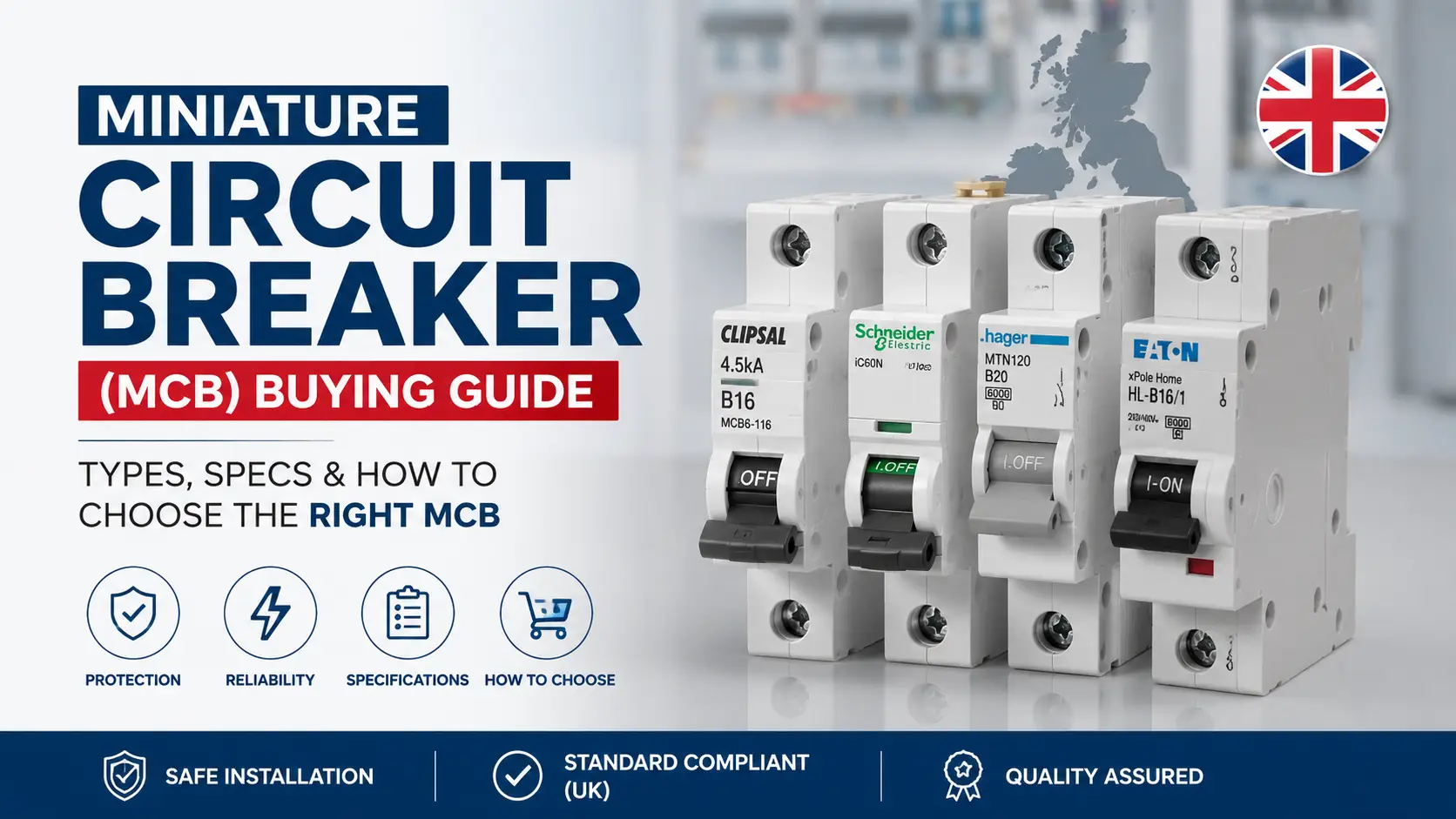
Miniature Circuit Breaker (MCB) Buying Guide: Types, Specs & How to Choose the Right MCB
Whether you're re-wiring a distribution board on a factory floor in Birmingham or specifying protection for a new panel build in Aberdeen, the miniature circuit breaker (MCB) is one of the most frequently replaced and most frequently mis-specified components in any UK electrical installation. Get the trip curve, pole count or breaking capacity wrong and you end up with nuisance tripping, under-protected circuits, or a breaker that simply won't fit the board. This guide walks through what an MCB actually does, the type B/C/D trip curves, the specifications worth checking before you order, and the standards it needs to meet.
Need help specifying or sourcing MCBs for your site?
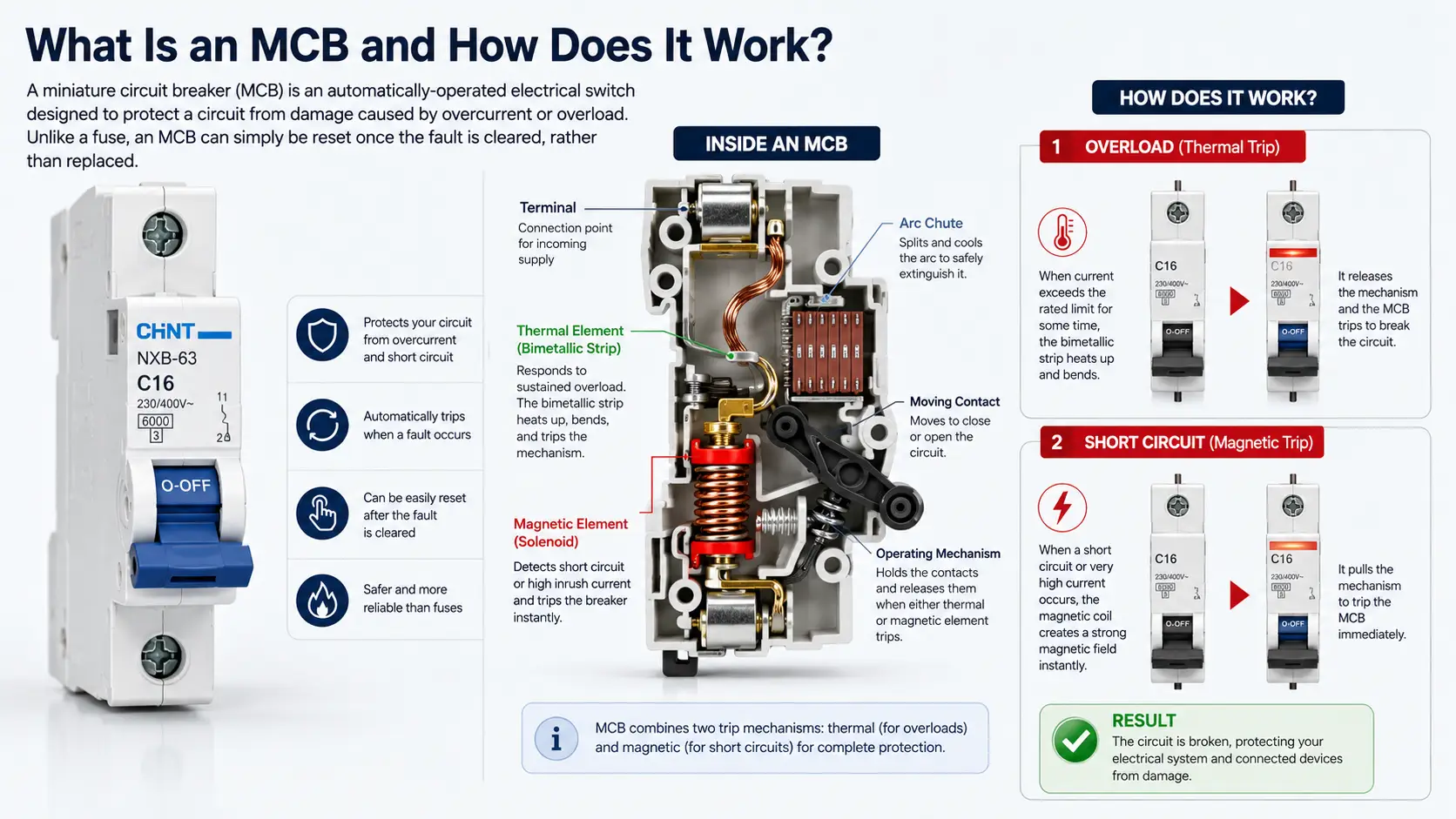
What Is an MCB and How Does It Work?
A miniature circuit breaker (MCB) is an automatically operated electrical switch designed to protect a circuit from damage caused by overcurrent or overload. Unlike a fuse, an MCB can simply be reset once the fault is cleared, rather than replaced. Inside, it combines two trip mechanisms: a thermal element that responds to sustained overload (a bimetallic strip that bends and trips the breaker as it heats up) and a magnetic element that trips near-instantly on a short circuit or heavy inrush current.
MCB Types & Trip Curves: B, C and D
The trip curve — stamped on the front of the breaker as B, C or D — determines how much inrush current the MCB will tolerate before it trips on the magnetic element. Choosing the wrong curve is one of the most common causes of nuisance tripping on UK installations.
Trip Curve | Trips At | Typical Use |
|---|---|---|
Type B | 3–5x rated current | Domestic circuits, resistive loads, lighting |
Type C | 5–10x rated current | Motors, transformers, fluorescent lighting, general industrial circuits |
Type D | 10–20x rated current | High-inrush loads: welding sets, X-ray machines, large transformers |
Quick Tip
If a Type B breaker keeps tripping on motor start-up, don't just fit a bigger amp rating — check whether a Type C curve is the actual fix, since the problem is usually inrush current, not overload.
Key Specifications to Check Before You Order
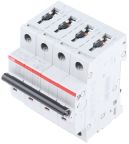
Pole count — 1-pole, 2-pole, 3-pole or 4-pole, matching single-phase or three-phase circuits.
Current rating — from 1A up to 125A on standard MCB frames.
Breaking capacity (Icn) — typically 6kA for domestic use, 10kA or higher for industrial and commercial boards with higher prospective fault current.
Voltage rating — AC and DC ratings differ; confirm the breaker is rated for the actual supply voltage.
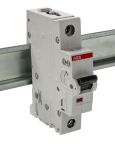
DIN rail compatibility — standard 35mm DIN rail width for board mounting.
Standards & Certifications for UK MCBs
BS EN 60898-1 — circuit breakers for overcurrent protection for household and similar installations.
IEC 60947-2 — the equivalent standard for industrial low-voltage circuit breakers, covering higher current and breaking capacity ranges.
CE / UKCA marking — confirms conformity for supply into UK and EU markets.
How to Choose the Right MCB
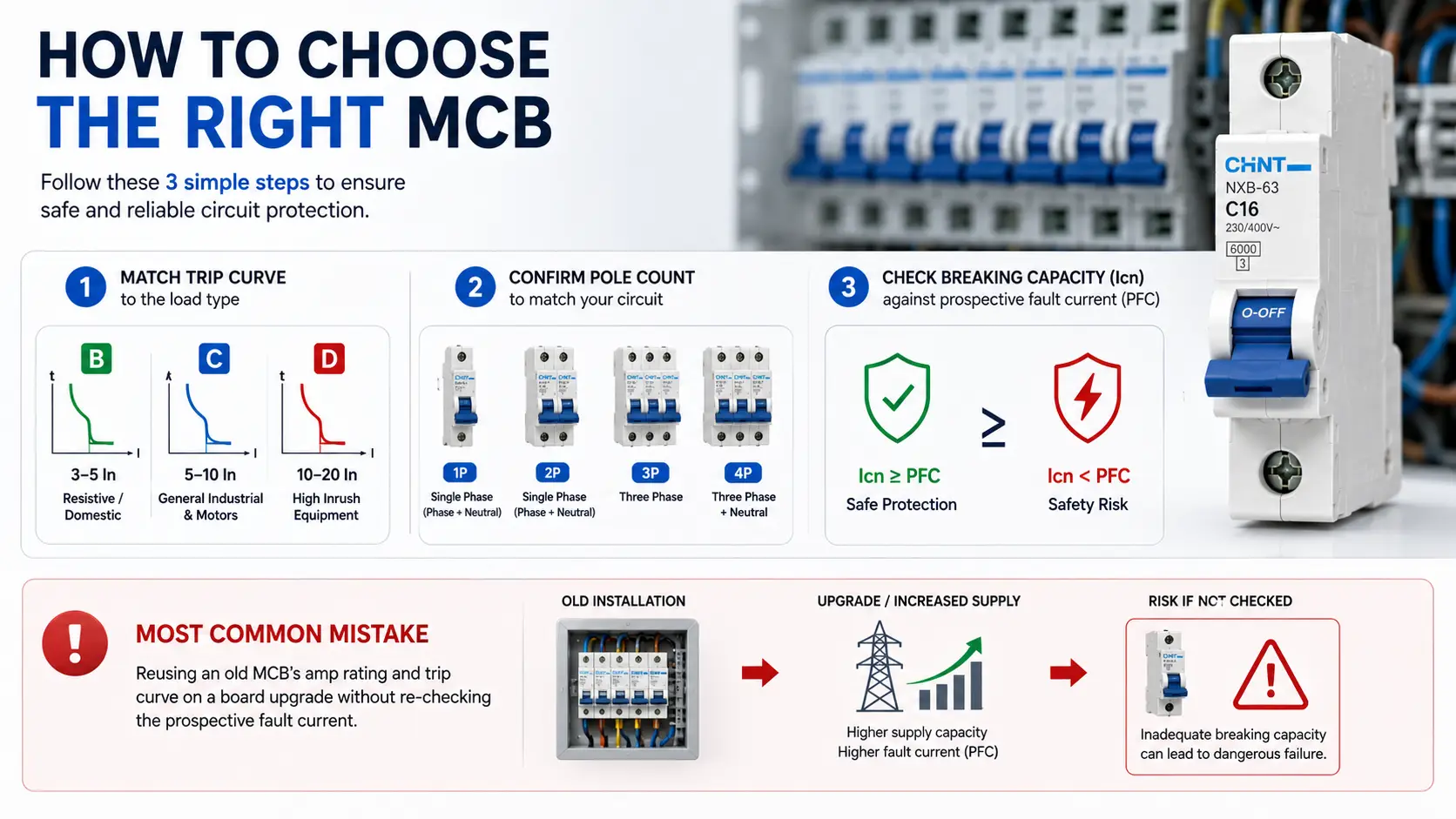
Match the trip curve to the load type first (B for resistive/domestic, C for general industrial and motors, D for high-inrush equipment), then confirm pole count against the circuit phase configuration, and finally check the breaking capacity against the prospective fault current at the board — an undersized breaking capacity is a safety issue, not just a spec mismatch.
Most Common Mistake
Reusing an old MCB's amp rating and trip curve on a board upgrade without re-checking the prospective fault current. As supply capacity increases, an MCB rated correctly years ago can end up with an inadequate breaking capacity for the site today.
MCB Specification Checklist
Confirm trip curve (B, C or D) matches the connected load type.
Check pole count against single-phase or three-phase circuit configuration.
Verify breaking capacity against the prospective fault current at the board.
Confirm AC/DC voltage rating matches the actual supply.
Confirm BS EN 60898-1 or IEC 60947-2 compliance documentation is available.
MCBs, RCDs & Enclosures — Complete the Panel
An MCB rarely goes in on its own — most UK boards pair it with an RCD or RCBO for earth fault protection, all housed inside a correctly IP-rated electrical enclosure or control panel. If you're speccing a new board from scratch, it's worth checking enclosure IP rating and DIN rail capacity alongside the breaker order.
Brands We Supply for Circuit Protection
For miniature circuit breakers specifically, ABB is our core range — but panel builds usually pull in accessories from more than one manufacturer, so here's what's genuinely on the shelf:
Brand | What We Stock | Brand Page |
|---|---|---|
ABB | Full MCB range (Type B/C/D, 1–4 pole), plus MCCBs and RCDs for the same board | |
Allen Bradley | Motor protection circuit breaker accessories and broader automation components for the same panel build |
ABB MCBs Available Through ZF Corporation
ZF Corporation stocks and sources ABB miniature circuit breakers across the full Miniature Circuit Breakers range — Type B, C and D, 1 to 4-pole, 1A to 125A — including current, obsolete and hard-to-find variants for panel repairs and board upgrades. A sample of what's available:
We also work through obsolete and superseded ABB references — if your board still uses a discontinued S200 or S200M part number, our procurement team can cross-reference it to the current equivalent.
Related Circuit Protection Categories
An MCB rarely solves the whole job on its own — most boards need one or two of these alongside it. Browse the full range in each category:
Category | What's Inside | Category Page |
|---|---|---|
Miniature Circuit Breakers | 1,200+ MCBs — Type B/C/D, 1 to 4-pole | |
Molded Case Circuit Breakers | Higher-current MCCBs for distribution boards and MCCs | |
RCCBs | Residual current circuit breakers for earth fault protection | |
RCBOs | Combined overcurrent + earth fault protection in one device | |
Residual Current Devices | Standalone RCDs for earth leakage protection | |
Switch Disconnectors | Manual isolation ahead of the breaker for safe maintenance | |
Motor Protection Circuit Breakers | MPCBs sized specifically for motor starting current |
Frequently Asked Questions
What is a miniature circuit breaker (MCB) used for?
An MCB automatically disconnects a circuit when it detects overload or short-circuit current, protecting the wiring and connected equipment from damage, and can be reset once the fault is cleared.
How do I choose the right trip curve and pole count?
Match the trip curve to the load (B for resistive/domestic, C for motors and general industrial, D for high-inrush equipment), and match the pole count to the circuit configuration — 1 or 2-pole for single-phase, 3 or 4-pole for three-phase.
What standards apply to MCBs in the UK?
Domestic and light commercial MCBs are typically tested to BS EN 60898-1; industrial breakers with higher ratings are tested to IEC 60947-2.
Can ZF Corporation source obsolete or discontinued MCBs?
Yes — we regularly cross-reference discontinued ABB part numbers to current equivalents for panel repairs and board upgrades where the original breaker is no longer manufactured.
What is the typical lead time for an MCB in the UK?
Common Type B and Type C ratings are typically available from stock; less common ratings, Type D breakers and obsolete cross-references may carry a short lead time — contact us with the exact part or specification for a quote.
Conclusion
Specifying the right MCB is mostly about matching three things correctly: the trip curve to the load, the pole count to the circuit, and the breaking capacity to the prospective fault current at the board. Get those three right, confirm the relevant standard, and the rest is straightforward.
Need a quote or help cross-referencing an existing MCB?
Talk to Our Expert Team
DISCLAIMER: Z&F Corporation is not affiliated with, authorized by, endorsed by, or acting as an official representative of any manufacturer, brand, or trademark owner referenced on this website. All product names, trademarks, brand names, logos, and manufacturer references are the property of their respective owners and are used solely for identification, reference, and compatibility purposes.