MRO Procurement Oman Oil & Gas: Complete Guide to Maintenance, Repair & Operations Supply Chain Management
MRO procurement in Oman oil and gas operations is much more than just a purchasing process for all the oil and gas fields of Petroleum Development Oman (PDO) at Fahud and Marmul, the Sohar refinery of Oman's oil company (OQ), the Duqm refinery, and the gas processing plants in Block 61. It's the lifeline that keeps equipment moving, controls instrumentation, maintains pipeline integrity, and ensures production objectives are achieved. The International Energy Agency estimates that in 2024, Oman crude oil production reached about one million barrels per day, meaning it needs a large network of supplies to maintenance, repair and operations (MRO) into the field, refineries and processing plants to keep it flowing throughout the country.
However, MRO procurement is identified by the Oman oil gas teams as the highest cost and most challenging procurement category. The variety and often volatile demand, the high level of complexity of the various equipment classes, the long lead times for specialist components, and the inherent challenges of unplanned downtime make it difficult to get MRO procurement right. There are thousands of SKUs across dozens of equipment classes, variable and sometimes unpredictable demand, long lead times for specialist components and the ever-present risk of unplanned downtime, making it hard to get MRO procurement right. It is a complete guide covering all aspects of the challenge: inventory classification, supplier qualification, digital transformation and management of procurement KPI.
Have a procurement question? Talk to Our Specialist →
What Is MRO Procurement?
Maintenance, Repair and Operations procurement MRO procurement is the process of sourcing, procurement, management and supply of all materials, spare parts, tools and consumables needed to keep industrial equipment, facilities and production systems in operational condition. MRO procurement is a procurement approach that involves the procurement of goods and services that are required to facilitate the production of the product, but not actually part of the product itself (as is the case in direct procurement).
Typically, MRO expenditure in the oil and gas industry is 10-25% of the total operating expenditure and can be much greater in the case of mature producing fields where the infrastructure is ageing. Still, MRO — which is often called "indirect" procurement — is extremely important to operations, even if it's large. A compressor failure without a critical spare part means immediate loss of production, a measurable loss of safety and the need to purchase an emergency compressor at an inflated price.
Direct vs Indirect Procurement
It is crucial to grasp the difference between direct and indirect procurement as part of developing a coherent MRO supply chain Oman strategy. To aid the understanding of the key differences in this context, the following table outlines some of the differences applicable to oil and gas operations.
Characteristic | Direct Procurement | Indirect Procurement (MRO) |
Definition | Goods that form part of the final product | Goods required to maintain production capability |
Examples | Raw materials, feedstocks, process chemicals | Spare parts, lubricants, tools, consumables |
Purchase Frequency | High — tied to production schedule | Variable — demand-driven or scheduled |
Budget Category | Cost of Goods Sold (COGS) | Operating Expenditure (OPEX) |
Inventory Priority | Driven by production planning | Driven by asset criticality and failure risk |
Supplier Relationship | Long-term, contractually structured | Mix of frame agreements and spot sourcing |
Procurement Complexity | Moderate — known specifications | High — large SKU count, variable demand |
Impact of Failure | Production shortfall | Equipment downtime, safety incidents |
Why MRO Procurement Matters in Oman's Oil & Gas Sector
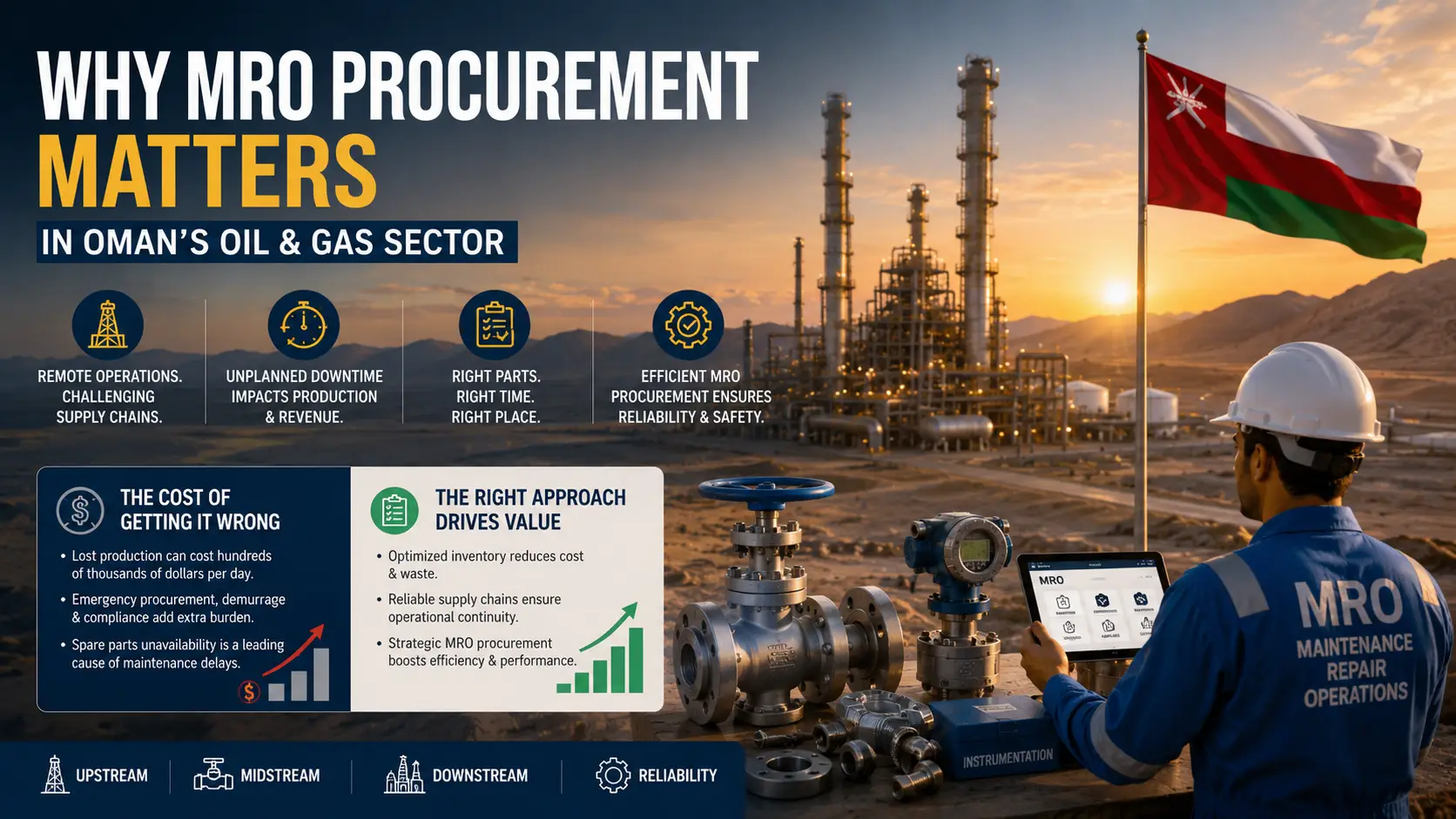
Oman's conditions for hydrocarbon operations make oil and gas procurement a challenge to Oman. The fields that produce the country's oil and gas, many of them venerable machines situated in remote desert areas, rely on the steady performance of their rotating equipment, control systems and pipeline facilities. PDO's operations are located in some of the most widely spread zones of oil production in the GCC, ranging from the northern Hajar Mountains down to the Empty Quarter in the south. Supply lead times to remote field sites coupled with the impact of unplanned downtime on production targets make inventory management and procurement responsiveness a key operational priority.
The economic diversification plans outlined in Oman's Vision 2040 and the growth of the Duqm Special Economic Zone continue to make waves in industrial procurement in Oman. The Duqm Refinery, one of the world's largest greenfield refineries, and downstream and petrochemical investments at Duqm are transforming the facility into a new industrial complex that will generate significant and increasing MRO demand. Meanwhile, the development of the 61 gas block is creating other challenges for the supply chain with its two Khazzan and Ghazeer tight gas fields, which are both operated by bp, and have high specification instrumentation and rotating equipment.
The Cost of Getting It Wrong
Unplanned production downtime is costly in the oil and gas industry. The cost of lost production for a mid size Oman producing facility for one day can be hundreds of thousands of dollars — without considering emergency procurement premiums, demurrage charges if the export shipment is delayed and regulatory reporting requirements. Availability of spare parts is a key factor in MRO procurement failure, which consistently is cited as the second most important cause of maintenance delays, after equipment failure: Industry studies consistently identify unavailability of spares as a leading cause of maintenance delays, just after equipment failure itself.
The converse is also true. The root of the parts unavailability problem is the instinctive solution of keeping more MRO inventory, which carries its own costs, such as hundreds or thousands of parts scattered across various storage areas, the cost of equipment being scrapped for parts that should still be usable, and the management burden of keeping stock on hand. The key problem in oil and gas MRO management is to optimize the stock availability/inventory carrying cost balance.
Key Categories of MRO Products for Oman Oil & Gas
Typically, procurement teams in Oman complete the effective MRO services that cover 10 or more product categories, each having unique specifications, suppliers, lead times and criticality profile. The table below outlines the categories that are most relevant to the operations of oil and gas in Oman.
MRO Category | Typical Products | Key Standards |
Rotating Equipment | Bearings, mechanical seals, couplings, impellers | ISO 281, API 610/676 |
Valves & Actuation | Gate, ball, globe, check valves, actuators | API 6D, API 6A, ASME B16.5 |
Instrumentation | Pressure gauges, flow meters, transmitters, sensors | IEC 61511, ISA standards |
Electrical & Power | Motors, switchgear, cables, transformers, UPS | IEC 60034, ATEX, IP ratings |
Pumps & Compressors | Centrifugal pumps, reciprocating compressors | API 610, API 618 |
Fasteners & Gaskets | Bolts, nuts, stud bolts, spiral wound gaskets | ASME B18, ASME B16.20 |
Safety Equipment | PRVs, PSVs, flame detectors, gas monitors | API 520/521, IEC 61508 |
Lubricants & Fluids | Turbine oil, compressor oil, hydraulic fluid, greases | ISO 6743, API lubricant specs |
Consumables & Tools | PPE, hand tools, abrasives, cleaning materials | ISO 9001, local HSE reqs |
Civil & Structural | Pipe supports, structural steel, grating, insulation | ASME, project specifications |
Rotating Equipment Spares
The most critical and the most valuable part of most oil and gas MRO inventories is rotating equipment (pumps, compressors, turbines, fans and their drive trains). High frequency replacement parts such as bearing sets, mechanical seals, impellers, wear rings, coupling parts, and seal face parts are parts that must be readily available when scheduled maintenance turns are called to ensure timely completion of those maintenance activities. In Oman, for rotating equipment spare parts sourcing, procurement teams face the challenge of balancing holding the critical spares on-site or sourcing them urgently when not held, and the various costs associated with both of the above approaches.
See our Valves page for industrial valves and flow control devices for rotating equipment systems.
Instrumentation and Control
Pressure transmitters, temperature sensors, flow meters, level instruments, control valves and positioners are among the highest SKU category parts in the oil and gas MRO business. This in turn makes them more complex to procure since they must be exactly functionally equivalent with installed equipment, compatible with control system protocols (HART, Foundation Fieldbus, Profibus), and often even certified for use in hazardous areas (ATEX or IECEx).
To learn more about instrumentation components and measurement equipment for the oil and gas industry, check out our Instrumentation page.
Fasteners, Gaskets, and Flange Hardware
All fasteners, gaskets and bolting hardware are MRO products that are often overlooked in procurement planning because they represent a large number of small quantities or high SKUs. Thousands of stud bolts, nuts and spiral wound gaskets can be used up in just one large turnaround for hundreds of flange joints. One of the frequent reasons for flange joint leaking after maintenance is due to incorrect fastener specification (material grade, thread form or gasket material is not suitable for the process fluid), which poses a safety risk and incurs repeat maintenance costs.
See our Fasteners page for specification data for stud bolts, nuts, gaskets and flange hardware.
MRO Procurement Challenges in Oman's Oil & Gas Sector
Structural and operational challenges are prevailing in MRO procurement for the oil sector operations in Oman. To address these challenges, effective mitigation strategies need to be developed, and understanding the challenges is a first step.
Supplier Fragmentation
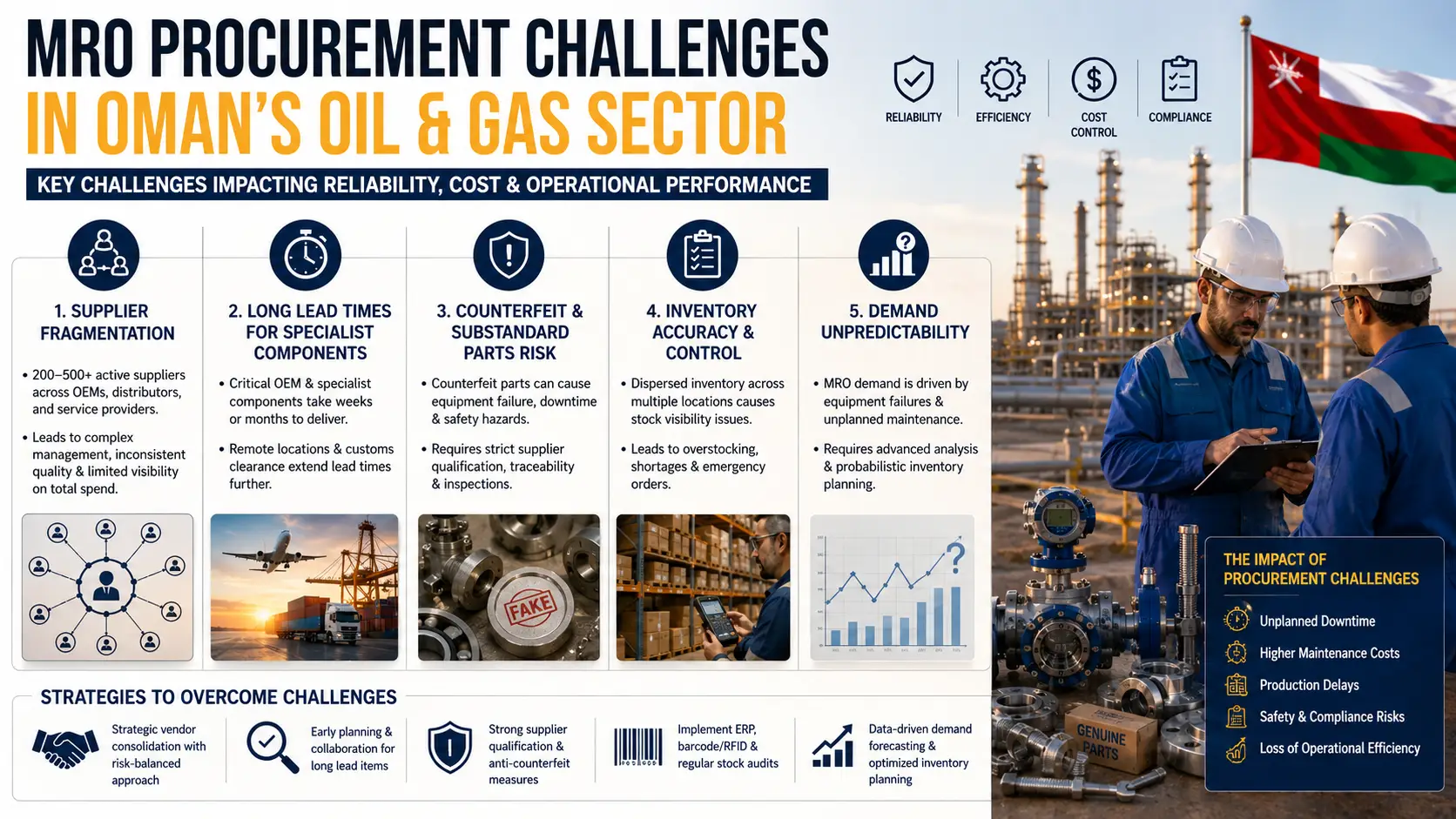
An oil and gas facility in Oman might have 200 – 500 or more active suppliers, including all the OEM authorized distributors for proprietary parts, all general industrial suppliers for commodities, and all specialist suppliers for calibration, repair, and refurbishment services. This scattered supplier base is time consuming, hard to manage for the procurement team, leads to varying quality and compliance standards, and makes it difficult to see the big picture of total spend needed for strategic negotiations.
Scalability, compliance and procurement overhead reduction are key benefits of consolidating vendors through frame agreements with multi-category distributors. There needs to be a balance though, between consolidation and the associated risk of single-source dependency, which implies procurement vulnerability if there is a disruption in the supply chain at the consolidated supplier. Featuring an extensive lead time for specialist components. Having a long lead time for specialist components.
Long Lead Times for Specialist Components
Oil and gas applications require many critical MRO items (large rotating equipment components, specialist valves, custom instrumentation, and explosion-proof electrical equipment) that take weeks or months to get from OEM or specialist manufacturers. In the far reaches of Oman, the supply chain also goes further: What takes 8-16 weeks from the order to delivery at the field, not counting customs clearance and inland transport, may be placed with European or North American manufacturers.
When a critical component is required to launch production within hours or days, the procurement process needs to shift gears completely – a process known as emergency sourcing from alternative sources, airfreight transportation, customs priority clearance and pre-positioning of regional stocks – is known as emergency procurement Oman. A high emergency procurement cost (which is usually 30% to 100% greater than the standard sourcing cost) highlights the economic benefit of doing more intelligent inventory planning to minimize emergency procurement frequency.
Counterfeit and Substandard Parts Risk
In the oil and gas industry the threat of the introduction of counterfeit or substandard parts into the MRO supply chain is a real and proven problem. Often, counterfeit components such as bearings, valves, fasteners or electrical parts look and sound like the originals, but can fail early or suddenly in service, resulting in equipment damage, loss of production or injury. For approved vendor procurement Oman oil and gas specifications, robust supplier qualification, material traceability requirements, and incoming inspection procedures are the primary defenses against counterfeit product risk.
Inventory Accuracy and Control
Oil and gas operations in Oman have MRO stock held in a variety of storage facilities such as central warehouse, field satellite stores and workshop stockrooms. The lack of accurate, real-time inventory management systems often means that the same product ends up in several stores without being seen anywhere on the chain, which leads to the riddle of apparent shortages (which then require emergency ordering) coupled with the same product unrecorded in another store. The core of this challenge is the implementation of one ERP inventory management system (SAP, Oracle, IBM Maximo) that has barcode or RFID tracking and that has regular stock counts.
Demand Unpredictability
Demand for MRO may be more difficult to predict than demands for production materials. Equipment failures are not predetermined, but random. Planned maintenance generates predictable demand for MRO parts used during turnaround work; most MRO demand is generated from unplanned corrective maintenance, which acts by definition, will not occur at predictable times. A review of the historical demands, failure rates and lead times leads to the basis of statistical demand analysis, which leads to probability based inventory decisions balancing service level and the carrying cost.
Inventory Optimization Strategies
An optimized inventory management begins in MRO inventory management for the oil and gas Oman with the correct classification of the inventory portfolio. Not every MRO item deserves the same stocking policy—the policy that would be appropriate for a critical production turbine spare is very different from the policy that would be appropriate for a box of cable ties. Differentiated inventory management is based on the ABC and criticality classification framework.
Critical vs Non-Critical Spare Parts Classification
Classification | Critical Spares | Insurance Spares | Operating Spares | Consumables |
Definition | Failure stops production immediately | Catastrophic failure, long lead time | Planned maintenance parts | Routine use items |
Examples | Turbine rotor, compressor crankshaft | Large motor, pressure vessel | Bearings, seals, gaskets | Lubricants, PPE, abrasives |
Stock Policy | Always held on-site | Held on-site or regional hub | Held to min-max levels | Replenished by consumption |
Inventory Value | Very High | High | Moderate | Low per unit |
Review Frequency | Annual or FMEA-driven | Annual reliability review | Monthly | Weekly / on consumption |
Obsolescence Risk | High (OEM lifecycle) | Moderate | Low | Very Low |
ABC Demand Classification
ABC analysis is used to categorize every inventory item according to its annual usage value into three categories:
A items — Usually 10-20% of SKU count, 20-30% of total annual consumption value. These require special attention, forecasting and negotiated supply contracts.
B items — Typically 20–30% of SKU count, 15–25% of value. Has a min-max replenishment system and periodic review.
C items — Typically 50–70% of SKU count, only 5–10% of value. Low value, high administrative costs; minimal internal holding. Candidates for VMI arrangements and catalogue procurement.
D tems are treated on an individual basis and safety stocks are calculated; B - Critical items are treated on an individual basis but no safety stocks; C - Non-Critical items are candidates for just-in-time or consignment supply arrangements.
Minimum-Maximum Replenishment Systems
The minimum-maximum (min-max) inventory control system offers a practical way of replenishment for standard operating spares. The minimum quantity (reorder quantity) is the sum of lead time demand and safety stock, which means that the quantity of stock placed will not fall below the quantity that should be received when the demand occurs under normal conditions. Order quantity determined by the maximum level based on balancing order costs and carrying costs. Min-max levels need to be updated at least once a year based on the data from actual consumption to avoid drift in the system due to equipment populations and failure rates.
Vendor Managed Inventory (VMI)
Vendor Managed Inventory arrangements (VMI) shift the responsibility for maintaining stock to the supplier, who manages usage information and orders stock when necessary – usually from a consignment or committed stock maintained near or at the customer's premises. VMI is controlled by high volume, low value MRO consumables: Lubricants, Safety consumables, Fasteners, Gaskets and Maintenance tools. The customer has fewer purchasing transactions and greater availability, while the supplier has greater visibility of the demand and a contract to supply. Oman oilfield supply distributors in Muscat ,Sohar are providing VMI program for appropriate product categories.
Supplier Qualification Requirements in Oman
Among the most stringent supplier qualification processes are those in the oil and gas procurement Oman companies, mirroring the critical importance of safety, environmental and operation aspects of the materials being procured. Supplier qualification is not a due diligence process in which operators have the choice to engage in, but is a prerequisite for any purchase, for PDO approved operators like Oman.
Joint Supplier Registration System (JSRS)
Oman's national Platform for supplier pre-qualification is the Joint Supplier Registration System (JSRS), jointly managed by PDO, OQ, and other major industrial buyers. All suppliers must register in JSRS before they are able to do business with these organizations. JSRS registration must be based on suppliers' legal entity status, commercial registration in Oman, financial soundness, quality management system certification (usually ISO 9001:2015), technical capability in the areas of products and services they have declared and health, safety and environment (HSE) management system, and compliance with In-Country Value (ICV) requirements in Oman.
Registration does not automatically qualify a buyer to be on a buyer's approved vendor list (AVL). Various technical evaluations, site visits and sample testing are performed by individual operating companies prior to approval for a supplier to place a purchase order in critical categories.
ISO and Industry Certifications
Typical requirements for industrial MRO suppliers include JSRS registration, as well as certification or supply of products to relevant international standards requirements of the oil and gas industrial sector in Oman. This entails API monogram licenses for valves and rotating equipment, ASME certification for pressure-containing components, ATEX or IECEx certifications for explosion-proof electrical equipment, ISO 9001:2015 quality management system certification and EN 10204 3.1 material test certificates for all metallic pressure-containing components for product certification.
Supplier Evaluation Matrix
Evaluation Criterion | Weight | Key Assessment Questions |
Technical Capability | 25% | Does the supplier have the technical knowledge and range to support our equipment types? |
Certification & Compliance | 20% | ISO 9001, API, ASME, ATEX, JSRS registration — what does the supplier hold? |
Inventory & Lead Time | 20% | Can the supplier fulfil standard orders in <7 days and emergency orders in <24 hours? |
Financial Stability | 10% | Is the supplier financially stable with sufficient capacity for our volumes? |
Quality Management | 10% | Does the supplier have documented QMS, inspection, and material traceability processes? |
Local Presence | 10% | Does the supplier have a physical presence in Oman (Muscat, Sohar, Duqm)? |
After-Sales Support | 5% | Can the supplier provide technical support, returns management, and warranty claims handling? |
How to Build an MRO Procurement Strategy for Oman Oil & Gas
In order to make strategic sourcing for the oil and gas maintenance operations in Oman successful, it is necessary to adopt a structured approach, shifting the procurement function from a reactive to a proactive and value creation supply chain management. Here is a step-by-step process that serves as the basis for a successful MRO strategy.
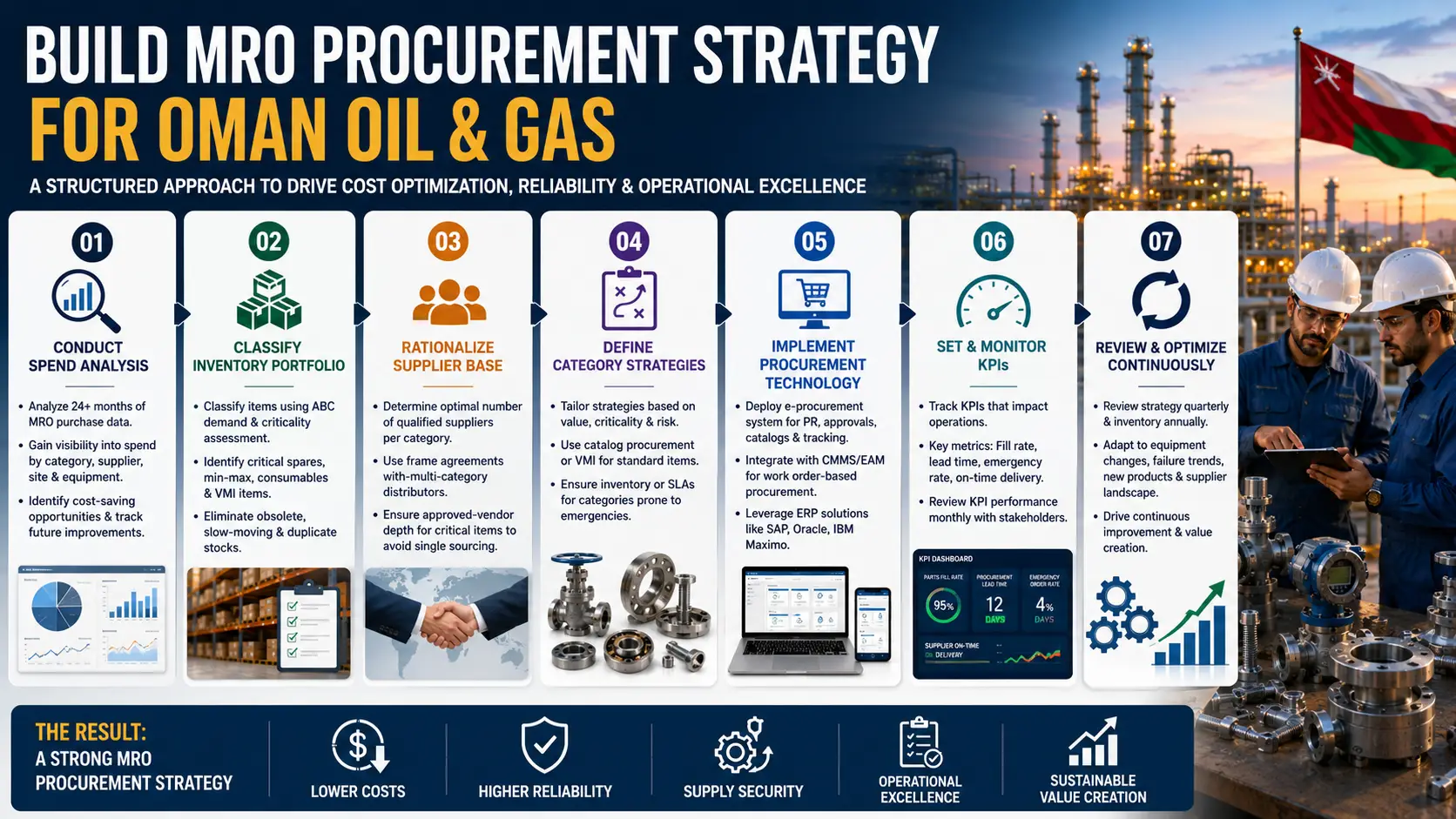
Conduct a spend analysis. Take a look at your historical MRO purchases data from the last 24 months and gain insights into the total spend per category, supplier, site, and equipment class. Spend analysis uncovers the depth and breadth of MRO spend, which can be used to gain an understanding of the most effective possible spend improvement and act as a measure to track future spend improvement.
Classify the inventory portfolio. Classify existing stock items using ABC demand classification and criticality assessment. Determine critical spares, min-max operating spares and consumables that can be procured from a catalogue or VMI. Check for obsolete, slow moving and duplicate stocks to be disposed off to free working capital.
Rationalize the supplier base. Determine the number of qualified suppliers needed to ensure competitive sourcing and supply security for each MRO category. Create frame agreements with multi-category distributors for standard items, and have approved-vendor depth for critical and specialist items to prevent single sourcing.
Define category strategies. Not all MRO categories warrant the same procurement approach. Where the value of an item, and its criticality, requires it, individual supplier relationships, detailed performance management, and rigorous supplier qualification are warranted. Catalogue procurement or VMI is more suitable for standard consumables. For those categories that could be prone to emergency, the inventory must be in place or there must be a commitment to SLAs for emergencies.
Implement procurement technology. Adopt or implement an e-procurement system for purchase requisition, approval process, supplier catalogue management and order tracking. Connect with maintenance management system (CMMS/EAM) and allow for purchase through demand, right from the work order. SAP PM/MM, Oracle EBS, and IBM Maximo are some of the ERP solutions that are widely used among the big oil and gas firms in Oman.
Set and monitor KPIs. Establish and monitor procurement performance metrics that are most significant to the operational results (parts fill rate, procurement lead time, emergency order rate, supplier on-time delivery); meet with procurement and operations stakeholders monthly to review the metrics. KPI transparency promotes accountability and helps identify supplier performance that is on the decline, early.
Review and optimize continuously. MRO procurement strategy is not a one-off task. Equipment populations shift, failure patterns change, new products become available and supplier landscapes change. The strategy is reviewed at regular intervals (quarterly) and is assessed for inventory (annually) to stay relevant to the operational requirements and market conditions.
Digital Transformation in MRO Procurement
The use of digital procurement technologies is changing the way the whole oil and gas industry is managing its MRO supply chain. Digital procurement platforms have been adopted by operators and procurement teams, and they have seen better outcomes across several key areas—including procurement efficiency, spend visibility, and supplier compliance.
Traditional vs Digital Procurement
Factor | Traditional Procurement | Digital / e-Procurement |
Purchase Requisition | Paper-based or email | Automated digital workflow |
Supplier Discovery | Manual catalog search, phone calls | Digital marketplace, vendor portals |
Price Comparison | Manual RFQ process | Automated reverse auctions, e-sourcing |
Approval Workflow | Manual sign-off chains | Automated routing with delegation |
Order Tracking | Phone / email follow-up | Real-time order status dashboard |
Spend Visibility | Periodic manual reporting | Real-time spend analytics |
Compliance | Manually audited | Built-in policy controls and alerts |
Lead Time Reduction | Moderate | Significant — 15–40% average reduction |
Cost Saving Potential | Limited | 5–15% typical annual spend reduction |
AI and Predictive Analytics in MRO
AI and machine learning tools are starting to help revolutionize MRO inventory and demand forecasting. Predictive maintenance systems can predict equipment component failure days or even weeks in advance, using real-time equipment condition data from vibration sensors, oil analysis and thermographic inspection, which allows parts to be ordered in advance, not when an emergency arises. Predictive maintenance outputs can, when linked to the CMMS and procurement system, automatically generate material reservations or purchase requisitions for the parts needed for the predicted corrective maintenance.
A probabilistic demand forecasting tool based on AI is used to use historical consumption trends, equipment failure data, and seasonal trends to generate demand forecasts at the SKU level, which can be reviewed and set in a more accurate min-max level than traditional manual review, thereby providing a higher level of safety stock calculation. Now, several ERP vendors and specialist MRO analytics providers are providing these functions as standard modules or add-ons for cloud ERP.
Digital Supplier Portals and Catalogues
Oil industry platforms in Oman are increasingly providing procurement outsourcing services, providing digital supplier catalogues—pre-negotiated, electronically integrated product databases, giving end users the ability to self-serviced against approved item lists without having to create individual purchase orders for each transaction for the contracted items. Available these catalogue integrations can significantly lower the transaction cost of high volume, low value MRO purchasing, and keep to negotiated frame agreements.
Procurement KPIs and Performance Metrics
Balanced and holistic KPIs are needed to measure industrial procurement Oman oil and gas operations and these should cover both procurement efficiency (cost and lead time) and performance (availability and uptime). Below is the list of the most critical MRO procurement KPIs and their industry best-practice levels.
KPI | Definition | Target (Best Practice) | Measurement Method |
Parts Fill Rate | % of MRO requests fulfilled from stock first time | ≥95% | Stock orders filled / total orders |
Procurement Lead Time | Days from requisition to goods receipt | <7 days (standard), <24hr (emergency) | Order date to delivery date |
Inventory Turnover | Times annual inventory value is consumed per year | 2–4x (critical spares) | Annual consumption / avg inventory value |
Emergency Order Rate | % of orders raised as urgent / emergency | <10% | Emergency POs / total POs |
Supplier On-Time Delivery | % of orders delivered on the committed date | ≥95% | On-time deliveries / total deliveries |
Procurement Cost Savings | Year-on-year cost reduction from strategic sourcing | 5–10% annually | Negotiated price vs market baseline |
Vendor Qualification Rate | % of active suppliers on qualified vendor list | 100% for critical categories | Approved vendors / total active vendors |
Inventory Carrying Cost | Annual cost of holding MRO inventory | <25% of average inventory value | Storage + capital + obsolescence cost |
KPI Dashboard Implementation
Procurement KPIs are only useful if they are routinely assessed by the appropriate parties and action taken to improve the situation when they are not met. Monthly KPI Review with procurement and operations leadership provides the accountability that is required to maintain performance improvement. If procurement KPIs are monitored in real time in the ERP or procurement system, the ability for maintenance managers to access the dashboard helps for quicker escalation of supply issues before they turn into product shortages.
Emergency MRO Procurement Procedures
Emergency parts demand always occurs in all oil and gas operations, regardless of the best inventory planning and preventive maintenance program. A formal emergency MRO procurement Oman process provides the benefit of responding quickly, effectively and cost-efficiently to emergencies, rather than reacting in a disorganized and uncontrolled way.
Emergency Sourcing Workflow
Equipment failure identification and impact assessment. Maintenance team verifies failed component, determines which component (OEM part number, specification, and cross reference) needs to be replaced, and evaluates the impact of the failure on production.
Stock check across all sites. The part is pulled from the CMMS or ERP system, regardless of its location (central warehouse, satellite stores, work-in-progress returns). If there is an emergency, a transfer from another location may solve the problem without having to go outside for items.
Emergency RFQ to qualified suppliers. Purchase requisition raised – expedite priority – sent to qualified suppliers that have the part in stock. Target response time: 2-4 hours for initial response and quote.
Expedited approval and purchase order. The process for financial sign-off for the order value is delegated and approved according to the guidelines of emergency PO in a fast-track delegation of authority process. The electronically issued PO shall be sent to the supplier within 1-2 hours of confirmation by the supplier.
Logistics coordination. Supplier makes airfreight or premium courier arrangement. Freight forwarder is responsible for customs clearance for international sourcing, and he will do it in priority. Estimated delivery time is communicated to maintenance/operations.
Post-emergency review. A root cause analysis is performed within 30 days of the emergency: What were the reasons for not having the part on hand? Could the need have been predicted? Would a change in the min-max be warranted? Should a blanket order be made with a guaranteed lead time? This review is a capstone and catalyst for improvement on a systemic level.
Future Trends in MRO Procurement for Oman Oil & Gas
Predictive Inventory Management
The adoption of predictive maintenance data streams to MRO procurement systems is progressing at a rapid pace. The overall more precise demand forecasting of parts becomes more precise as the increased availability of equipment health information through vibration analysis, oil condition monitoring and ultrasonic inspection program. Forward-looking oil and gas operators are developing procurement systems that automatically convert the predicted failure times to materials requirements, and create procurement actions weeks before the scheduled maintenance event.
ESG-Driven Procurement Requirements
Oman's oil and gas companies are under growing investor, lender and international scrutiny on their ESG practices. These pressures are starting to be felt in industrial sourcing Oman procurement strategies – a carbon footprint assessment of suppliers, preferring certified sustainable lubricants and chemicals, supply chain transparency criteria and local content (ICV) compliance are now expected to be considered alongside price and quality. Procurement teams require systems and frameworks to capture and report ESG performance metrics to complement the traditional procurement metrics.
Smart Warehousing and Vending Technology
Across the GCC, industrial vending machines are being deployed in oil and gas maintenance workshops and field stores for the high consumption of materials and products (PPE, fasteners, cutting tools, lubricants). These systems have the ability to give real-time consumption data, to authorize consumption and to automatically replenish; they can cut down the manual effort to manage stocks and cut down the informal consumption that goes around the stores system.
Procurement Outsourcing and Managed Services
Oman oil industry outsourcing services providers who provide integrated MRO oil managed services (category management, supplier management, inventory management and transactional procurement in a single outsource service), are gaining more attention from operators who wish to decrease the overhead of in-house managing large and complex MRO supply chain. Managed MRO services can offer substantial savings and performance benefits for operators who don't have the in-depth procurement knowledge or systems infrastructure.
Common MRO Procurement Mistakes to Avoid
Overstocking Without Criticality Analysis
When parts are in short supply, the natural answer is to boost inventories – but if you do so without criticality analysis, you end up with capital that's stuck in slow-moving or moving, but stagnant inventories. When adding stock to any item, ask: What is the “Lead Time?” if the item has to be sourced urgently? What is the impact of it not being in place right away? Permanent inventory is justified only in items where the cost of not having the item is more significant than the cost of carrying the inventory.
Single-Source Dependency for Critical Items
If the item is an MRO – whether it's an OEM exclusive, historical relationship or convenience in procurement – then relying on a single supplier can make your supply chain very vulnerable. Ensure that there are at least two qualified and tested supply sources for each item rated as critical. This calls for initial investment in qualified alternate suppliers, but is indispensable in the event of disruption of supply. Supplier diversification is constantly mentioned as a key risk management strategy by MRO procurement best practices Oman.
Ignoring Total Cost of Ownership
It is a false economy to make the decision to purchase MRO items based on purchase price only, and not on quality, reliability, service life and total maintenance cost. This is because that this cheaper bearing will need replacement once every six months while this premium bearing will last for two years, making the cost of the cheaper bearing be greater for the asset's life. The purchase price per unit is not a rational basis for selection for replacement items used often, compared to the total replacement cost per year, including labour.
Poor Supplier Documentation Requirements
The MRO companies that ordered the goods without any documentation requirements shall receive the goods without any documentation. (Material test certificate, inspection record, ATEX certificate, calibration certificate). Going back to suppliers to get documentation is time consuming and costly and at times even unfeasible. Documentation for all purchases orders for material or instrument that require specification should include the specification as a delivery condition.
Neglecting Procurement KPIs
If you are not measuring and reviewing the KPIs regularly, then there is no accountability for procurement performance. Parts fill-rates drop, lead times increase, emergency order rates go up – and with no data, you have nowhere to begin looking for the source of the problem or quantifying the cost of its impact. A simple monthly KPI dashboard is enough to make procurement a proactive cost center that becomes a contributor to operational performance.
Frequently Asked Questions
What is MRO procurement in oil and gas?
The procurement of oil and gas maintenance, repair and operational (MRO) is the sourcing of all supplies needed to maintain production equipment and facilities. This comprises the following: spare parts, bearings, valves, pumps, instrumentation, lubricants, tools and consumables. For oil and gas activities in Oman, all the way from simple consumables to spares for critical equipment that require long lead times and certification requirements, MRO procurement Oman oil gas operations rely on.
Why is procurement in MRO important for Oman Oil fields?
The oil and gas fields of Oman, especially the geographically dispersed PDO operations and the new producing fields of Block 61 and Duqm, are reliant on a steady supply of MROs to sustain their production. The loss of time due to failure in the equipment to get spares directly impacts production and operational cost. Oil and gas maintenance procurement help minimize downtime, keep emergency purchasing costs low, and ensure asset integrity and safety compliance throughout the oil and gas production lifecycle.
Which products are considered MRO products?
MRO products include: rotating equipment spares (bearings, seals, impellers, coupling elements), valves and actuators, instrumentation and control components, electrical equipment (motors, switchgear, cables), pumps and compressor parts, fasteners and gaskets, safety equipment, lubricants and industrial chemicals, maintenance tools and consumables, and civil and structural materials. A large oil and gas facility would likely have thousands of individual SKUs for each of these categories in its entire MRO portfolio.
What cost savings does MRO procurement bring?
Cost savings that can be achieved with effective MRO procurement include: strategic sourcing and frame agreements, which focus on sourcing for committed quantities at below-market prices; inventory optimization, which minimizes the investment required in slow-moving inventory; vendor consolidation, which eliminates transaction overhead and contributes to negotiating better prices; demand forecasting, which helps lower the risk of emergency purchases and the associated premium cost; and lifecycle cost analysis that helps identify higher quality, longer-life alternatives to low cost, short-life components.
What does MRO Inventory Strategy mean?
An MRO inventory management for oil and gas Oman approach involves categorizing inventory based on criticality (critical, insurance, operating spares and consumables) and demand pattern (ABC classification), and taking different stocking policies for each category. Permanently stored on-site, no matter the cost, are critical spares that could halt production. Min-max replenishment systems are used to operate spares. Consumables are purchased via VMI, catalogue. The strategy is reviewed on a year-on-year basis with the review based on actual consumption data and equipment population.
What are the criteria that are used to select suppliers by the oil companies in Oman?
Oman's key oil and gas operators have established a Joint Supplier Registration System (JSRS) that involves suppliers being legally registered, financially fit, ISO 9001 quality management and HSE management systems, and compliance with In-Country Value (ICV). Aside from JSRS registration, individual operators carry out technical evaluations and site audits, sample evaluations and reference checks prior to authorizing suppliers to be included in approved vendor procurement Oman oil and gas operations. Regular performance reviews and re-qualification cycles ensure supplier standard over time.
What are the MRO procurement KPIs?
Common key performance indicators (KPIs) for MRO procurement are: parts fill rate (at least 95 percent), procurement Lead Time (less than seven days standard, and less than 24 hours for emergency orders), emergency order rate (less than 10 percent), supplier On Time Delivery rate (at least 95 percent), inventory turnover (two to four times per year for critical items), procurement cost savings (at least 5 – 10 percent annually), vendor qualification rate (100 percent for critical categories), and inventory carrying cost (less than 25 percent of average inventory value).
What are the benefits of digital procurement for MRO?
The digital procurement platforms offer a range of capabilities that benefit MRO supply chain management in Oman, such as automating purchase requisition and approval processes, offering real-time spend visibility and analytics, supporting electronic supplier catalogues and punchout purchasing, integrating with CMMS systems for demand-driven procurement, automatically tracking supplier performance, and generating procurement KPI dashboards. Organizations that adopt digital procurement platforms see a 15-40% reduction in purchase-to-pay cycle time and 5-15% reduction in total MRO spend, as a result of better compliance and adherence to negotiated pricing.
Who should be certified to be a MRO supplier?
Qualifications for industrial MRO supplier for the oil and gas sector in Oman are the following: ISO 9001:2015 (quality management system), JSRS registration (for operations in Oman), API monogram licenses (valves and rotating equipment), ASME certification (pressure-containing components), ATEX/IECEx certification (explosion-proof electrical equipment), and ISO 17025 accreditation (pressure calibration services). Suppliers of critical metallic components should make EN 10204 3.1 material test certificates as standard documents.
What are the ways for companies to maximize spending on MRO?
Oman organizations are implementing procurement best practices to optimize spend such as spend analysis to ensure that the optimum savings are generated, supplier consolidation and frame agreements to achieve volume based pricing, catalogue procurement of standard consumables to ensure negotiated prices are followed and reduce any maverick buying, make-or-buy analysis for repair or replacement decisions, lifecycle cost comparison for optimum product specifications and finally, procurement process automation for lower value, high frequency items and reductions in transaction overheads.
What is strategic sourcing in MRO procurement?
Strategic sourcing for oil and gas maintenance Oman shifts purchasing from an ad hoc activity to a more formalized approach that includes a process of market analysis, supplier evaluation and developing long-term relationships to ensure the maximum value is delivered from the supply chain rather than just the lowest price per unit. Strategic sourcing in MRO includes spend analysis and spend segmentation, market benchmarking against global pricing standards, competitive tendering for high value categories, supplier relationship management for critical suppliers and ongoing performance management using KPIs and regular business reviews.
Conclusion
Oman's oil and gas industry procurement is not a routine process to MRO. It is very strategic and directly affects plant availability, operational safety and maintenance costs. Those fasteners, valves and instrumentation you purchase today will make the difference between operating your facility smoothly today, and being shut down tomorrow because of unplanned downtime.
Oman's Oil & Gas sector is a very challenging one with high temperatures, corrosive environments and 24/7 production cycles. All parts in these facilities have to be of superior quality and comply with strict certifications. Not checking a valve in a process line and not checking a substandard fastener in a critical flange joint is not just a maintenance problem, it's a safety problem.
The most effective method for MRO procurement is a structured approach: check with the issuing bodies for certifications, validate material traceability and assess suppliers against documented standards, not catalogue claims. The same rules apply whether you need fasteners for pipe flanges, flow control valves or process instrumentation.
When it comes to understanding local logistics, whether in Muscat, Sohar or Duqm, a supplier can make all the difference with reliable delivery and after-sales support for procurement teams in Oman. A multi-supplier approach is a benefit for each product category for resilience against supply chain disruptions.
The demand for dependable MRO procurement will only get larger as Oman goes full steam ahead with the expansion of its oil, gas and petrochemical developments, as outlined in Vision 2040. For long-term operational success, it's necessary to use a disciplined, standards-based approach to sourcing.
Looking for MRO procurement services for your oil and gas project in Oman? Communicate your needs — whether it be fasteners, valves, or instrumentation.
Our team will guide you in the process of discovering certified products with reliable delivery throughout Oman.
DISCLAIMER: Z&F Corporation is not affiliated with, authorized by, endorsed by, or acting as an official representative of any manufacturer, brand, or trademark owner referenced on this website. All product names, trademarks, brand names, logos, and manufacturer references are the property of their respective owners and are used solely for identification, reference, and compatibility purposes.