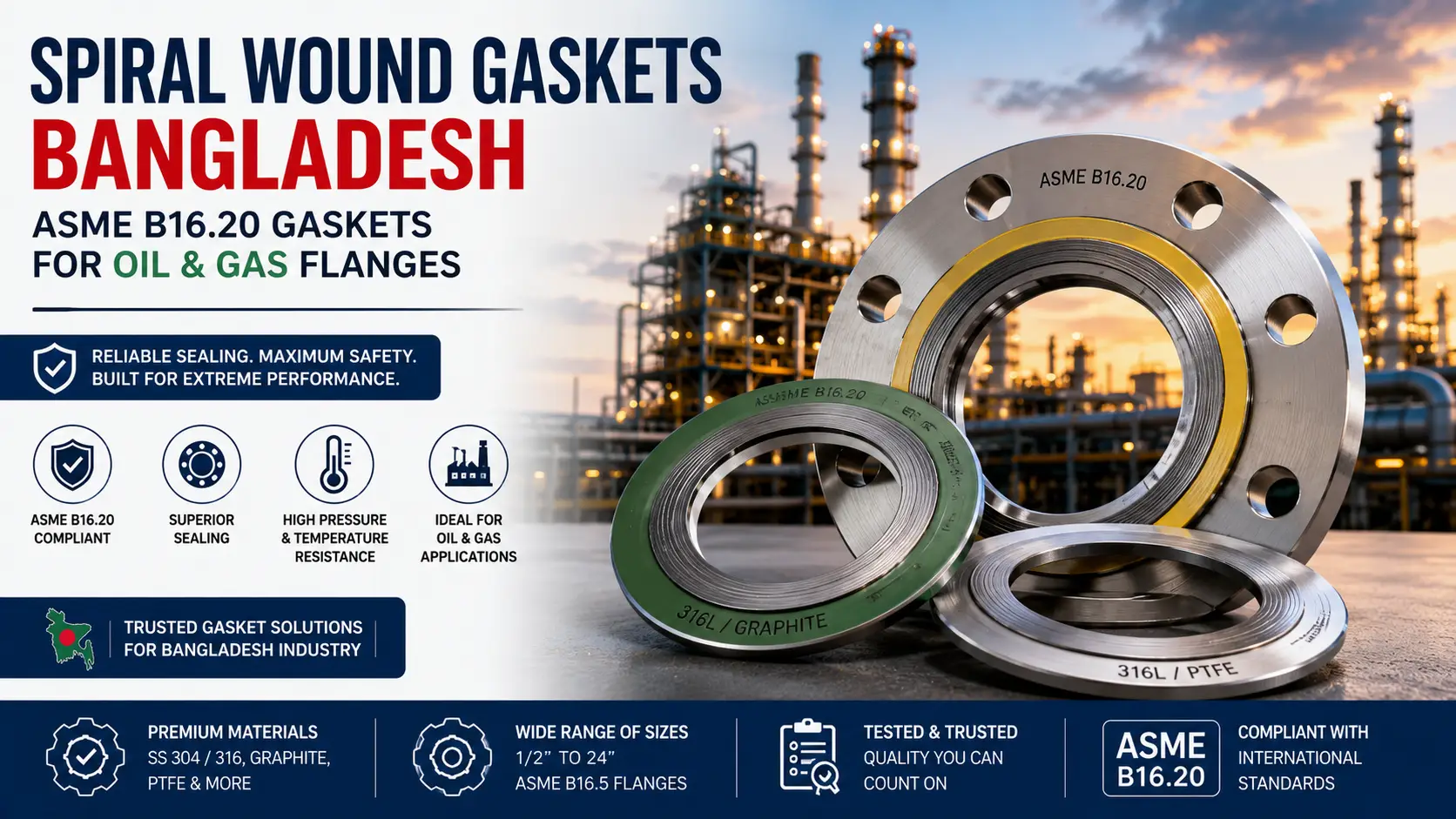
Spiral Wound Gaskets Bangladesh: Complete Industrial Buying Guide
For the procurement team and maintenance engineers looking for the ideal sealing component for their high-pressure flanged joints in Bangladesh, there is a clear technical challenge and need: the sealing product must operate without failure in a demanding operating cycle. From the industrial areas of Chattogram and Narayanganj to gas transmission lines of Dhaka and Khulna to LNG plants and power generation systems, Spiral wound gaskets are the most preferred semi-metallic sealing option for oil and gas pipelines throughout Bangladesh. Every flanged connection that uses the right gasket grade, material and standard compliance is leak free, lasts longer and complies with regulations.
Request a Quote — ASME Compliant Spiral Wound Gasket Bangladesh | Bangladesh's Best and Quality Gasket Suppliers
Our procurement experts find certified industrial gaskets, fully-documented for oil & gas, petrochemical, power and process industries. Contact us today.
What Are Spiral Wound Gaskets?
Spiral wound gasket is a semi-metallic gasket that is wound into a spiral pattern with alternate layers of metal strip and soft sealing material, and compressed between a raised-face or flat-face flanges in pressurized piping systems. The metal winding (usually stainless steel) offers structural resistance and rebound when there is variation in the bolt load, but the filler material fills out any imperfections in the surface of the flange face to form a leak-tight joint.
Spiral wound gaskets can be used to seal flanges that have a slight misalignment, thermal expansion and pressure cycling without loss of sealing properties, unlike solid metallic gaskets. They are not subject to blow out when pressure is applied during high pressure excursions as are soft gaskets. Their flexibility and strength renders them ideal gasket for most challenging sealing applications in Bangladesh oil, gas, power and chemical industry.
The incorrect selection and installation of gaskets is one of the most common causes of flange joint leaks in pressurized piping systems, as per ASME and API recommendations, which highlight the need to use gaskets that meet the specification requirements and to install them correctly, using a calibrated procedure, for every flange joint.
Why Spiral Wound Gaskets Are Widely Used in Bangladesh
Many energy, manufacturing and infrastructure industries are growing in Bangladesh. The country's gas transmission network that connects gas power stations, fertilizer plants and industrial plants throughout the country demands reliable sealing solutions that can provide continuous service at operating pressure and temperature which only metallic or semi-metallic gaskets can deliver.
Industrial areas are booming in Chattogram, Narayanganj, Gazipur and Bangladesh Economic Zones, and as such, the demand for high-pressure gaskets that meet international standards is significant. ASME B16.20 spiral wound gaskets are the standard sealing material that is always required by the EPC contractors, plant maintenance engineers, and MRO procurement teams involved in refinery upgrades, power plant construction, and gas infrastructure projects.
The projects in the energy sector in the Bay of Bengal and LNG projects for import in the country will continue to add to the demand for oil and gas gaskets Bangladesh that satisfy international engineering standards and the procurement specifications of large EPC project owners and operators.
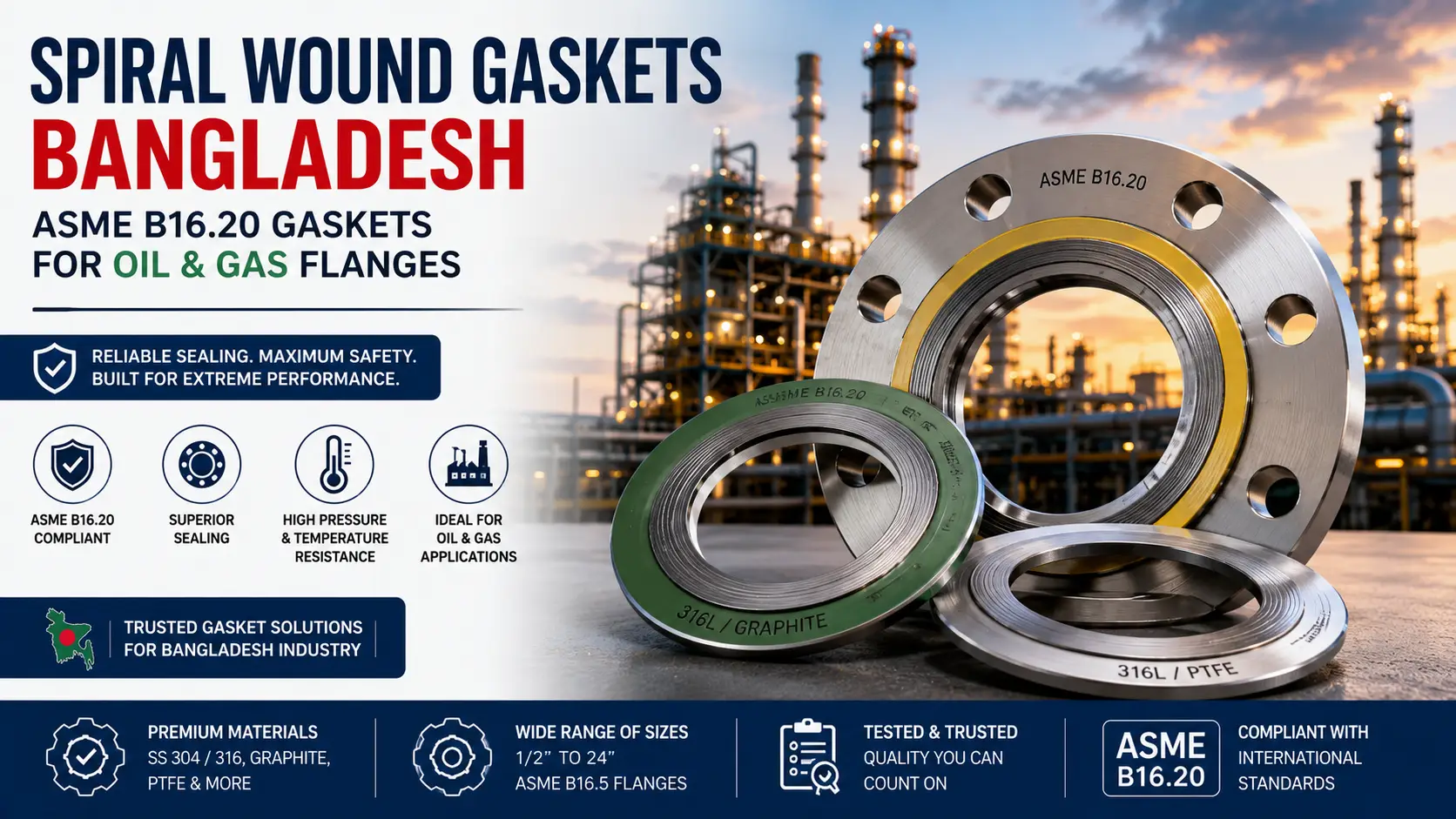
Industries That Use Spiral Wound Gaskets
Spiral wound gaskets Bangladesh are used in various industries. There are certain demands on gasket material, filler type, and pressure/temperature rating for each application environment.
Industry | Typical Applications | Recommended Gasket Materials |
Oil & Gas Transmission | Pipeline flanges, compressor stations | SS316 + Graphite, ASME B16.20 |
Petrochemicals | Process piping, heat exchangers | SS316 + PTFE or Graphite |
Power Generation | Steam lines, boiler flanges | SS304/316 + Graphite (high temp) |
LNG Terminals | Cryogenic piping, terminal flanges | SS316L + Flexible Graphite |
Fertilizer Manufacturing | Ammonia & urea process lines | SS316 + Graphite or PTFE |
Chemical Processing | Acid & solvent piping | SS316 + PTFE (chemical resistance) |
Water Treatment | High-pressure water flanges | SS304 + PTFE or Graphite |
Offshore & Marine | Subsea and topside piping | SS316L + Graphite, API 6A rated |
Types of Spiral Wound Gaskets
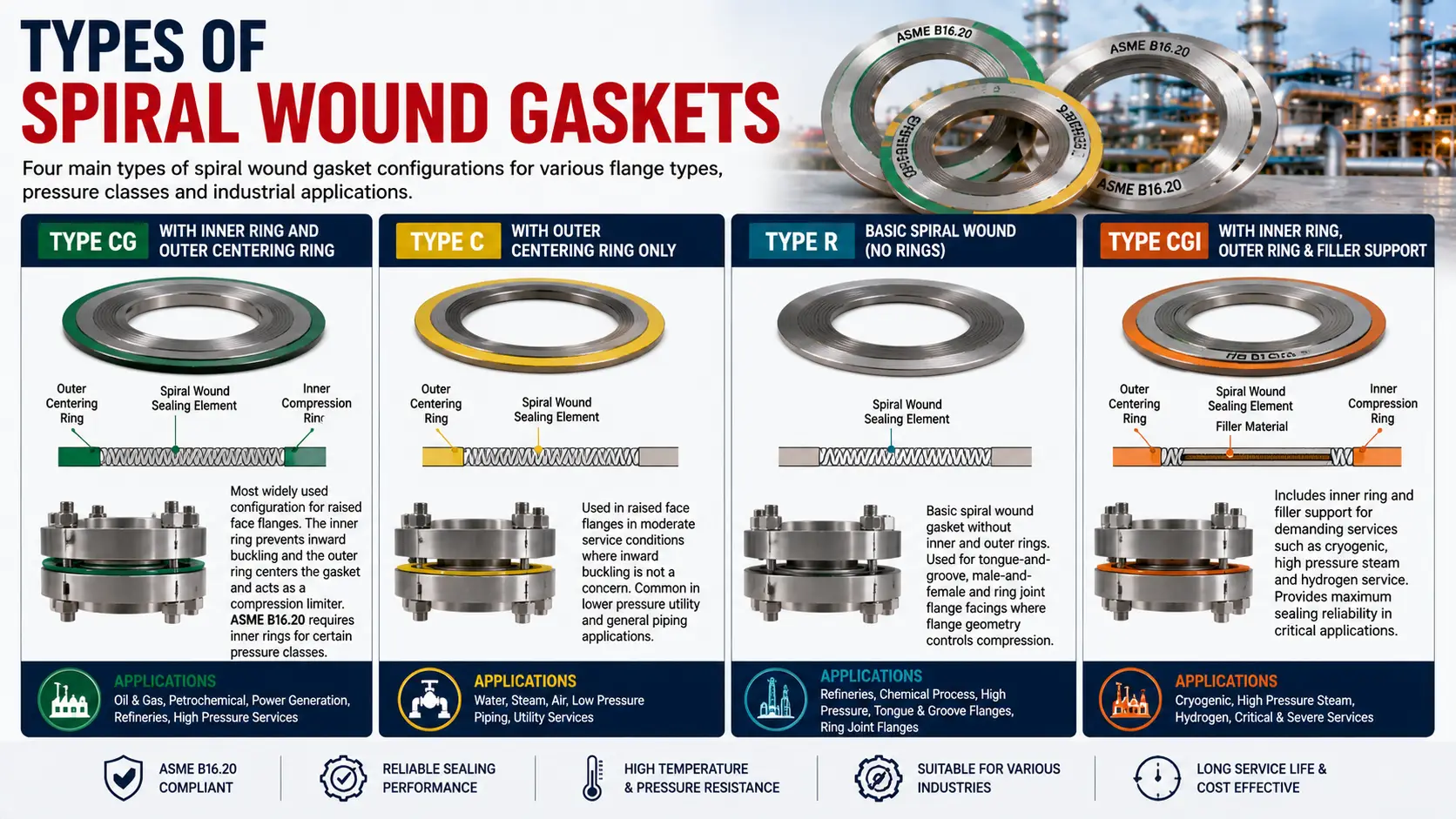
There are four main types of spiral wound gasket configurations for varying flange face types, pressure classes and applications. The ability to recognize the differences enables procurement teams to state the appropriate configuration for each service.
Type CG — With Inner Ring and Outer Centering Ring
The type CG gaskets are made up of two parts, an inner compression ring and the outer guide ring. This is the most frequently required configuration for raised face flanges, and is the standard configuration for oil and gas, petrochemical, and power generation applications. The inner ring ensures that gasket will not buckle inwards under heavy bolt loads and the outer ring ensures that the gasket is positioned exactly on the flange face and acts as a compression limiter. ASME B16.20 requires the use of inner rings for some of the pressure classes.
Type C — With Outer Centering Ring Only
Type C gaskets are gaskets that contain no inner ring and an outer centering ring. It can be used in raised-face flanges in moderate service conditions where buckling of flanges into the gasket is not likely to be a problem. This arrangement is often employed in lower pressure utility pipes and pipes which are not required to be in full Type CG specification.
Type R — Basic Spiral Wound (No Rings)
Type R is the basic spiral wound type without inner and outer rings. It is used for tongue-and-groove, male-and-female and ring joint flange facings with the flange geometry centering and controlling compression. These gaskets are employed in the sealed-groove flange concept also widely employed in high pressure refinery and chemical process uses.
Type CGI — With Inner Ring, Outer Ring, and Filler Support
Additional inner ring and filler support arrangements for use in highly aggressive services such as cryogenic, high pressure steam and hydrogen service are available in Type CGI gaskets. This configuration ensures the greatest sealing security in the most important flanged joint applications.
Materials Used in Spiral Wound Gaskets
Metal Winding Materials
The metal winding offers spring-back recovery, structural integrity and corrosion resistance. The following materials are commonly used for windings and are used for their respective applications:
Metal Grade | Key Properties | Typical Applications |
Stainless Steel 304 | Good corrosion resistance, cost-effective | General industrial, water, steam |
Stainless Steel 316 | Superior chloride & chemical resistance | Chemical, offshore, LNG, acidic media |
Stainless Steel 316L | Low carbon, weld-compatible | Cryogenic, LNG, severe chemical service |
Inconel 625 | Extreme temp & corrosion resistance | High-temp, offshore, aggressive media |
Duplex SS 2205 | High strength + corrosion resistance | Offshore, sour gas, subsea |
Carbon Steel | High strength, economical | Low-corrosion industrial service |
Filler Materials
Filler material is used to fill in the minute surface irregularities on the face of the flange and acts as the primary sealing element. The choice of fillers will vary depending on the process media, operating temperature, chemical compatibility, and environmental compliance requirements.
Filler | Temp Range | Chemical Resistance | Best For |
Flexible Graphite | Up to 450°C (steam) / 650°C (inert) | Good, except strong oxidizers | Steam, hydrocarbons, general oil & gas |
PTFE | Up to 260°C continuous | Excellent — nearly universal | Acids, corrosive chemicals, food processing |
Ceramic / Mica | Up to 1000°C+ | Moderate | Extreme high-temperature, furnace flanges |
Mineral Fibre | Up to 550°C | Moderate | Steam, high-temp general service |
Graphite vs PTFE — Which Filler Should You Choose?
Graphite-filled Spiral wound gaskets are the most common gasket type used on steam applications, hydrocarbon process lines and in general oil and gas applications, and are filled with graphite to achieve high sealing characteristics at high temperatures. Graphite is the most popular specified filler material in the refinery gasket supplier applications in Bangladesh due to its good compatibility and recovery in a broad temperature range.
PTFE-filled spiral wound gaskets have medium to high chemical resistance, but are recommended for use with highly corrosive, acidic and alkaline media for processes where the chemical resistance of graphite is not adequate. Furthermore, in the food processing, pharmaceutical and clean water applications where contamination prevention is a priority, PTFE is also utilized. It is not suitable for use in high-temperature steam and hydrocarbon applications due to its temperature limit of about 260°C continuous.
ASME and API Standards Explained
In order to ensure compliance with internationally recognized standards, especially when engineering review, third party inspection or regulatory oversight is required, spiral wound gaskets Bangladesh procurement is essential. Spiral wound gaskets and the flanges to which they are attached are designed, sized, fabricated and tested in accordance with the following standards.
Standard | Scope | Application |
ASME B16.20 | Metallic gaskets for pipe flanges — dimensions, materials, markings | Primary standard for spiral wound gaskets in process piping |
ASME B16.5 | Pipe flanges and flanged fittings — Class 150 to Class 2500 | Specifies flange dimensions that determine gasket size |
ASTM A182 | Alloy steel flanges, fittings, valves for high-temperature service | Parent material standard for flange components |
ASTM A240 | Chromium and chromium-nickel stainless steel plate | Material spec for stainless steel winding strip |
API 6A | Wellhead and Christmas tree equipment | Upstream oil & gas flanged connections |
API 601 | Metallic gaskets for refinery piping | Refinery and petrochemical gasket requirements |
ISO 9001 | Quality management systems | Supplier quality assurance |
EN 10204 3.1 | Material test certificates | Required traceability documentation |
ASME B1620 is a leading Standard that defines the dimensions, markings and material specifications for spiral wound gaskets This Standard specifies gasket dimensions for flange pressure classes from Class 150 to Class 2500 and complies with ASME B165 and ASME B1647 All ASME B1620 compliant spiral wound gaskets must bear permanent markings, specifying manufacturers, material grade, pressure class and flange Standard Buyers in Bangladesh should verify that the gaskets supplied by suppliers are fully label with ASME B1620 and include a material test certificate according to EN 10204 31 certifying the chemical composition and mechanical properties
The Bangladesh Standardization and Testing Institute (BSTI) is the country's national Standardization organization. While ASME and API define the technical requirements for gaskets in the petroleum, natural gas, and industrial industries, procurement teams must also ensure that imported industrial sealing products comply with applicable customs and product acceptance regulations.
For more information on industrial sealing products and gasket types, check out our Industrial Gaskets pillar page. Refer to our detailed Flanges article for guidance on flange specifications, dimensions and materials.
How to Select the Right Spiral Wound Gasket
Determination of the appropriate spiral wound gasket selection must be done in a systematic way, considering the operating conditions, process media, flange geometry and applicable standards. Documenting through the following framework avoids specification errors, causing gasket failure, fugitive emissions or high maintenance costs.
Step 1 — Define Operating Pressure and Temperature
Verify maximum operating pressure and design temperature of flanged joint. Compare the gasket pressure class with the flange class rating on the piping design (such as ASME Class 300, Class 600, Class 900). For Class 900, 1500 and 2500 services, High pressure gaskets must be of Type CG with the inner ring as specified in ASME B16.20.
Step 2 — Identify the Process Media
The right metal winding grade and filler material is dependent upon the process fluid or gas which is in contact with the gasket. Graphite fillers with SS316 windings are preferred by hydrocarbons and steam. Steam and hydrocarbons prefer graphite fillers with SS316 winding. PTFE fillers are good for aggressive acids, chlorinated solvents and chemical process fluids. For cryogenic service, LNG terminals, SS316L windings are required that are filled with flexible graphite to ensure sealing at cryogenic temperatures.
Step 3 — Determine Flange Face Type
The flange face type dictates the gasket configuration used. raised-face (RF) flanges are used with Type CG or Type C gaskets. No outer gasket rings are required for Type R gaskets on tongue and groove or male and female flanges. Ring-type joint (RTJ) flanges feature solid metallic ring gaskets, instead of the spiral wound type.
Step 4 — Confirm Pipe Size and Pressure Class
There are common gasket dimensions that are specified by the ASME B16.20 standard for NPS (nominal pipe size) ranging from ½" to 60" and Class (pressure class) ranging from Class 150 to Class 2500. Order with care, confirming NPS and pressure class from the isometric or equipment datasheet to avoid dimensional mismatch between the gasket, flange bore and the diameter of the bolt circle.
Step 5 — Verify Certification Requirements
If the project involves API compliance, or having product test certificates or dimensional inspection reports for third-party inspection, ensure that the spiral wound gasket supplier in Bangladesh is able to supply the required certification showing their compliance to API specifications, or the dimensional inspection report and product marking records traceable back to the batch of manufacture. Also, requests for ASME certified quality system documentation should be included for projects involving pressure vessels and critical piping.
Spiral Wound Gasket vs RTJ vs Soft Gasket
When considering sealing solutions Bangladesh, procurement teams typically consider spiral wound gaskets, ring type joint (RTJ) gaskets and soft/flat gaskets. The selection of the appropriate choice is based on the following factors: operating pressure, flange face type, reusability and cost.
Property | Spiral Wound | RTJ Gasket | Soft / Flat Gasket |
Pressure Range | Class 150 – 2500 | Class 600 – 2500+ | Class 150 – 300 (typical) |
Temperature Range | Cryogenic to 650°C+ | Cryogenic to 650°C+ | Limited by material |
Flange Face | Raised Face, T&G | Ring Joint Groove | Flat Face, Raised Face |
Reusability | Not recommended | Sometimes (inspect first) | Single use |
Installation Complexity | Moderate | Higher | Low |
Blowout Resistance | High | Very High | Low to Moderate |
Cost | Moderate | Higher | Low |
Best Application | General oil & gas, process piping | High-pressure wellhead, offshore | Low-pressure utilities |
Installation Best Practices
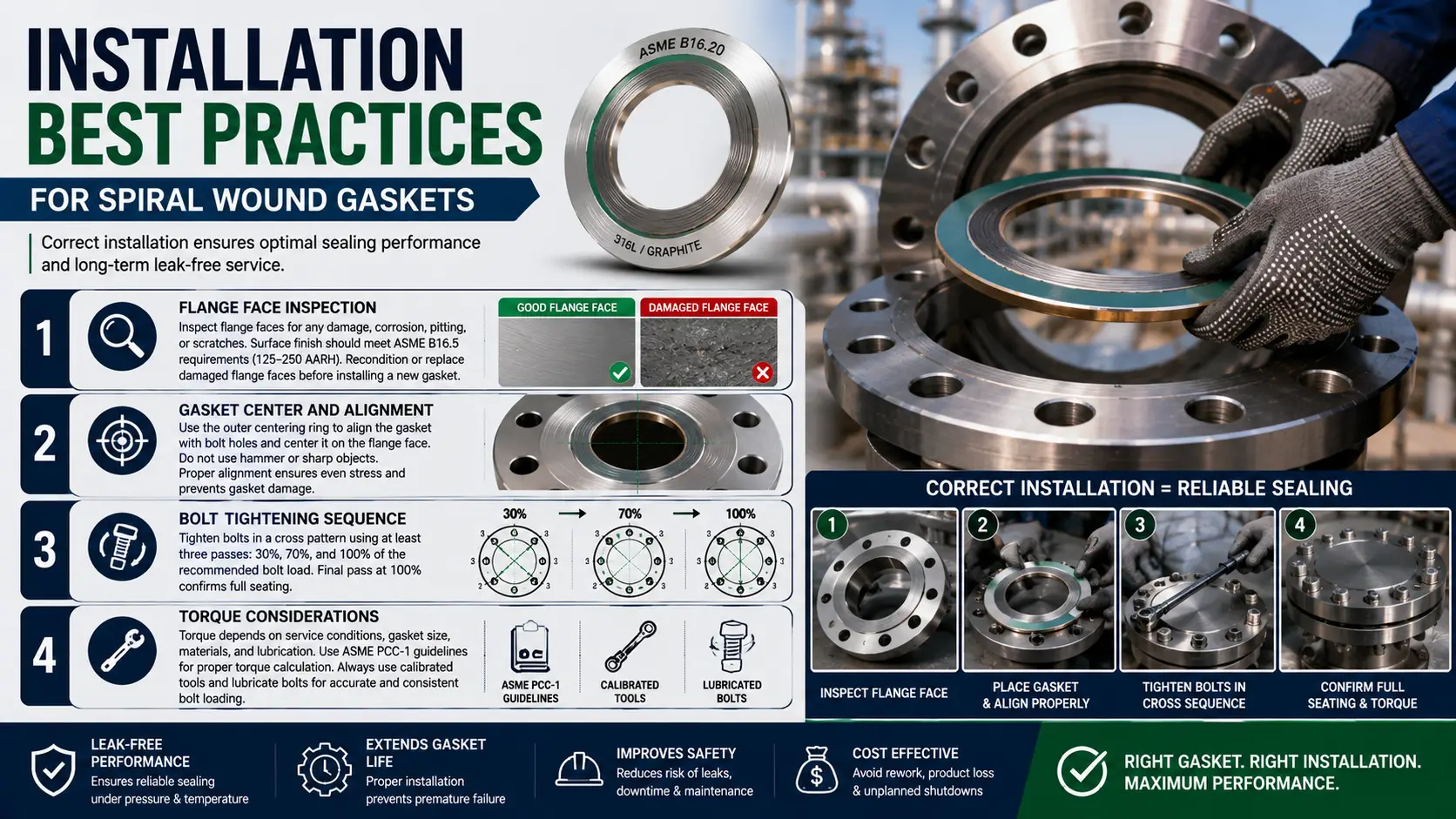
Correct installation is as important as correct gasket selection. Most gasket leaks due to a spiral wound gasket have been due to installation mistakes, not gasket faults. A carefully designed installation method will eliminate the most frequent sources of failure in the early life of a joint.
Flange Face Inspection
Examine flange faces prior to assembly. The flange face should be free of corrosion pitting, tool marks or radial scratches. Raised-face flanges specified by ASME B16.5 have a surface finish requirement of 125–250 AARH (Arithmetic Average Roughness Height). Flange faces that have been damaged must be reconditioned or replaced with a new flange gasket before installing a new flange gasket. Do not over-torque the bolts to compensate for a damaged flange face.
Gasket Center and Alignment
Use the outer centering ring to align the flange face with the bolt holes and install the spiral wound gasket in the center of the flange face. Do not position gasket using a hammer or sharp objects. Under bolt load, misaligned gaskets result in uneven stress on the gasket surface, reducing the sealing performance and jeopardizing the gasket winding.
Bolt Tightening Sequence
Use a calibrated torque wrench or hydraulic bolt tensioner to apply bolt loads step by step. Complete at least three passes of cross-bolting (opposite bolts) at 30%, 70%, and 100% of the indicated bolt load. A last pass at 100% torque will confirm full seating. Do not apply full torque in one stroke as this will cause gasket loading to be uneven and potential over loading on one side of the flange.
Torque Considerations
The torque for a bolt assembly with a spiral wound gasket is dependent on the service conditions, gasket size, the material and lubrication of the bolts. Torque values in ASME PCC-1 (Guidelines for Pressure Boundary Bolted Flange Joint Assembly) are a commonly referenced method of calculating and applying torque. Install bolts with calibrated torque wrenches and lubricate with thread lubricant (antisize or approved gasket lubricant) to ensure consistent and accurate bolt loading.
Common Causes of Gasket Failure
This knowledge of the reasons behind the failure of flange gasket Bangladesh installations helps maintenance engineers and procurement teams to avoid reoccurring leakage issues and the unnecessary maintenance costs that arise from them.
Reusing Old Gaskets: Don't reuse old gaskets with spiral wound when the flange is disassembled. The stress introduced during first seating, adversely affects the sealing performance when reattached. Always use a new gasket.
Incorrect Bolt Torque: Not enough gasket seating stress is generated. Excessive torque can deform the gasket winding resulting in permanent deformation and loss of sealing ability. In both cases the leakage results. Always use calibrated equipment, and always follow specified torque values.
Wrong Filler Selection: Failure to select the right filler in an oxidizing acid service can cause the degradation of the filler and loss of sealing – for example a graphite-filled gasket in a strongly oxidizing acid or a PTFE-filled gasket when operating outside of the gasket's temperature limit. Select filler material for the process media and operating temperature.
Damaged Flange Faces: Any radial scratches, pits or corrosion on flange faces will allow gasket to leak for any amount of bolt load. The condition of flange faces should be checked before each gasket installation.
Improper Storage: If not properly stored, the spiral wound gasket edges can be damaged, the metal strip can be corroded or the filler material can become contaminated. Store gaskets in a clean, dry place out of direct sunlight and solvents, in original packaging, stored horizontally.
Ignoring Standards: Failure to procure gaskets with the appropriate Standards markings or material certificates (ASME B16.20 or EN 10204 level 3.1) denies the engineering guarantee that the gasket will meet its rated specifications. Always check standards compliance prior to procurement.
Preventive Maintenance Recommendations
Flanged joint proactive maintenance helps to minimize unplanned leakage events and helps to maximize the operating life of a piping system. The below recommendations apply to plant maintenance personnel that maintain plants with spiral wound gaskets Bangladesh installations in process facilities.
Schedule Inspection at Every Turnaround: Plan to inspect all critical flanged joints during scheduled maintenance shutdowns. Inspect for any leaks, rust, and/or gasket extrusion that indicate failure of the sealing.
Replace Gaskets at Every Flange Opening: Do not reuse a gasket. As a routine expense of every flange maintenance job, budget for gasket replacement.
Verify Bolt Condition: Check bolts and nuts for thread damage, corrosion and stretch before reusing. New, approved bolts should be used for each reassembly of critically loaded bolts.
Maintain a Critical Spare Parts Inventory: Ensure minimum parts stock of popular gasket pressure classes and size is carried, avoiding the possibility of unplanned downtime due to extended procurement.
Document Gasket Installations: Record Gasket Specifications, batch numbers, installation dates, torque values applied and identifier of the person installing on all critical flanges for document gasket installations. This will help with root cause analysis if there is a future leak.
Why Work With an Industrial Procurement Partner
Record Gasket Specifications, batch numbers, installation dates, torque values applied and identifier of the person installing on all critical flanges for document gasket installations. This will help with root cause analysis if there is a future leak.
Standards Compliance Assurance: Experienced procurement partners ensure that all gaskets are supplied with compliant markings, EN 10204 3.1 material test certificates and are compliant with the ASME B16.20 standard.
Multi-Brand Access: Spiral wound gaskets are made by a variety of industrial brands, such as Flexitallic, Garlock, KLINGER, Lamons, Teadit, and others, all of which are compliant with ASME B16.20. Independent procurement partners offer access to various brands, according to technical suitability and specification requirements, without tying up buyers to a particular manufacturer's product range.
Technical Selection Support: Gasket engineering expertise is provided by procurement specialists to ensure the correct configuration, metal grade, filler material and pressure class for each application is selected before placing an order, avoiding costly specification errors.
Import Documentation: Industrial sealing products are delivered to industries throughout Bangladesh through the reliable import documentation and customs coordination, along with logistics management, from Chattogram Port.
Emergency Supply Capability: The Emergency Supply Capability component involves having established procurement networks that can provide quick delivery of critical items of gasket stock when plant maintenance requires them before standard delivery periods.
Frequently Asked Questions
What is a spiral wound gasket?
A spiral wound gasket is a semi-metallic sealing component manufactured from alternating layers of profiled metal strip (typically stainless steel) and soft filler material (graphite or PTFE), wound spirally and installed between pipe flanges to prevent leakage in high-pressure and high-temperature piping systems.
What is ASME B16.20?
ASME B16.20 is the American Society of Mechanical Engineers standard that specifies the dimensions, materials, marking requirements, and performance criteria for metallic gaskets used with pipe flanges. It covers spiral wound gaskets and ring type joint gaskets for ASME Class 150 through Class 2500 flanged connections. Compliance with ASME B16.20 is mandatory on most oil and gas and process piping projects.
Are spiral wound gaskets reusable?
Never re-use a spiral wound gasket after flange disassembly. During initial installation, the windings layers are permanently stressed by the seating stress applied. A leaking joint re-gasketed on a re-opened joint will not seal as well and will be more likely to leak. When reassembling a flanged joint always use a new gasket.
Which filler material should I choose?
Use graphite filler for steam service, hydrocarbon process lines and general oil and gas applications at temperatures over 260°C. Use PTFE filler for acidic, alkaline and highly corrosive chemical media and for clean water and food processing applications. If temperature is greater than 450°C, in inert or reducing atmospheres, use ceramic or mica.
What is the difference between RTJ and spiral wound gaskets?
Ring type joint (RTJ) gaskets are solid metal rings (oval or octagonal cross section) which fit into a precision-machined groove on ring joint flange faces. These are usually employed in very high temperature and high pressure applications. Spiral wound gaskets can be used with raised face, tongue and groove and male and female flange faces and are the most frequently specified gasket for general process piping in the oil and gas sector in Bangladesh.
How long do spiral wound gaskets last?
The service life is also related to the operating pressure, temperature cycling, media aggressiveness, installation quality and maintenance. If properly installed and operated, spiral wound gaskets can last for many years. But, always replace flanged gaskets when opening the flanged joints in maintenance work, regardless of the apparent flanged gasket condition.
How do I identify genuine compliant spiral wound gaskets?
ASME B16.20 spiral wound gaskets have permanent laser or color coded marking for the manufacturer, gasket material, winding metal, filler type, pressure class and flange standard. Such markings must be checked upon receipt. Also, ask the supplier to provide material test certificates in accordance to EN 10204 3.1 to verify chemical composition and mechanical properties of the winding material.
Where can I source spiral wound gaskets in Bangladesh?
Certified spiral wound gasket Bangladesh is obtainable by buying from industrial procurement partners that are importing gaskets from known manufacturers from other countries that meet the ASME standards. For choosing a spiral wound gasket supplier in Bangladesh ensure their capability to supply ASME B16.20 compliant products, material certificates as per EN 10204 level 3.1, dimensional inspection report and logistics support with Chattogram port.
Conclusion
In the oil and gas, petrochemical, power generation, and industrial processing industries in Bangladesh, spiral wound gaskets Bangladesh are a critical category that affect plant security and operational performance from the accuracy of the technical specification, compliance with standards, and the reliability of suppliers.
The proper gasket configuration, metal winding grade and filler material for the service condition, with the assurance that the ASME B16.20 compliance and complete material traceability documentation is present, is the critical step that makes flange sealing a reliable, long-life process, rather than a maintenance headache.
Our team is able to offer independent industrial procurement Malaysia — and throughout the wider South Asia region, including Bangladesh — for certified industrial gasket Bangladesh as well as complete sealing solutions, assisted with technical selection, full documentation and reliable logistics, for projects in the oil and gas, petrochemical, power and process industries.
Communicate with Our Specialists – Gasket Selection & Procurement Support
Our team can provide your with professional advice on selecting the right gaskets for your project, gasket material compatibility, ASME standards and a free, no-obligation quotation for your spiral wound gasket needs.