Stainless Steel Fasteners Sudan: Industrial Supply Guide for Reliable Performance
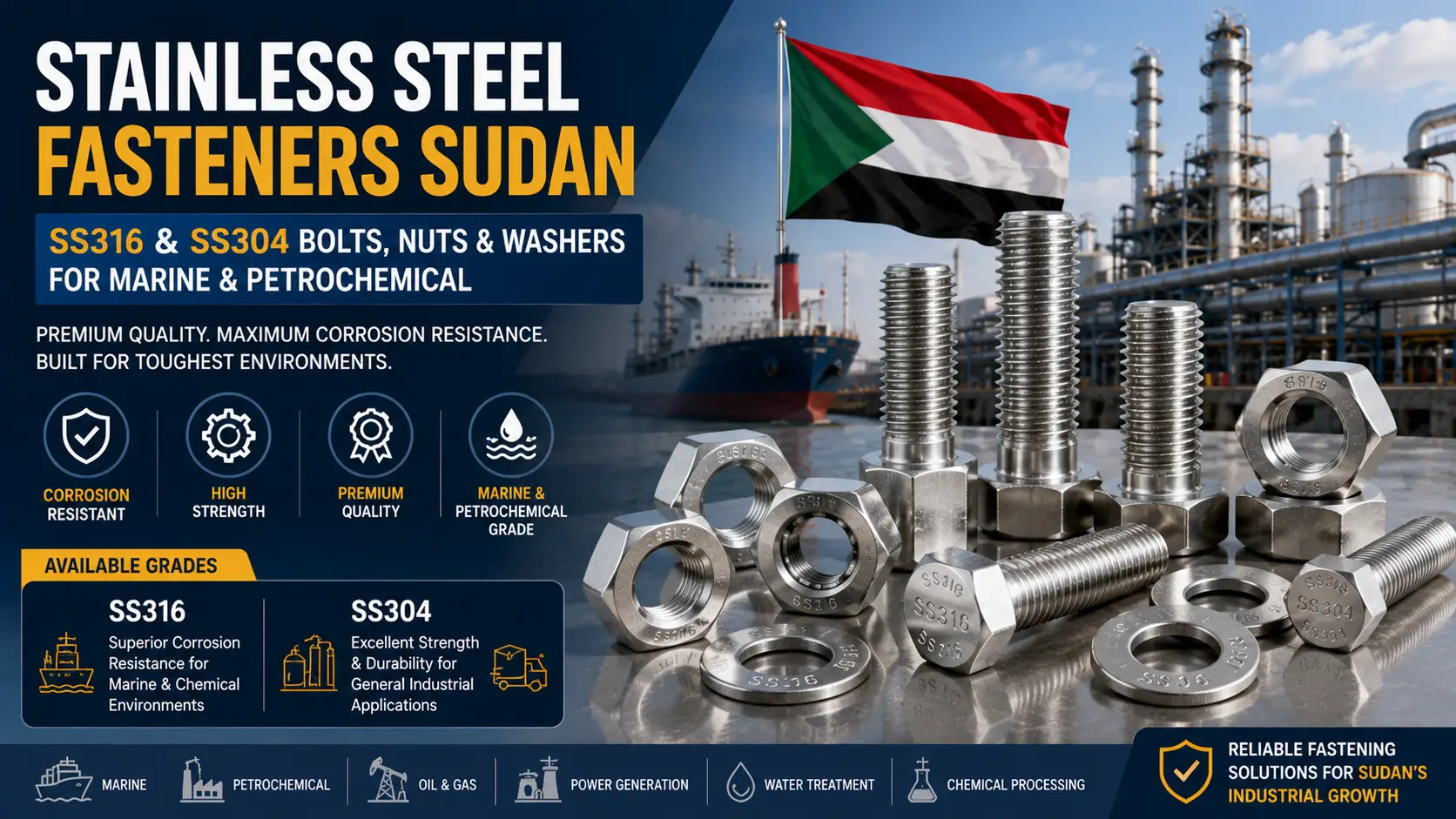
Industries all over Sudan rely on stainless steel fasteners Sudan to ensure the critical infrastructure they rely on runs smoothly in harsh environments. Whether it's on the Red Sea coast, Khartoum's building frenzy or the oil fields extending far south, stainless steel fasteners provide the corrosion resistance, strength and durability that industrial applications demand. It is important to select a grade, standard and type of fastener that will yield optimum structural reliability and lower maintenance costs in all applications.
Request a Quote — Certified Stainless Steel Fasteners for Sudan. Our procurement team will assist you in getting compliant fasteners from our sources along with the complete documentation. Contact us today.
What Are Stainless Steel Fasteners?
Stainless steel fasteners (screws, nuts, washers, threaded bolts, threaded rods, etc.) are machine parts made of stainless steel alloys with excellent corrosion resistance. Their most characteristic feature is the chromium content of at least 10.5 %. This chromium forms a passive layer on the surface and protects the base material from rust even under harsh outdoor conditions and industrial environments.
Stainless steel fasteners are not susceptible to corrosion like carbon steel fasteners are in wet, marine, and corrosive environments. This makes them a top choice in construction, oil & gas, water treatment, and manufacturing in Sudan.
The World Stainless Association reports that stainless steel manufacturing worldwide saw a total production of over 62 million metric tones in 2024, indicating strong demand for stainless steel in various sectors around the world, including industrial, infrastructure, marine, and energy. This strong worldwide supply guarantees the availability of certified, specification grade fasteners to Sudan buyers.
Benefits of Stainless Steel Fasteners specification-grade
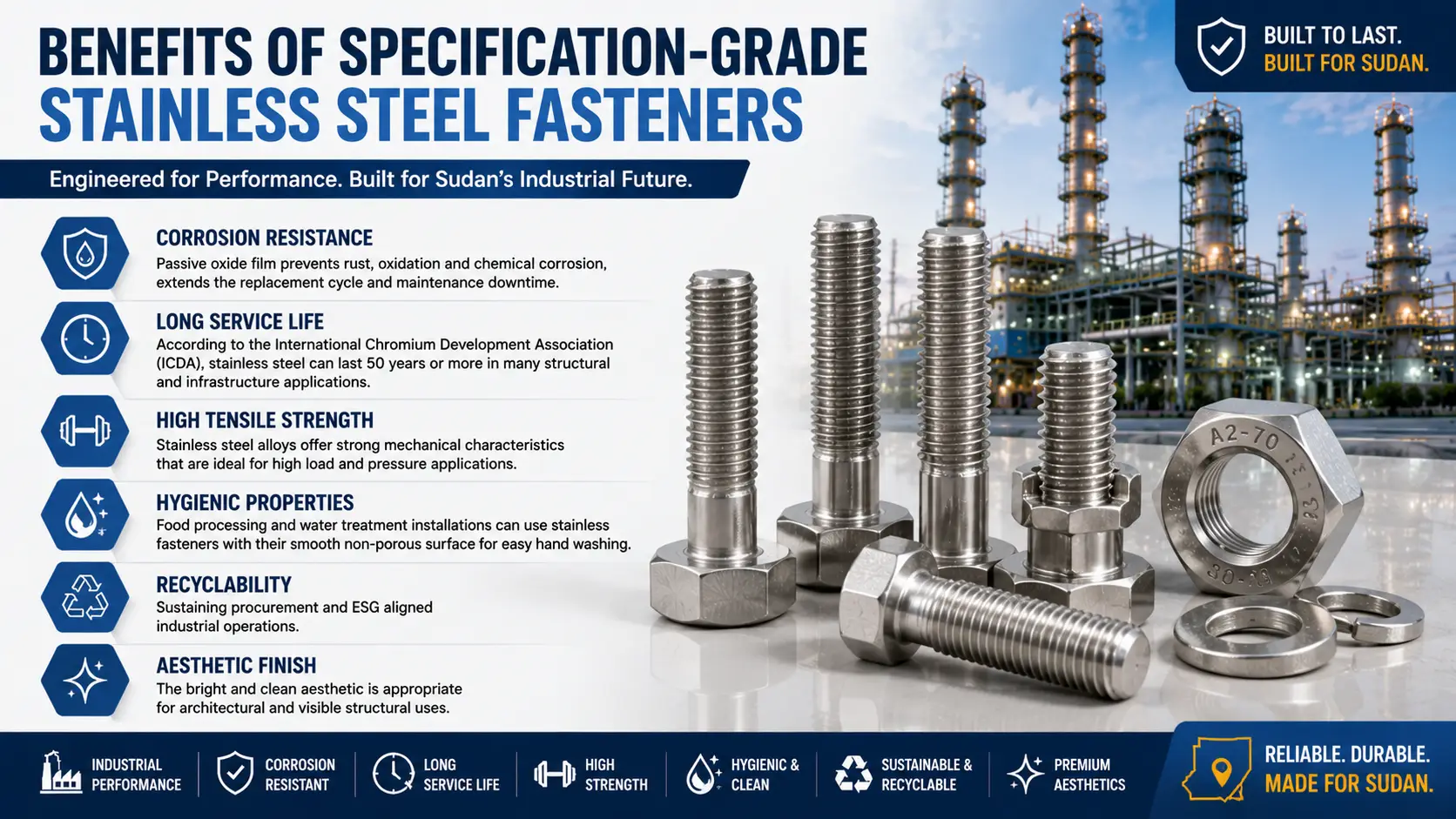
The use of stainless steel fasteners for industrial projects in Sudan comes with a number of performance and economic benefits:
Corrosion Resistance: Passive oxide film prevents rust, oxidation and chemical corrosion, extends the replacement cycle and maintenance downtime.
Long Service Life: According to the International Chromium Development Association (ICDA), stainless steel can last 50 years or more in many structural and infrastructure applications.
High Tensile Strength: Stainless steel alloys offer strong mechanical characteristics that are ideal for high-load and pressure applications.
Hygienic Properties: Food processing and water treatment installations can use stainless fasteners with their smooth, non-porous surface for easy hand washing.
Recyclability: Sustaining procurement and ESG-aligned industrial operations.
Aesthetic Finish: The bright and clean aesthetic is appropriate for architectural and visible structural uses.
Types of Stainless Steel Fasteners
Industrial, construction and special stainless steel fasteners come in a variety of types for use in all parts of Sudan. Each type has its advantages and disadvantages, and learning about them is important for procurement teams to write the correct specifications for each project.
Hex Bolts
Stainless steel hex bolts are one of the most popular fasteners used in industrial construction and structural applications. They can be found in full-thread and partial-thread options, and are ideal for general-purpose bolting on steel structures, industrial equipment, and infrastructure.
Stud Bolts
Stud bolts are the fully threaded rods that are used to connect flanges in pressure piping, oil refinery equipment and process plant installations, made of stainless steel. They are typically ordered to ASTM A193 B8 and B8M standards to be used in corrosive and high-temperature applications.
Anchor Bolts
Structural steel/machinery bases, equipment bases, and machinery are anchored to concrete foundations with stainless steel anchor bolts. They are utilized in industrial plants, powerhouses and commercial building projects throughout Khartoum and Port Sudan and throughout Sudan's growing infrastructure industry.
Socket Head Cap Screws
Precision assemblies, machinery and equipment that need a hex key drive and for those that cannot be installed in a larger space. They offer a high tensile strength and small head size, which are ideal for manufacturing and maintenance.
Machine Screws
Machine screws used to attach parts to the enclosures of electrical equipment, HVAC systems, control panels and light mechanical assemblies are generally made from stainless steel. It comes in several types of heads, such as a pan head, a flat head and a round head.
Nuts and Washers
Stainless steel nuts Sudan and stainless steel washers Sudan work in conjunction with the bolt assemblies to distribute the load and to prevent vibration and loosen between joints. They come in various shapes such as hex nuts, heavy hex nuts, flange nuts, flat washers and spring washers, and are typically made in SS304 and SS316.
Threaded Rods and U-Bolts
Threaded rods can be used for a wide range of applications, including the attachment of suspended equipment, pipe supports, and structural connections. Pipework, cable trays, and cylindrical structural components are secured in place reliably by U-bolts in many different industrial applications.
Related Reading: See our Industrial Fasteners pillar page for a wider range of information on industrial fastening solutions. For high-strength bolting, see our guide on High Tensile Fasteners.
Stainless Steel Grades Explained
The most important choice you can make when purchasing stainless steel fasteners in Sudan is the grade you choose. Corrosion resistance, mechanical strength, suitability for specific environments, and compliance with project specifications are determined by the grade.
Property | SS304 | SS316 | Duplex SS2205 |
Chromium Content | 18% | 16–18% | 22% |
Molybdenum | None | 2–3% | 3% |
Corrosion Resistance | Good | Excellent | Superior |
Chloride Resistance | Moderate | High | Very High |
Tensile Strength | ~515 MPa | ~515 MPa | ~620 MPa |
Typical Applications | General industrial | Marine, chemical | Offshore, oil & gas |
Common ASTM Standard | ASTM F593 | ASTM F593 / A193 B8M | ASTM A182 F51 |
SS304 (Grade 304): SS304 is the most widely used stainless steel grade, and is suitable for general industrial, construction and manufacturing applications due to its corrosion resistance. It is suitable for most indoor and mild outdoor uses in Sudan, but not recommended for use in coastal and highly chloride-exposed areas.
Grade 316 SS316: SS316 is a 2-3% molybdenum content grade for added resistance to chloride corrosion and pitting. It's the standard grade for marine projects, coastal projects, chemical processing and oil & gas projects. Offshore installations and procurement teams based close to Sudan's Red Sea coast always request SS316 fasteners for marine use Sudan.
Duplex Stainless Steel (2205): These steel grades have a mixed austenitic and ferritic microstructure, resulting in high tensile strength and resistance to stress cracking corrosion. They are used in demanding environments where conventional austenitic steels are not sufficient, such as Offshore installations, deep sea and petrochemical plants, where long-term stability is critical.
International Standards and Certifications
The addition of internationally recognized standards is a critical part of guaranteeing the stainless steel fasteners satisfy engineering specifications, inspection, and documentation standards. The most common fastener procurement scenarios in Sudan are summarized below.
Standard | Scope | Application |
ASTM A193 | Alloy and stainless steel bolting for high-temperature service | Refineries, pressure vessels, flanged joints |
ASTM A194 | Nuts for high-pressure and high-temperature service | Paired with ASTM A193 bolts |
ASTM F593 | Stainless steel bolts, hex cap screws, studs | General industrial fasteners |
ASTM F594 | Stainless steel nuts | General industrial nuts |
ISO 3506 | Mechanical properties of stainless steel fasteners | International procurement, food, construction |
DIN 931 / DIN 933 | Hex bolts, partially and fully threaded | European-standard projects |
ASME B18.2.1 | Square and hex bolts and screws | ASME pressure systems |
Technical standards in Sudan are regulated by the Sudanese Standards and Metrology Organization (SSMO), and procurement teams are responsible for checking how well the suppliers' documentation matches the applicable International standard (as called for in project specifications) and SSMO.
Industrial Applications in Sudan
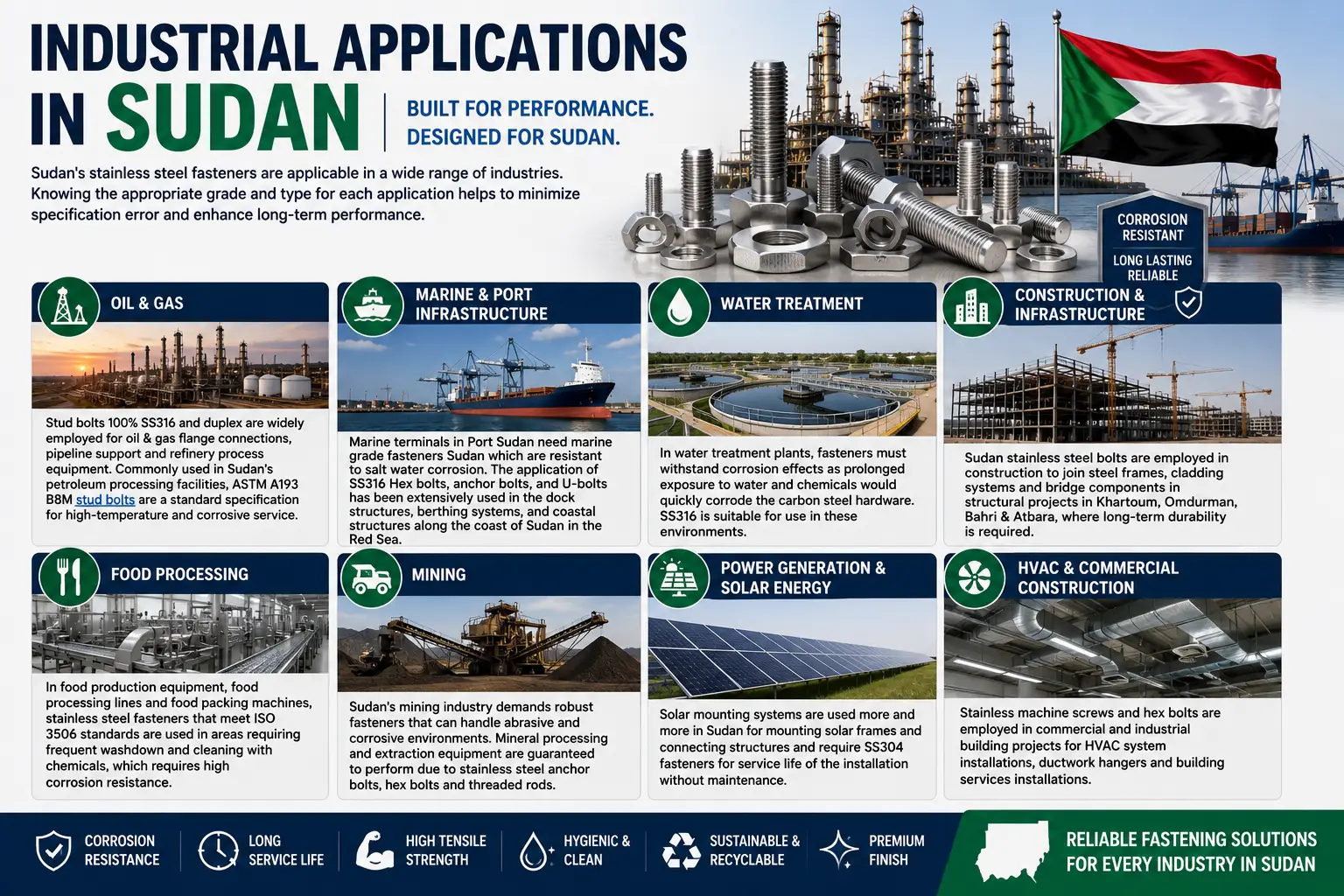
Sudan's stainless steel fasteners are applicable in a wide range of industries. Knowing the appropriate grade and type for each application helps to minimize specification error and enhance long-term performance.
Oil & Gas: Stud bolts 100% SS316 and duplex are widely employed for oil & gas flange connections, pipeline support and refinery process equipment. Commonly used in Sudan's petroleum processing facilities, ASTM A193 B8M stud bolts are a standard specification for high-temperature and corrosive service.
Marine & Port Infrastructure: Marine terminals in Port Sudan need marine grade fasteners Sudan which are resistant to salt water corrosion. The application of SS316 Hex bolts, anchor bolts, and U-bolts has been extensively used in the dock structures, berthing systems, and coastal structures along the coast of Sudan in the Red Sea.
Water Treatment: In water treatment plants, fasteners must withstand corrosion effects as prolonged exposure to water and chemicals would quickly corrode the carbon steel hardware. SS316 is suitable for use in these environments.
Construction & Infrastructure: Sudan stainless steel bolts are employed in construction to join steel frames, cladding systems and bridge components in structural projects in Khartoum, Omdurman, Bahri & Atbara, where long-term durability is required.
Food Processing: In food production equipment, food processing lines and food packing machines, stainless steel fasteners that meet ISO 3506 standards are used in areas requiring frequent washdown and cleaning with chemicals, which requires high corrosion resistance.
Mining: Sudan's mining industry demands robust fasteners that can handle abrasive and corrosive environments. Mineral processing and extraction equipment are guaranteed to perform due to stainless steel anchor bolts, hex bolts and threaded rods.
Power Generation & Solar Energy: Solar mounting systems are used more and more in Sudan for mounting solar frames and connecting structures and require SS304 fasteners for service life of the installation without maintenance.
HVAC & Commercial Construction: Stainless machine screws and hex bolts are employed in commercial and industrial building projects for HVAC system installations, ductwork hangers and building services installations.
How to Choose the Right Stainless Steel Fastener
Appropriate material choice guarantees that failures don't happen too early, leads to lower maintenance expenses, and helps to ensure that the systems meet regulatory requirements. When ordering stainless steel fasteners for any project in Sudan, adhere to these steps.
Step 1: Define the Operating Environment
Take moisture and chlorides, chemicals, temperature and mechanical loads into consideration. The coastal and marine environment, around Port Sudan, requires minimum SS316. Consider SS304 for interior and sheltered industrial applications where cost is a consideration.
Step 2: Select the Correct Grade
Choose the appropriate grade of fastener based on the application's mechanical and corrosion conditions. SS304 is economical for industrial applications. Use SS316 or duplex grades for marine, offshore and chemical service.
Step 3: Specify the Applicable Standard
Verify the required standard with the engineering staff. The most widely used industrial fastening specifications for ASTM stainless steel fasteners are A193, F593, and A320, the Sudan specifications. When international interoperability is desired, ISO 3506 applies.
Step 4: Verify Certifications and Traceability
Ask suppliers to deliver the following: Mill Test Certificates (EN 10204 3.1), Heat Number Traceability and Inspection Document. This is particularly important in the oil & gas, pressure vessel and infrastructure sectors where verification of materials is a requirement.
Step 5: Confirm Size, Thread, and Drive Type
Stainless steel fasteners come in metric and imperial dimensions, different pitches and the various drives. Check dimensions against project drawings and engineering specifications prior to ordering.
Why Material Traceability Matters
Material traceability confirms that all fasteners supplied are manufactured from a specific source, have a consistent chemistry, meet mechanical specifications and are identifiable by a specific batch number. Traceability is essential for critical applications such as oil & gas, pressure systems, and infrastructure, as it is a quality requirement.
When asking suppliers to provide industrial fasteners to Sudan, procurement teams should ask each supplier to supply the following documentation:
Mill Test Certificate (MTC): these EN 10204 3.1 certificates reinforce that the material has been tested and conforms to the required specifications as well as providing chemical and mechanical test results.
Certificate of Conformity: A Certificate of Conformity is a statement of conformance for the batch of fasteners that are specified, sized and graded.
Heat Number / Lot Number: Unique numbers that enable quick identification of fasteners for the steel heat and mill production.
Dimensional Inspection Report: Proves that the form, head size and tolerances of the thread meet the standard.
Third-Party Inspection (TPI): In critical applications, to provide an extra layer of verification prior to delivery, independent inspection by an accredited body.
International fastener supply chains are increasingly turning to digital Mill Test Certificates and material traceability using QR-codes to provide faster, more reliable material quality verification for procurement teams in Sudan.
Common Mistakes to Avoid
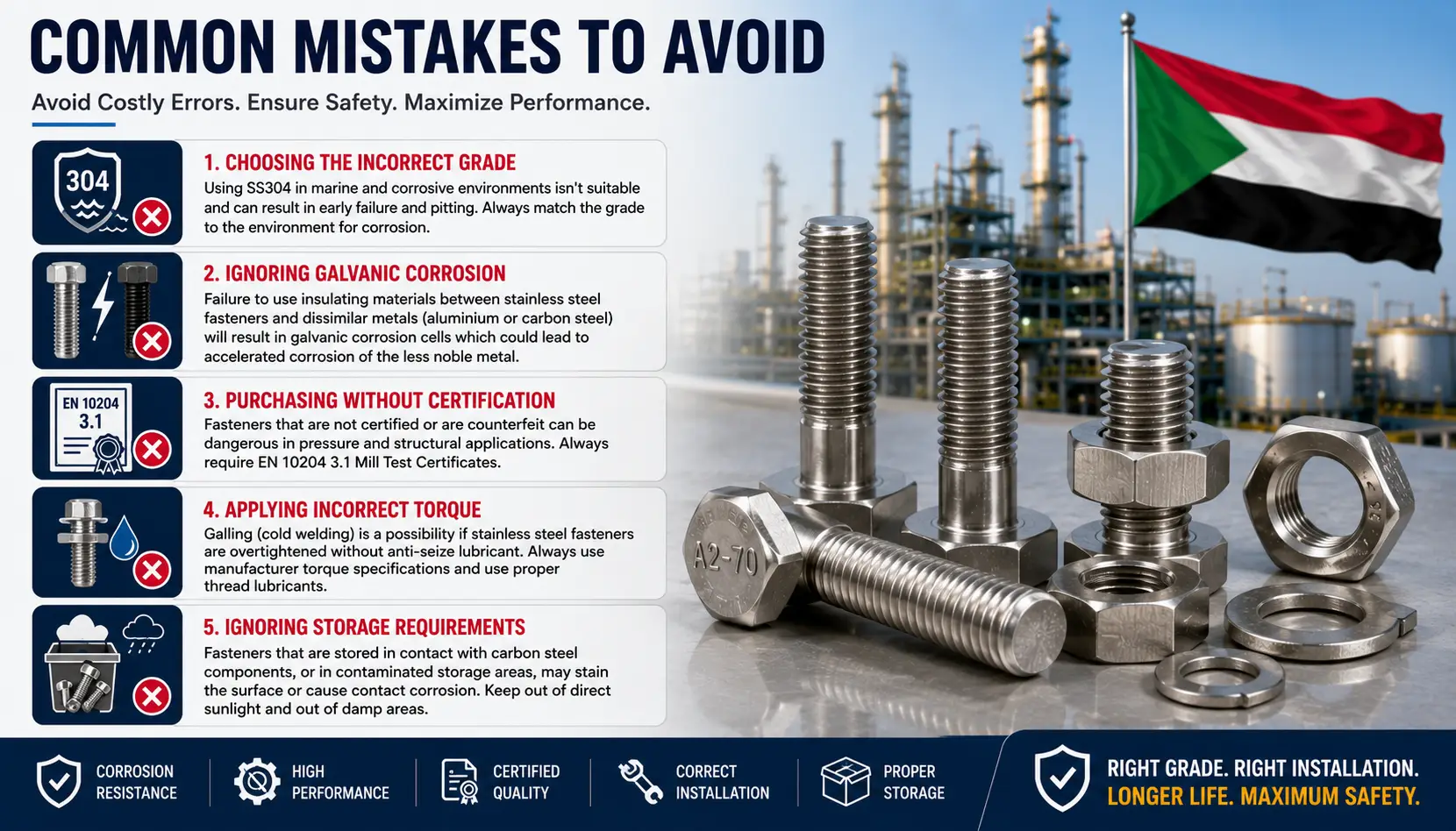
Choosing the Incorrect Grade: Using SS304 in marine and corrosive environments isn't suitable and can result in early failure and pitting. Always match the grade to the environment for corrosion.
Ignoring Galvanic Corrosion: Failure to use insulating materials between stainless steel fasteners and dissimilar metals (aluminium or carbon steel) will result in galvanic corrosion cells which could lead to accelerated corrosion of the less noble metal.
Purchasing Without Certification: Fasteners that are not certified or are counterfeit can be dangerous in pressure and structural applications. Always require EN 10204 3.1 Mill Test Certificates.
Applying Incorrect Torque: Galling (cold welding) is a possibility if stainless steel fasteners are overtightened without anti-seize lubricant. Always use manufacturer torque specifications and use proper thread lubricants.
Ignoring Storage Requirements: Fasteners that are stored in contact with carbon steel components, or in contaminated storage areas, may stain the surface or cause contact corrosion. Keep out of direct sunlight and out of damp areas.
Pro Tips for Procurement Teams
Always Specify EN 10204 3.1 Certificates: International standard certificate format for industrial fasteners. Be specific for each order, no matter what the application.
Verify Heat Number Traceability: At time of receipt, double check heat number details from the MTC with the markings on fasteners. Any differences between the information in the books and in your own text are a warning of poor quality or misrepresentation.
Match Grade to Environment: SS316 will be the baseline for any project close to the Red Sea shores of Sudan and duplex grades should be utilized in highly corrosive chemical service environments and offshore applications.
Use Anti-Seize on Stainless Threads: Anti-seize lubricant is a good idea to apply before installation because it helps to prevent galling, makes future removal easier, and will prolong the life of a threaded connection.
Conduct Periodic Inspections: All fasteners, regardless of their corrosion resistance, will benefit from periodic visual inspections, particularly when working in aggressive environments. Provide regular inspections in maintenance plans.
Frequently Asked Questions
Which stainless steel grade is best for Sudan’s industrial projects?
The molybdenum content and excellent chloride resistance make SS316 suitable for use in coastal, marine and chemical applications. Applications for SS304 include general industrial and sheltered types of construction work where the corrosion environment is not as harsh.
Are stainless steel fasteners rust proof?
Stainless steel fasteners do not prevent corrosion, they only offer a high resistance. A localized surface corrosion may result due to extreme chloride exposure or if passive layer is damaged and does not reform. This risk is greatly reduced by the proper choice of grades and proper installation. significantly mitigate this risk.
What is the difference between SS304 and SS316?
The key difference is that SS316 contains 2-3% molybdenum whereas SS304 does not have molybdenum. The addition greatly enhances the resistance to chloride induced pitting and crevice corrosion and makes SS316 the material of choice for marine, offshore and chemical processing applications.
What is ASTM A193?
ASTM A193 is an ASTM International specification for alloy steel and stainless steel bolt materials. Both B8 and B8M are highly popular refinery and pressure vessel stud bolts, with B8 being Type 304 stainless and B8M being Type 316 stainless.
Can stainless steel fasteners handle high temperatures?
Yes, they are suitable for intermittent use in high temperature applications up to about 870°C for SS304 and 925°C for SS316. Specialist grades, such as 321 or 347, can be used for continuous high-temperature application.
Are stainless steel fasteners magnetic?
The 304 and 316 grades of austenitic stainless steel are generally non-magnetic when in the annealed condition, but can be slightly magnetic when cold worked. Duplex grades, with their ferritic phase content, are more magnetic than their other grades.
How should stainless steel fasteners be stored?
Keep stainless steel fasteners in a clean, dry environment, away from carbon steel surfaces, contaminated surfaces, and water. To avoid contact corrosion and cross-contamination, use separate storage bins or packaging.
What documents should suppliers provide with stainless steel fasteners?
Ask to see Mill Test Certificates (EN 10204 3.1), Certificates of Conformity, heat number traceability documents, dimensional inspection reports, and/or third party inspection certificates as applicable.
Where can I source industrial fasteners for Sudan?
Quality international procurement services may supply certified stainless steel fasteners Sudan, having full documentation, technical support and worldwide shipping. Fasteners are imported from overseas through the Sudan's Port Sudan Free Zone and regional distribution network into the industrial zones and the centeres of Sudan's buying and selling in Khartoum and Omdurman.
Conclusion
The stainless steel fasteners Sudan are a core component in the country's oil & gas, marine, construction, water treatment and manufacturing industries, and are essential for reliable performance. The first major decision in the procurement process is choosing the appropriate grade; whether it be SS304 for general usage, SS316 for marine and chemical applications, or duplex grades for the most extreme offshore applications.
When backed by appropriate grade selection, adherence to ASTM, ISO or DIN standards and commitment to complete material traceability documentation, procurement teams know that their specified fasteners will perform reliably throughout the project's service life.
Our procurement experts can help buyers in all parts of Sudan find trusted international sources for industrial fastener compliance in Sudan, offer technical advice, prepare full certification packages and provide logistics services for the entire world.
Get the complete stainless steel fastener specification checklist — grades, standards, applications, and procurement tips — delivered to your inbox. Request your free copy today.
DISCLAIMER: Z&F Corporation is not affiliated with, authorized by, endorsed by, or acting as an official representative of any manufacturer, brand, or trademark owner referenced on this website. All product names, trademarks, brand names, logos, and manufacturer references are the property of their respective owners and are used solely for identification, reference, and compatibility purposes.