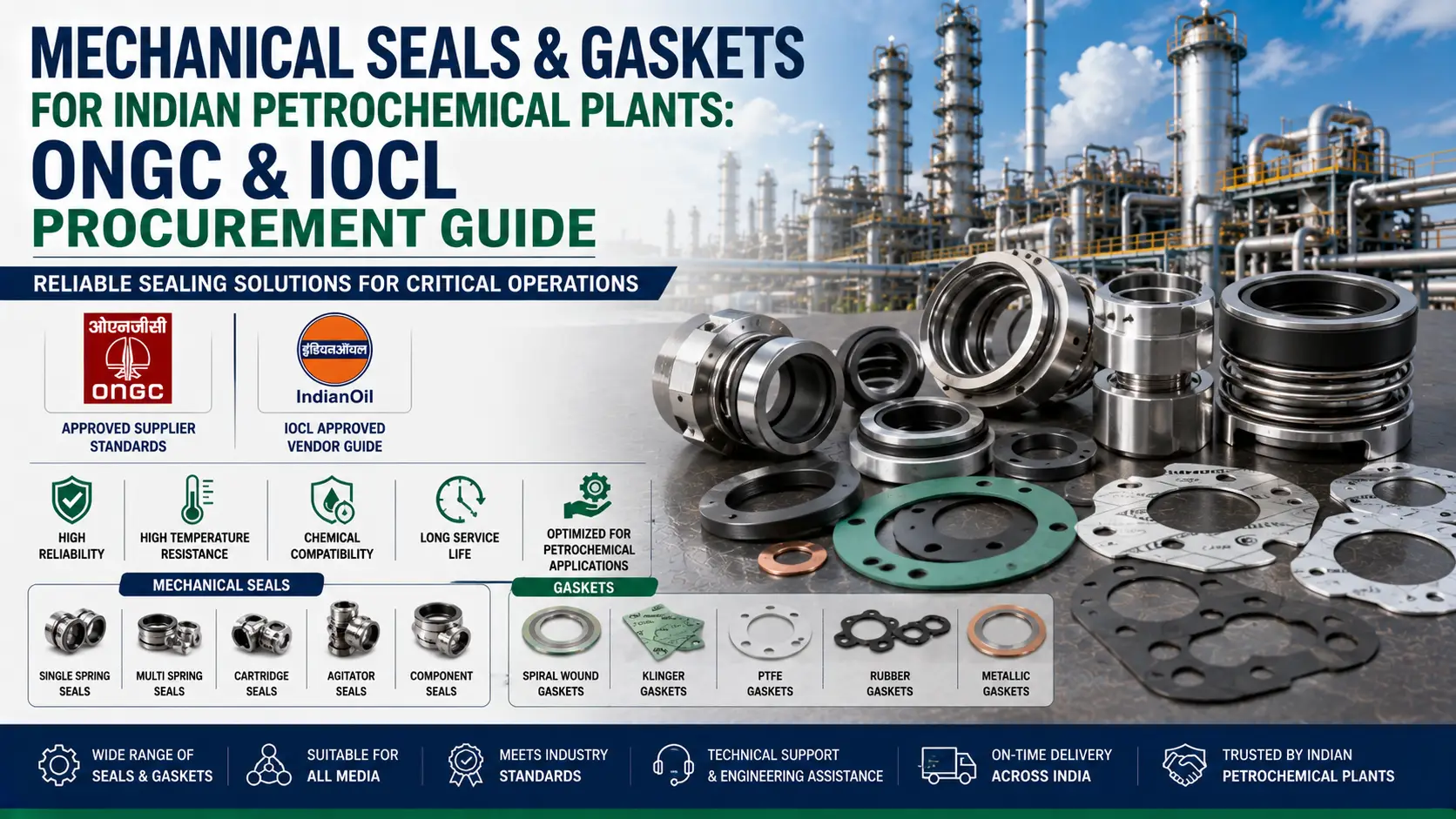
Mechanical Seals & Industrial Gaskets for India's Petrochemical Industry
Ensuring mechanical seals gaskets India petrochemical operations are specified correctly is essential for refineries and processing plants in Jamnagar, Vadodara and throughout the industrial belt in Gujarat to prevent leakage, ensure safety for employees and avoid downtime. From the crude unit where centrifugal pumps operate to the turnaround time when mechanical seals gaskets India are replaced, it is a direct impact on safety, uptime, and fugitive emission compliance that mechanical seal gaskets are sourced from a trustworthy supplier. This guide gives an overview of the many types of seals and gaskets, API standards, ASME standards, material selection criteria, reasons for seal and gasket failure, and an objective engineering approach to assessing suppliers.
Looking for pricing for mechanical seals or gaskets for your plant?
What Are Mechanical Seals?
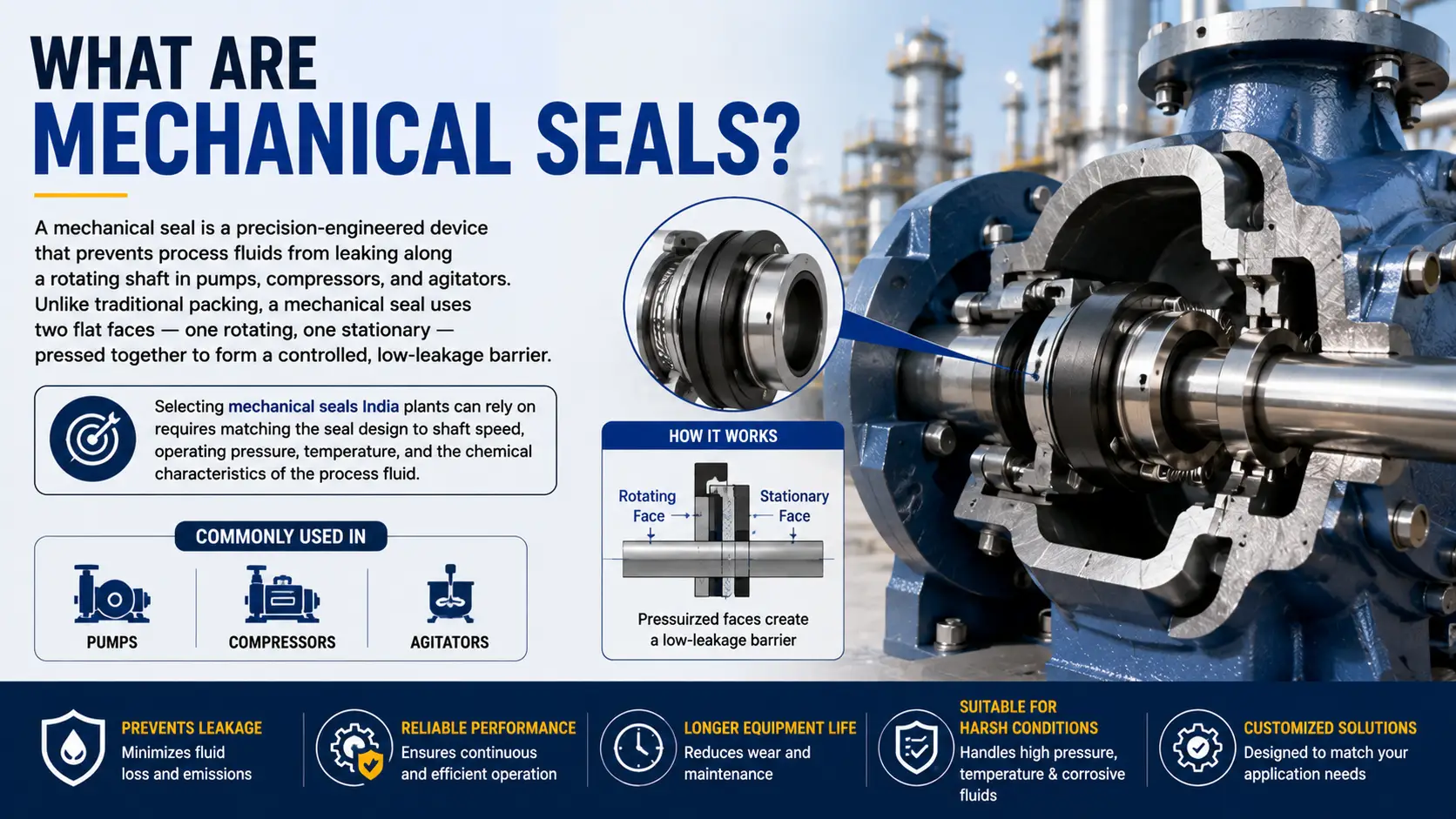
Mechanical seal, a precision-engineered device that stops the leakage of process fluid along the rotating shaft of pumps, compressors and agitators. A mechanical seal is different from the traditional packing method, which is based on two flat faces, one moving and the one stationary, that are pressed together to create a low-leakage barrier. Choosing mechanical seals India plants depends on the type of mechanical seal selected and speed of the shaft, operating pressure, operating temperature and the chemical properties of the process fluid.
Why Mechanical Seals Matter in Petrochemical Plants
Rotating equipment is continuously operated at challenging pressure, temperature and chemical exposure conditions at Petrochemical sites. An ill-fitting or worn seal is not only a maintenance problem, it can cause fugitive emissions, safety issues, and expensive, unplanned shutdowns. That is why petrochemical sealing solutions are no longer purges of routine spare parts but rather, an engineering choice with reliability implications.
Types of Industrial Gaskets
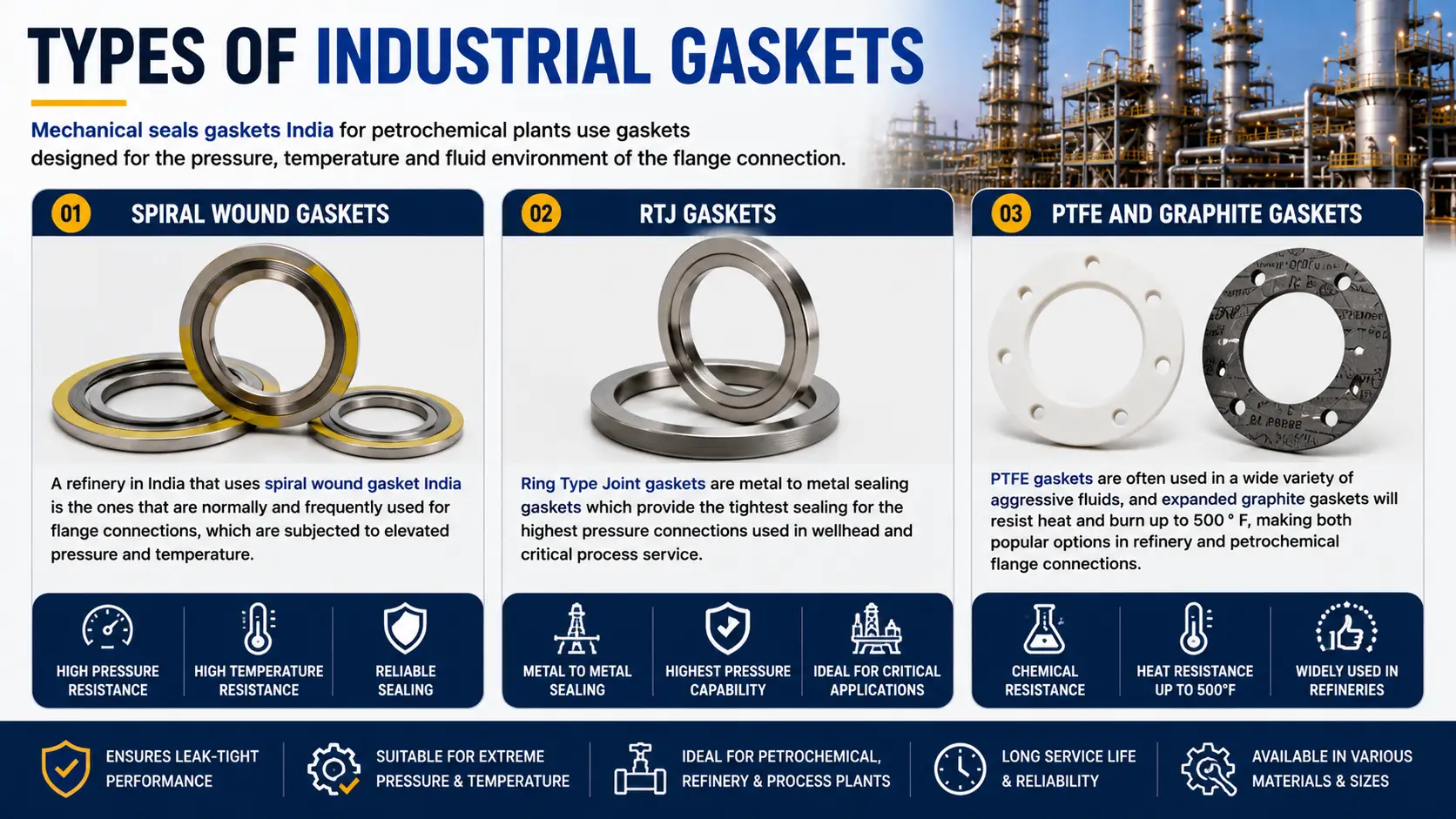
Mechanical seals gaskets India for petrochemical plants use gaskets designed for the pressure, temperature and fluid environment of the flange connection.
Spiral Wound Gaskets
A refinery in India that uses spiral wound gasket India is the ones that are normally and frequently used for flange connections, which are subjected to elevated pressure and temperature.
RTJ Gaskets
Ring Type Joint gaskets are metal to metal sealing gaskets which provide the tightest sealing for the highest pressure connections used in wellhead and critical process service.
PTFE and Graphite Gaskets
PTFE gaskets are often used in a wide variety of aggressive fluids, and expanded graphite gaskets will resist heat and burn up to 500° F, making both popular options in refinery and petrochemical flange connections.
Mechanical Seal Types
For simplicity and hazard level of application, seal configuration should be in accordance:
Cartridge vs Component Seals
Cartridge mechanical seals come pre-assembled on a sleeve, minimizing assembly errors and downtime, whereas component seals are fitted at the site and are more precise.
Single vs Double Mechanical Seals
Single seals are recommended for process fluids in non-hazardous applications with low risks, and double mechanical seals, with a barrier fluid between the two seal faces, are recommended for toxic, flammable, or environmentally sensitive process fluids found in petrochemical services.
Gasket Materials Comparison
Material | Temperature Range | Best Suited For |
PTFE | Up to ~260°C | Aggressive chemicals, broad fluid compatibility |
Expanded graphite | Up to ~450°C+ | High-temperature hydrocarbon and steam service |
Spiral wound (graphite-filled) | Up to ~450°C | High-pressure flange connections, refinery piping |
Metal jacketed | Up to ~500°C+ | Extreme pressure/temperature, heat exchanger service |
API 682 and ASME Standards
When purchasing mechanical seals for API mechanical seal systems for centrifugal pumps in refinery service, buyers should consult API 682, the industry standard for mechanical seal systems for centrifugal pumps in refinery service. Standard flange connections are specified to ensure consistent sealing performance by using gasket dimensions and flange compatibility as defined in ASME B16.20 (metallic and spiral wound gaskets) and ASME B16.21 (non-metallic flat gaskets).
Standard | Scope |
API 682 | Mechanical seal systems for centrifugal pumps in refinery/petrochemical service |
ASME B16.20 | Metallic and spiral wound gaskets for pipe flanges |
ASME B16.21 | Non-metallic flat gaskets for pipe flanges |
ISO/ASTM material specs | Material composition and mechanical property verification |
Applications in Petrochemical Facilities
Mechanical seals gasket demand has been identified in various critical equipment categories within India petrochemicals.
The sealing systems used for pumping in refinery crude and process units are covered.
Pumping sealing systems in the refinery crude and process units are addressed.
Seals for compressors used in the petrochemical processing industry.
Pipeline and heat exchanger flange gasket connections
Chemical processing reactor sealing assemblies
The process pumps at the LNG terminal and offshore oil terminal.
Process pumps at LNG terminal and offshore oil terminal.
The sealing of the chemical injection and dosing system.
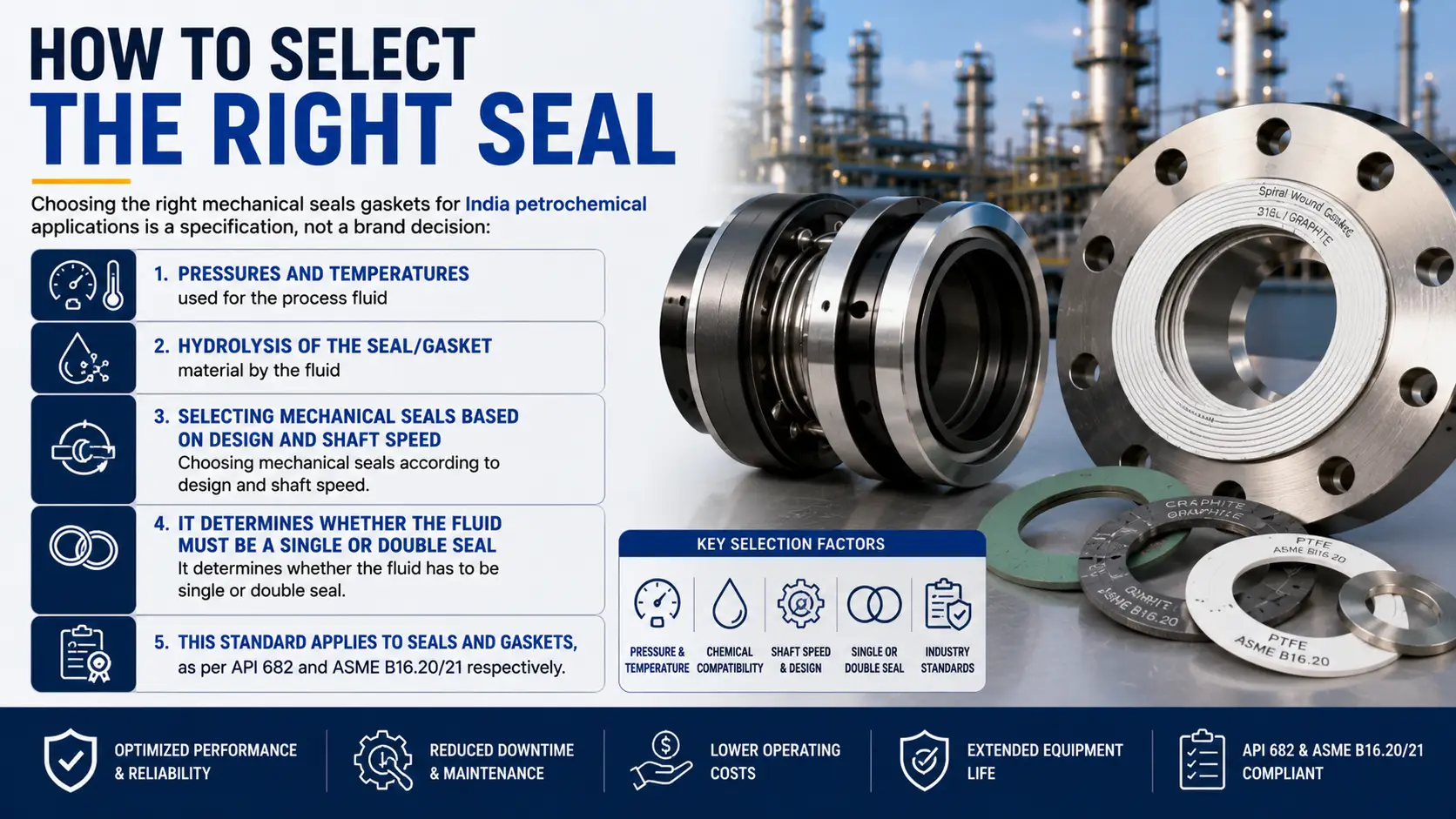
How to Select the Right Seal
Choosing the right mechanical seals gaskets for India petrochemical applications is a specification, not a brand decision:
Pressures and temperatures used for the process fluid
Hydrolysis of the seal/gasket material by the fluid
·Selecting mechanical seals based on design and shaft speed. Choosing mechanical seals according to design and shaft speed.
It determines whether the fluid must be a single or double seal. It determines whether the fluid has to be single or double seal.
This standard applies to seals and gaskets, as per API 682 and ASME B16.20/21 respectively.
Common Failure Causes
Mistakes in the installation/alignment at commissioning
Pump failure due to mechanical, chemical or corrosion issues after just a few hours of operation
Failure to refrain from contamination of the process fluid or barrier fluid system.
Incorrect materials of the chemical or temperature environment
If the flange is leaking, it could be a result of improper torque of the bolts or reused gaskets.
Maintenance Best Practices
The trick to maximizing the life of mechanical seals gaskets in India petrochemical plants begins with a degree of maintenance discipline:
Install flange gaskets according to manufacturer's torque specifications
Do not re-use gaskets after flange disassembly
Check vibration and alignment of sealed rotating machinery
Avoid dirty, polluted installation surfaces
Use data from seal support system to schedule predictive maintenance.
Procurement Considerations
The same due diligence considerations are also applied when sourcing industrial gaskets India plants specify or application-specific engineering support, API 682 or ASME compliance documentation, for mechanical pump seals for rotating equipment. As a primary consideration for determining the sealing performance, compatibility with the pump is covered in our Pumps Article, and information on material comparison and standards for all types of seals is covered in our Gaskets & Seals Pillar resource. If you need sector specific sourcing advice, our Oil & Gas Page includes a section dedicated to sourcing for refinery and petrochemical projects.
Frequently Asked Questions
What is API 682?
API 682 is an industry standard for mechanical seals used in centrifugal pumps used in oil refineries and petrochemical plants.
What is the best gasket material to use with chemicals?
PTFE has a very high resistance to various corrosive chemicals and is commonly used in environments where such liquids are handled.
When do seals need to be replaced?
Replacement depends upon operating conditions, fluid properties and quality of the maintenance services provided, not on a set time schedule.
What causes mechanical seals to leak?
Common causes of seal leaks include improper assembly, slippage, foreign body contamination, vibration, and the choice of the wrong material.
Why do gasket fail?
Sealing problems are usually caused by inadequate screw tightening, damaged sealing surfaces, the choice of the wrong material, and faulty flange alignment.
In which industries mechanical seals are used?
Mechanical seals are used in a variety of industries, including mechanical engineering, oil and gas, pharmaceutical, food processing, chemical, water treatment, and power generation
Can graphite gaskets be used again?
Most industrial gaskets, such as graphite varieties, are created to be utilized just once and are used to guarantee sealing when connections are opened.
What does "cartridge seal" mean?
A cartridge mechanical seal is a pre-assembled mechanical seal on a sleeve that makes easy and reduces risk of set up errors.
Request Mechanical Seal & Gasket Sourcing Assistance
Desperate for mechanical seals gasket India for your petrochemical plants? Our team is independent industrial sourcing experts to help you choose a sealing solution – from different manufacturers – that meets your operating pressure, chemical compatibility and reliability needs for your application and is standards compliant. See related resources for procurement in our Gaskets & Seals Pillar, Pumps Article and Oil & Gas Page.
Know how to specify seals and gasket on your plant.
It is beneficial to chat with our specialist.
DISCLAIMER: Z&F Corporation is not affiliated with, authorized by, endorsed by, or acting as an official representative of any manufacturer, brand, or trademark owner referenced on this website. All product names, trademarks, brand names, logos, and manufacturer references are the property of their respective owners and are used solely for identification, reference, and compatibility purposes.