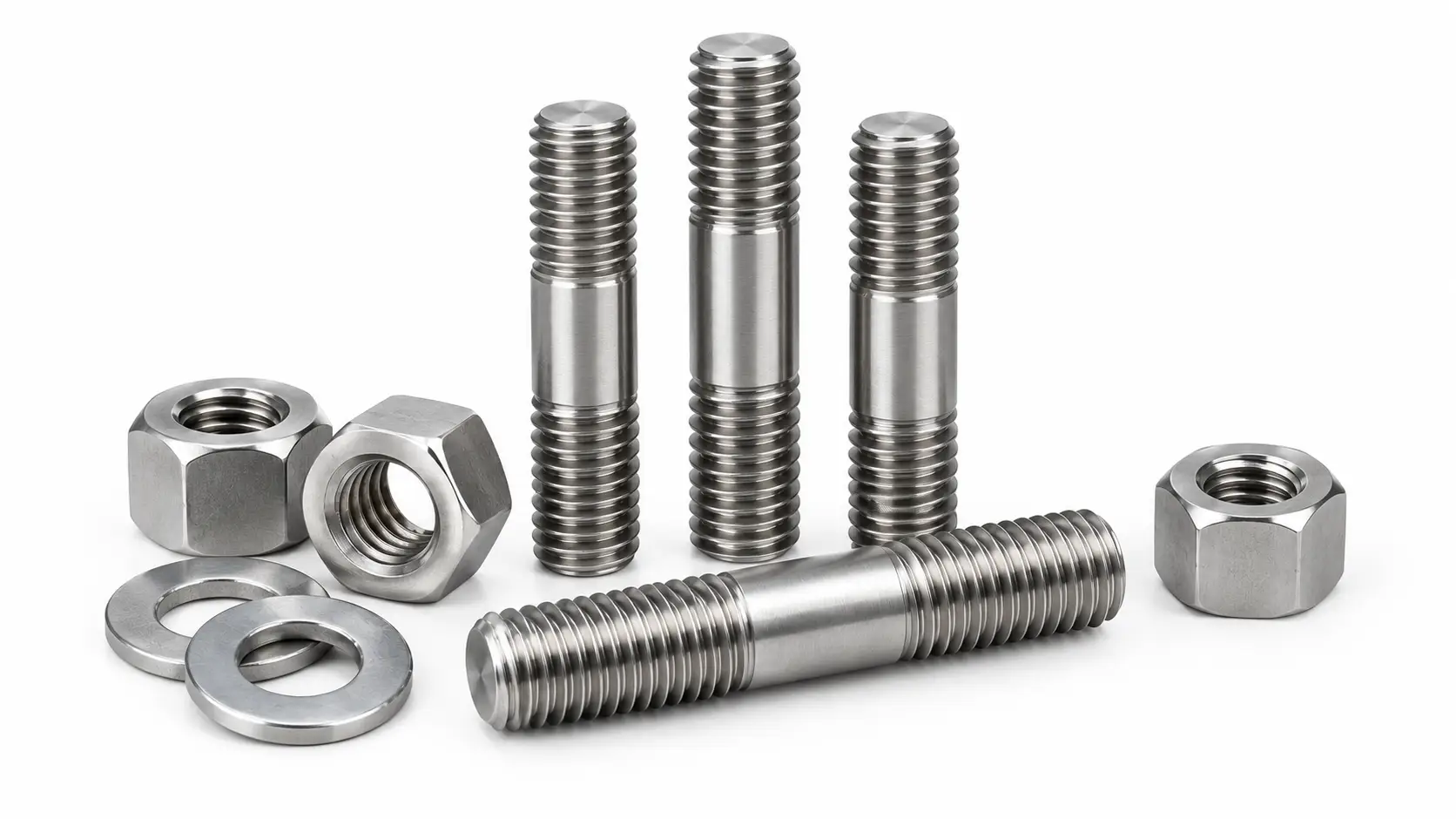
One of the most critical fasteners for any flange connection is the stud bolt, but too often the size of the stud bolt is ordered without considering the other critical parameters. Standards, thread type, material grade, length and coating are also at play in the right selection. This can lead to delays, a leaking joint or rework on site if one of these things is not done correctly. This guide will discuss stud bolts, the size of stud bolts, the materials they use, and which standard they follow, as well as the differences between a stud bolt and a standard bolt or threaded rod. It is written for engineers, maintenance teams and buyers to help them select the right flange bolts and nuts when ordering.
What is a Stud Bolt?
A stud bolt is a rod threaded along its full length, or at both ends, with no head. It passes through the bolt holes of two mating flanges, and a nut is fitted on each end. When the nuts are tightened, the studs stretch slightly and clamp the joint together, compressing the gasket. The stud bolt and nut assembly for flanges normally uses hex nuts or heavy hex nuts, sometimes loosely called flange nuts, chosen to match the stud grade. This arrangement is widely used for bolting in pressure-containing joints.
Stud Bolt Standards & Specifications
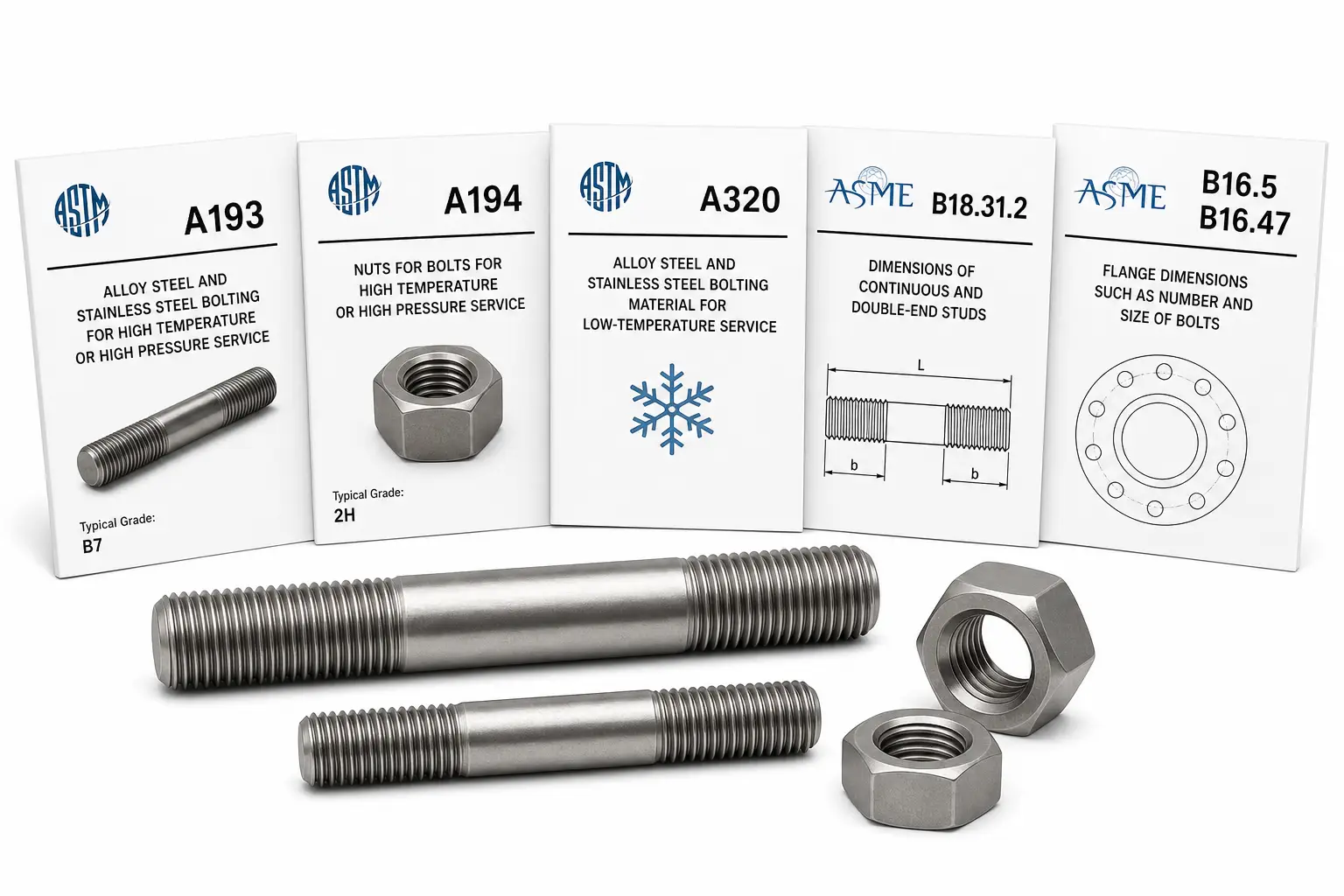
Unless you have the correct specification in your project documents, the dimensions, materials and testing are defined by Standards. Common references include:
ASTM A193: Alloy Stainless steel Bolting for high temp or pressure. One of the more frequently referred to specifications is the ASTM A193 B7 for stud bolts.
ASTM A194: nuts for the same service range, such as Grade 2H heavy hex nuts.
ASTM A320: bolting for low-temperature service.
ASME B18.31.2: dimensions of continuous and double-end studs.
ASME B16.5 and B16.47: Flange dimensions such as number and size of bolts.
Pre-order if necessary, the standard edition along with any additional tests or certification.
Stud Bolt Sizes and Dimensions
Stud sizes for flanged connections are not specified by a single chart; they come from the flange standard, pressure class and nominal pipe size. The number of studs required, their diameter and length are determined by the flange. A list of common thread sizes for flange bolting are given below to identify them on a drawing.
Stud Size | Thread Pitch | Thread Series |
|---|---|---|
1/2 in | 13 threads per inch | UNC |
5/8 in | 11 threads per inch | UNC |
3/4 in | 10 threads per inch | UNC |
7/8 in | 9 threads per inch | UNC |
1 in | 8 threads per inch | UNC / 8UN |
M12 | 1.75 mm | ISO metric coarse |
M16 | 2.0 mm | ISO metric coarse |
M20 | 2.5 mm | ISO metric coarse |
M24 | 3.0 mm | ISO metric coarse |
Refer to the applicable flange standard or approved drawing for the number, length and diameter of the flange studs. Important information for the heavy hex nut dimensions is included in ASME B18.2.2, which should be compared to the nut you purchase.
Types of Stud Bolts
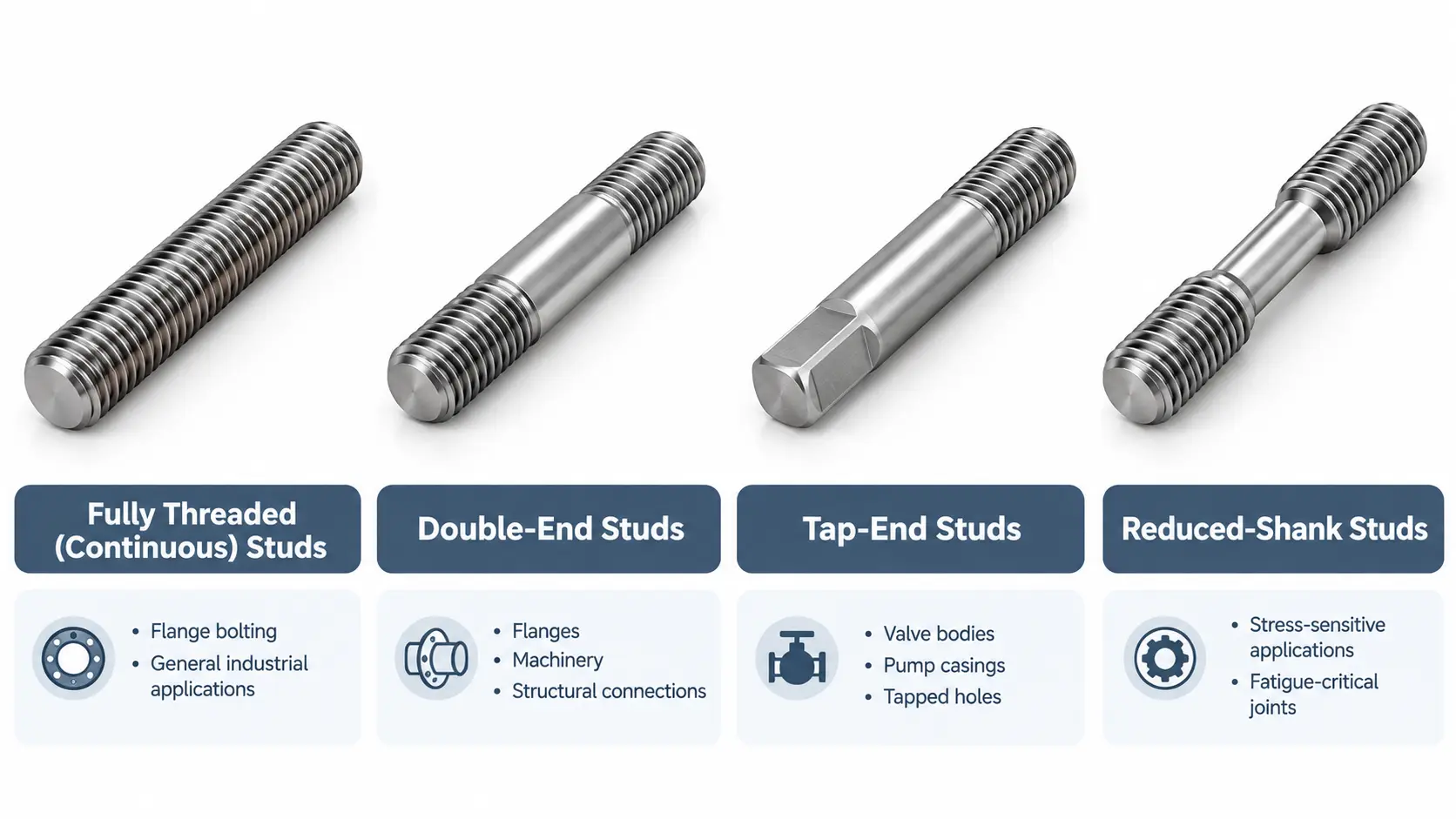
Stud bolts come in several forms:
Fully threaded (continuous) studs: threaded along the whole length, the usual form for flange bolting.
Double-end studs: studs on both ends, with a plain middle part.
Tap-end studs: one end is a screw that fits into a tapped hole, the other end has a nut. Usually found in valve bodies or pump casings.
Reduced-shank studs: smaller machined shank for certain applications which are sensitive to stress or fatigue.
The right type is dependent on the joint design and the project specification.
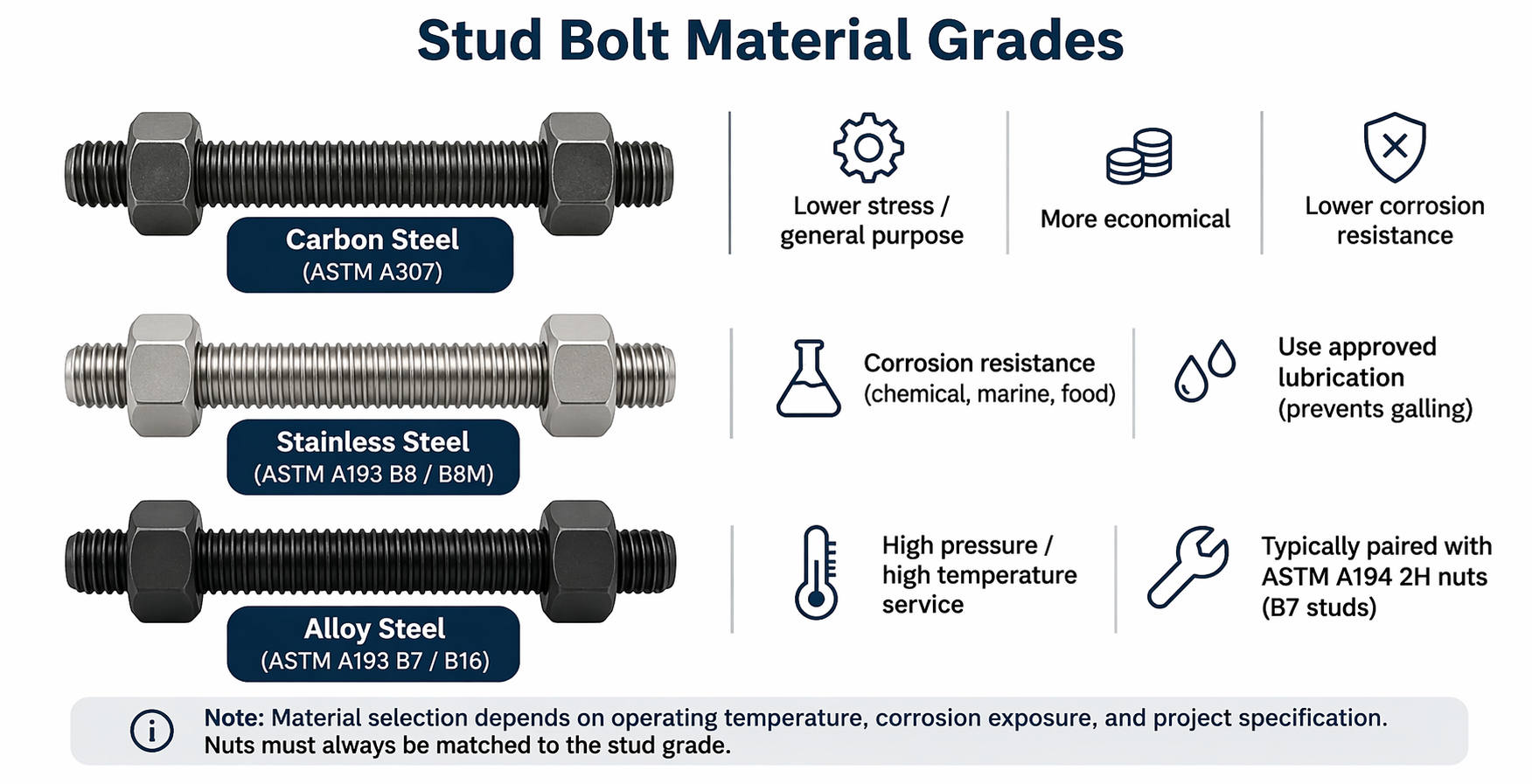
Stud Bolt Material Grades
The operating temperature and corrosion exposure and the specification determine the choice of materials. Nuts must always be matched to the stud grade.
Carbon Steel Stud Bolts
Carbon steel stud bolts (e.g. ASTM A307 grades) are appropriate for lower stress applications and general purposes. They also tend to be more expensive, and are not always used in high-pressure, high-temperature flange pairs without a coating because they do not have the same corrosion resistance as other types.
Stainless Steel Stud Bolts
Stainless steel stud bolts (ASTM A193 B8 and ASTM A193 B8M) are available for corrosion resistance in chemical, marine and food applications. Do follow the approved lubrication procedure as stainless threads have a tendency to gall when tightened.
Alloy Steel Stud Bolts
Presently, pressure and high temperature flange connections typically employ alloy steel stud bolts such as ASTM A193 B7 (chromium-molybdenum steel) and B16 (elevated temperature). Typically, B7 studs are fitted with ASTM A194 2H hex nuts. None of the grades are suitable for all services, so check with the project specification.
Stud Bolt Thread Types
The type of thread determines the fit, strength and tightening characteristics. Typical types are UNC (coarse) for general bolting, UNF (fine) for more precise adjustment, 8UN (8 thread) for larger flange stud diameters and ISO metric coarse thread for metric flange studs. The standard also specifies the thread class which influences the fit of the stud and nut. Always match the nut thread with the stud thread; double check both in the specification before ordering.
Stud Bolt Length (OAL vs FTF)
Not all suppliers will indicate length in the same manner, so be sure to ask about the convention. The total length of the stud (from one end to the other) is called the overall length (OAL). In general, the distance between the bearing faces of the fitted nuts is the face-to-face (FTF) length, which is related to the clamped joint.
To determine the length required, add the flange thickness, gasket thickness, nut height at each end and the required thread projection. The final value is determined by the flange standard or approved drawing set. A stud that is too short will not engage the thread as much and a too long stud will not allow access. Always check the units your artwork will be drawn in before ordering.
Stud Bolt Coating MaterialsPTFE-based
Coatings not only help prevent corrosion of stud bolts, but also impact the way they can be tightened. These are often zinc plating or hot dip galvanizing if the surface is to be exposed outdoors, PTFE based coatings to protect against corrosion and reduce friction, or phosphate coatings for light protection. Changing the coefficient of friction will cause different bolt loads. The approved procedure should therefore specify the coating and the lubricant, and the nuts should be tight on the coated threads.
Stud Bolt Uses and Applications
The use of stud bolts is specified in all instances where a flange connection requiring a high level of strength and even loading is required. Common applications include oil and gas pipelines, petrochemical plants, power generation, water treatment, marine applications, valve bonnets, pressure vessels and heat exchangers.
They should not be confused with clamp hardware such as a bolted pipe support or a tube support kit. These hold pipework to a structure and are not flange bolting. The tube support listing is also marked as discontinued by the manufacturer.
Difference Between Stud Bolt, Bolt, and Threaded Rod
Many readers have asked for some clarification on the difference between a stud bolt and a hex bolt. The table below compares the three fasteners.
Feature | Stud Bolt | Bolt | Threaded Rod |
|---|---|---|---|
Head | None | Hex or other head | None |
Threading | Full length or both ends | Partly or fully threaded shank | Full length |
Tightened from | Nut at each end | One side only | Nut at each end |
Typical use | Flanged and pressure joints | General fastening | General purpose |
Material control | Usually to a bolting specification | Depends on standard | Often not to a bolting specification |
For a headed example, see this hex bolt. It is shown for comparison only and is not a substitute for a specified flange stud. More fasteners from the same maker are listed in the ABB range.
Frequently Asked Questions
How to tighten flange bolts?
Check threads and flange faces, lubricate according to approved procedures, hand tighten nuts (then tighten in a cross pattern in stages). Final torque is specified by the project and is dependant on materials, lubricant and joint design.
How to install stud bolts on flange?
Fit flanges and gasket; install the studs; install a nut on each end of the studs with the same number of threads showing on each, then tighten in the specified order.
Is a flange bolt torque chart PDF safe to use?
If it is the same flange class, stud grade, lubricant and gasket. Use values from the specification or manufacturer as a generic chart may not work for the joint.
Can I order a part marked discontinued?
Do not assume so. Such a discontinued bellows bolt listing may not be available for an emergency replacement situation, so be sure to check before ordering.
Conclusion
The selection of the proper stud bolts involves confirmation of the standard, size, material grade, thread, length and coating with the flange specification. Ensure the nuts are the same size as studs, and ensure they have the approved tightening method and are available before ordering. By checking all flange connections carefully up front, all connections are more reliable and easier to maintain.
Disclaimer: Z&F Corporation is not affiliated with, authorized by, endorsed by, or acting as an official representative of any manufacturer, brand, or trademark owner referenced on this website. All product names, trademarks, brand names, logos, and manufacturer references are the property of their respective owners and are used solely for identification, reference, and compatibility purposes.