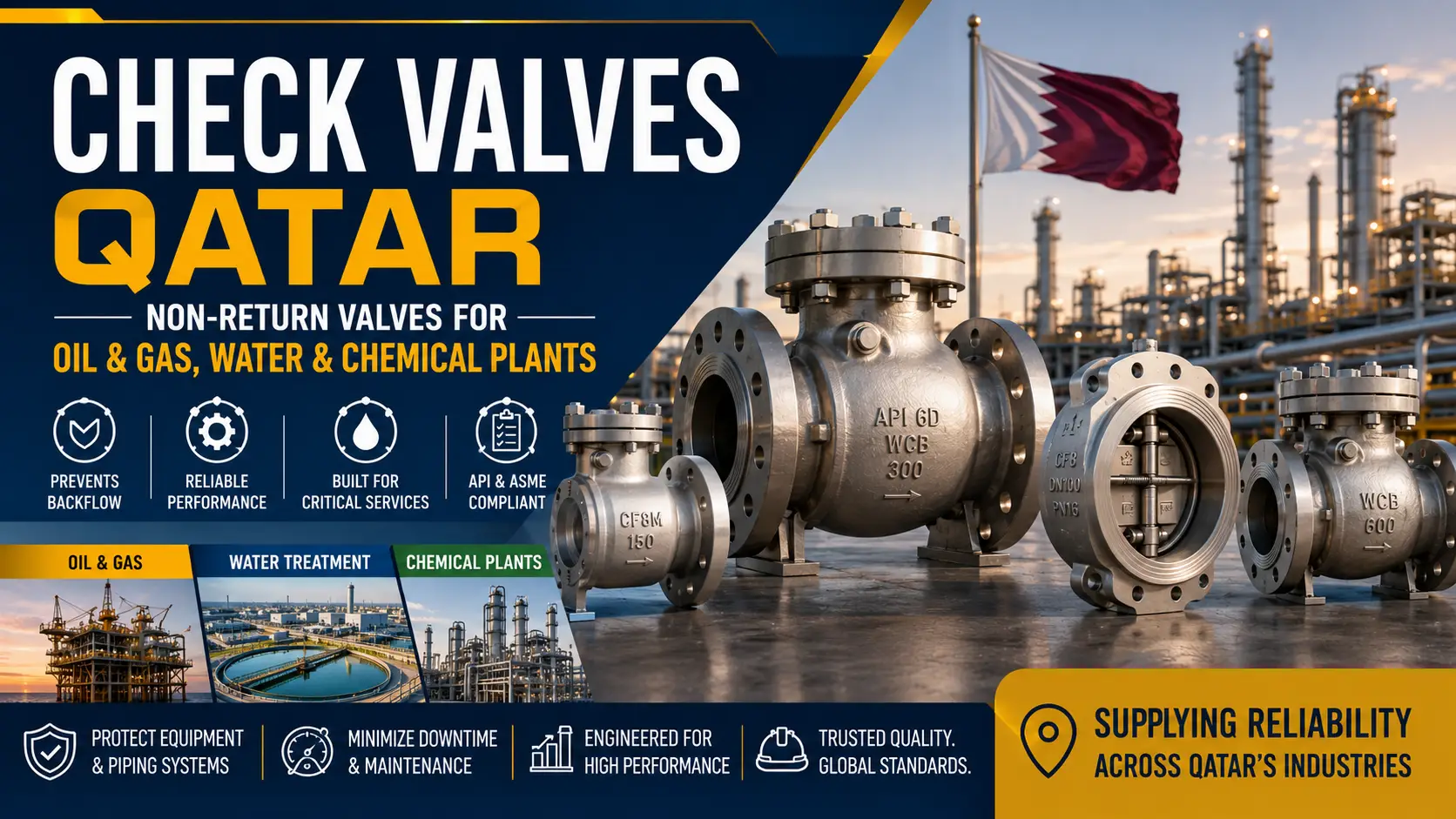
Check Valves Qatar Oil Gas: Complete API 6D & LNG Industry Guide
Backflow in a compressor discharge line, LNG transfer system or refinery process unit is not a small process upset. It can destroy rotating equipment, affect process safety, and can even result in a complete unit shutdown in the worst of circumstances. Choosing the right type, material, and certification for check valves for sourcing in check valve Qatar oil gas is a line of defense for all procurement engineers, EPC contractors, and project teams that depend on check valves.
The gas industry in Qatar is poised for major growth. The North Field Expansion project by Qatar Energy will expand Qatar's LNG output from 77 million tonnes per annum to 126 million tonnes per annum, which is creating sustained procurement demand for certified flow control equipment throughout Ras Laffan, Mesaieed and across the entire Qatari industrial base. In that demand, check valves are one of the most common items on any material requisition for a project.
It is designed for high-level technical buyers who are familiar with basic valve fundamentals and are looking for a comprehensive approach for sourcing check valves for projects in the oil gas industry in Qatar: valve types, the true standards for compliance, material selection for sour service and seawater exposure, application guidance in LNG, offshore and refinery contexts, and a procurement checklist that distinguishes genuine certification from a logo on the catalogue page.
Need reliable check valves for your Qatar oil, gas, or water project? Get a Quote from our team today.
What Are Check Valves
A check valve is a valve which opens and closes automatically, without the need of manual action or external power source, so that fluid can only flow through in one direction. The valve opens when flow is moving forward and then either closes automatically due to flow reversal (gravity, spring force, or both) or closes automatically once the pressure of the flow reverses, preventing backflow damage to upstream equipment like pumps, compressors, and process vessels.
This guide on check valves is part of a broader category overview, found in our guide to industrial valves, that gives a full picture of the contribution check valves make to industrial piping system design, and how they can be used in conjunction with gate, globe and ball valves. Our comparison of gate valves and globe valves explains the difference between the engineering types of valves often used as part of the same piping system, in addition to check valves, when specifying for flow regulation versus simple non-return protection.
How Check Valves Work
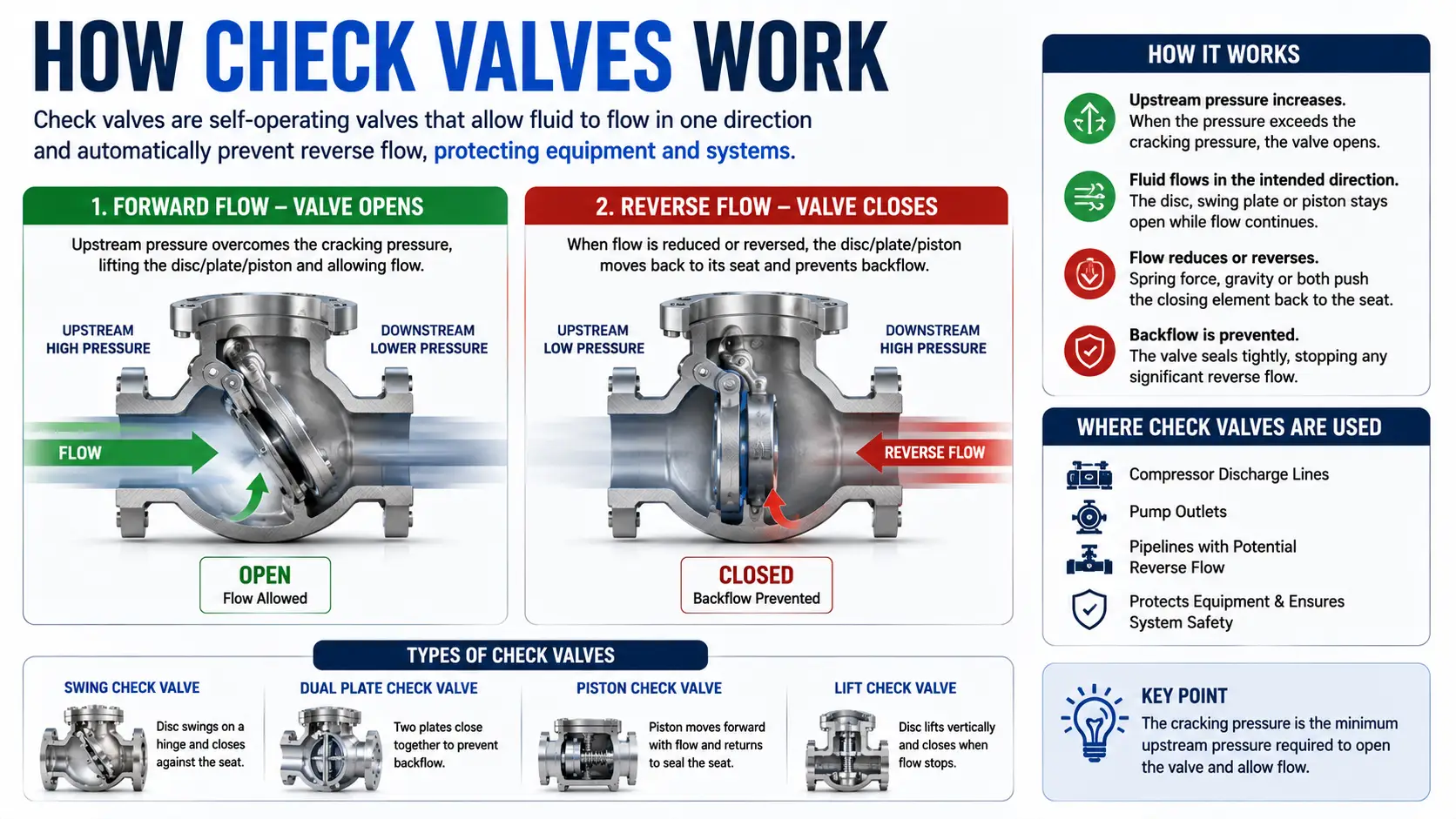
UP pressure on the valve disc, swing plate or piston is greater than the valve's cracking pressure (the minimum UP pressure needed to lift the valve disc away from its seat) and the valve opens to allow flow. The closing element repels to its seat when flow is reduced or reversed due to spring force, gravity or both, and prevents any significant backflow volume from passing through the line. Check valves are required in those situations where there is a potential for reverse flow: compressor discharge lines, pump outlets, and any part of a pipeline where downstream pressure may exceed upstream pressure during upset conditions, since they are self operating.
Types of Check Valves
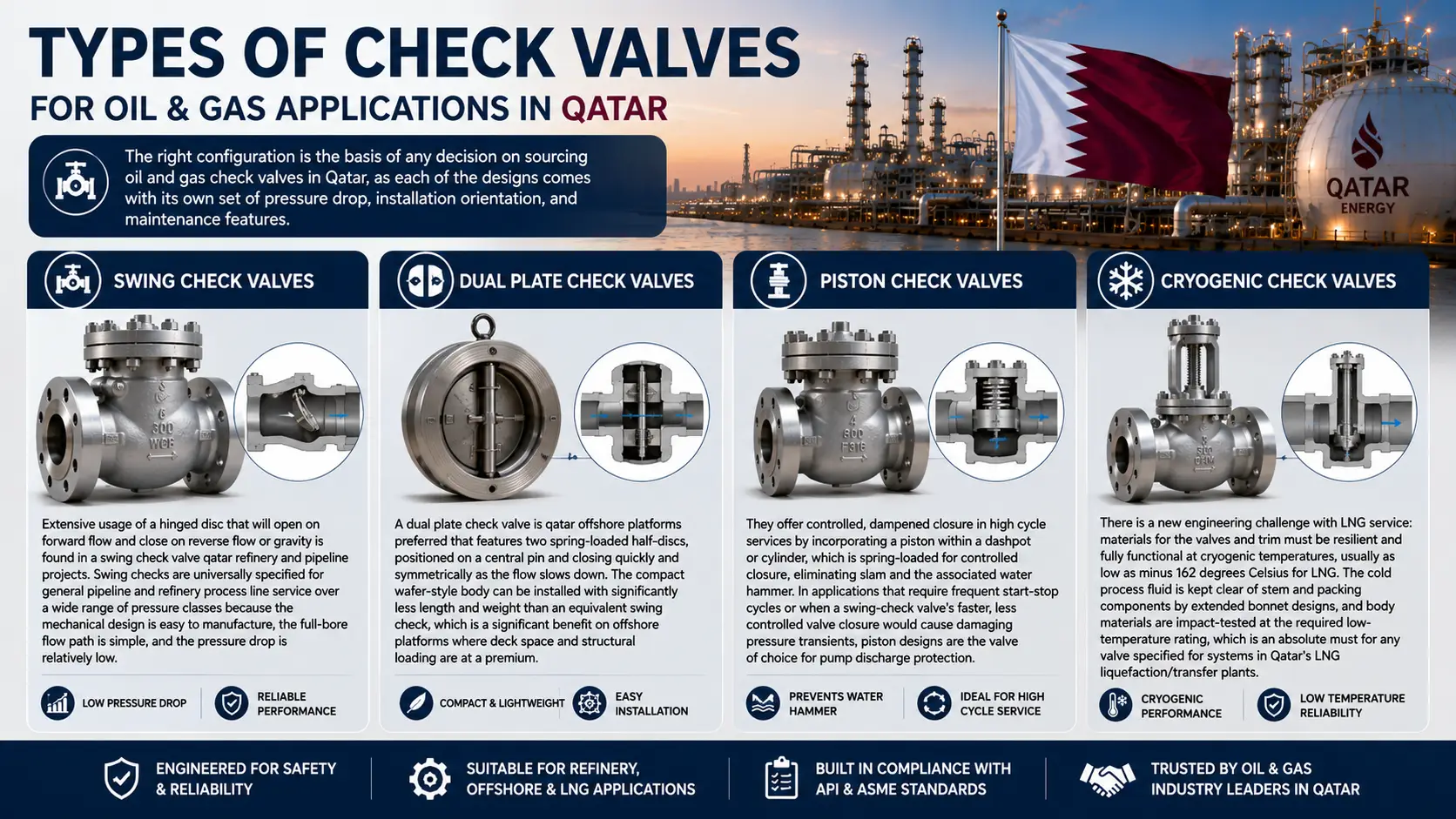
The right configuration is the basis of any decision on sourcing oil and gas check valves in Qatar, as each of the designs comes with its own set of pressure drop, installation orientation, and maintenance features.
Check Valve Type Comparison
Valve Type | Closing Mechanism | Typical Size Range | Best Application |
Swing Check Valve | Hinged disc swings closed under reverse flow | 2" - 48" | General pipeline, refinery process lines |
Dual Plate Check Valve | Two spring-loaded plates, compact wafer body | 2" - 48" | Offshore platforms, space-constrained piping |
Piston Check Valve | Spring-loaded piston, dampened closure | 1/2" - 24" | High-cycle service, pump discharge protection |
Cryogenic Check Valve | Extended bonnet, low-temp rated trim | 1/2" - 24" | LNG transfer, liquefaction process lines |
Wafer Check Valve | Compact dual or single plate, flangeless | 2" - 36" | Petrochemical plants, space-limited installations |
Swing Check Valves
Extensive usage of a hinged disc that will open on forward flow and close on reverse flow or gravity is found in a swing check valve qatar refinery and pipeline projects. Swing checks are universally specified for general pipeline and refinery process line service over a wide range of pressure classes because the mechanical design is easy to manufacture, the full-bore flow path is simple, and the pressure drop is relatively low.
Dual Plate Check Valves
A dual plate check valve is qatar offshore platforms preferred that features two spring-loaded half-discs, positioned on a central pin and closing quickly and symmetrically as the flow slows down. The compact wafer-style body can be installed with significantly less length and weight than an equivalent swing check, which is a significant benefit on offshore platforms where deck space and structural loading are at a premium.
Piston Check Valves
They offer controlled, dampened closure in high cycle services by incorporating a piston within a dashpot or cylinder, which is spring-loaded for controlled closure, eliminating slam and the associated water hammer. In applications that require frequent start-stop cycles or when a swing-check valve's faster, less controlled valve closure would cause damaging pressure transients, piston designs are the valve of choice for pump discharge protection.
Cryogenic Check Valves
There is a new engineering challenge with LNG service: materials for the valves and trim must be resilient and fully functional at cryogenic temperatures, usually as low as minus 162 degrees Celsius for LNG. The cold process fluid is kept clear of stem and packing components by extended bonnet designs, and body materials are impact-tested at the required low-temperature rating, which is an absolute must for any valve specified for systems in Qatar's LNG liquefaction/transfer plants.
API Standards and Certifications
Standards verification is the most crucial due diligence action when it comes to API 6D check valves Qatar procurement, and is the most commonly overlooked task when pushed for schedule.
API 6D: Specifies design, manufacture and testing criteria for pipeline valves, such as check, ball, gate and plug valves in oil and gas transmission and distribution systems.
API 594: Check valve application (wafer, dual plate, swing, and other check valve configuration) dimensional and testing requirements that are unique to check valves as compared to the pipeline valve scope of API 6D, specifically API 594.
ASME B16.34: Specifies pressure-temperature ratings, dimensions and material specifications for all standard pressure classes of flanged, threaded and welded end valves.
NACE MR0175 / ISO 15156: Specifies material needs for valves in Sour Service environments, which is an important part of several upstream gas production areas in Qatar.
ISO 14313: The American Petroleum Institute (API) standard for pipeline valves, which is often used in conjunction with or as an equivalent to ISO 14313, depending on the project's governing specification.
Qatar General Organization for Standards and Metrology (QGOSM): National conformity requirements pertaining to industrial equipment that enters into the Qatari market.
In practice, the difference between the requirements of API 6D and API 594 for check valves is important: API 594 covers the design and dimensions of check valves, and API 6D covers the general requirements for pipeline valves. When ordering a check valve, a project specification that references API 6D should be confirmed to see if API 594 compliance is also required, as the two are complementary and not interchangeable for check valves.
Materials Selection
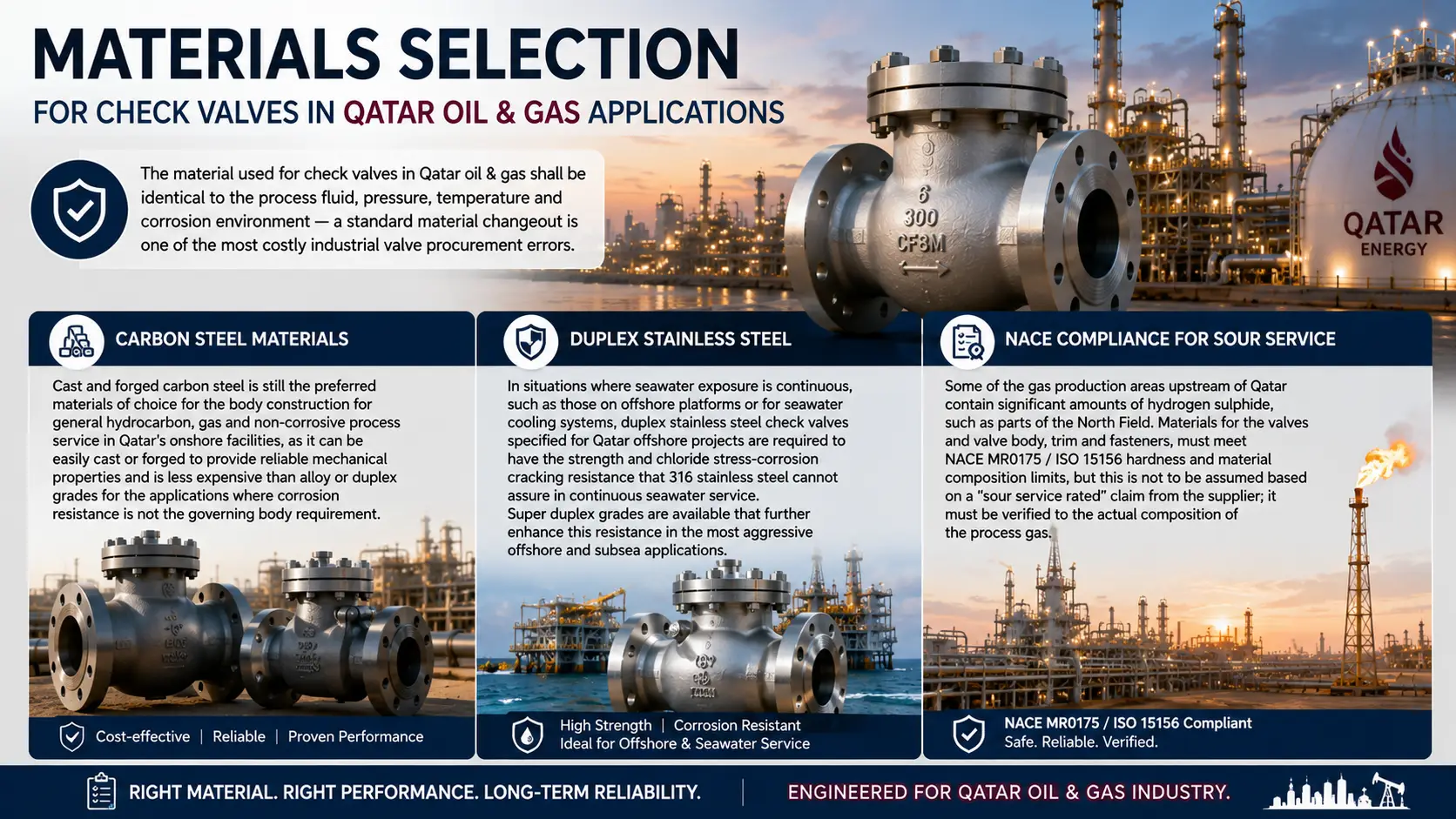
The material used for check valves qatar oil gas shall be identical to the process fluid, pressure, temperature and corrosion environment — a standard material changeout is one of the most costly industrial valve procurement errors.
Carbon Steel Materials
Cast and forged carbon steel is still the preferred materials of choice for the body construction for general hydrocarbon, gas and non-corrosive process service in Qatar's onshore facilities, as it can be easily cast or forged to provide reliable mechanical properties and is less expensive than alloy or duplex grades for the applications where corrosion resistance is not the governing body requirement.
Duplex Stainless Steel
In situations where seawater exposure is continuous, such as those on offshore platforms or for seawater cooling systems, duplex stainless steel check valves Qatar offshore projects specify are required to have the strength and chloride stress-corrosion cracking resistance that 316 stainless steel cannot assure in continuous seawater service. Super duplex grades are available that further enhance this resistance in the most aggressive offshore and subsea applications.
NACE Compliance for Sour Service
Some of the gas production areas upstream of Qatar contain significant amounts of hydrogen sulphide, such as parts of the North Field. Materials for the valves and valve body, trim and fasteners, must meet NACE MR0175 / ISO 15156 hardness and material composition limits, but this is not to be assumed based on a "sour service rated" claim from the supplier; it must be verified to the actual composition of the process gas.
LNG Applications
The LNG check valves Qatar projects have a unique and challenging niche in the larger oil and gas valve market, due to Qatar's status as one of the world's largest LNG exporters, based on the North Field Extension and liquefaction plants in Ras Laffan Industrial City.
Cryogenic material qualification: The valve body, bonnet and trim materials need to be impact tested and qualified for the low temperature service rating for the LNG process stream, which is usually minus 162 degrees Celsius or lower.
Extended bonnet design: Prevents ice from forming around the stem and seal, which might lead to seal failure and compromise the valve integrity.
Fire safe design: API 607 or equivalent fire safe testing many times specified in LNG facility design to assure the valve has acceptable sealing qualities during a fire event even if the soft seat is destroyed.
Fugitive emissions control: New LNG capacity increasingly specifies for fugitive emissions, which are important for Qatar's growing production base as minimizing fugitive methane emissions is an operational and environmental compliance requirement.
Offshore Applications
The combination of space limitations, weight sensitivity, and corrosion exposure for Qatar's offshore gas gathering systems and platform infrastructure directly influences the selection of the check valves. Dual plate check valves for offshore platforms projects in Qatar are preferred exactly because of their compact wafer construction which helps to minimize the installed weight and space requirements when compared to a swing check valve – a very significant engineering advantage where every kilogram of topside structure has a cost implication.
Typically, materials such as duplex or super duplex are specified on offshore platforms for seawater cooling systems and firewater systems due to the continuous exposure to chloride, and process gas gathering lines are specified for the sour service requirements of the particular gas composition of a specific field.
Refinery Applications
Check valves are widely used in the downstream sector in QATAR refinery process units as pump discharge protection, compressor back flow prevention, and as process unit isolation valves to prevent reverse flow. Swing check valves are used in a majority of general process line service, and the piston check valve is often called out for applications where controlled, dampened closure reduces the threat of water hammer and extends valve and pump service life, such as at the pump discharge point when cycling frequently occurs.
Procurement Checklist
Select the correct valve type desired: swing/hardened dual plate/piston/cryogenic
Confirm body, disc and trim material against the complete process fluid specification including sour gas composition if applicable
Verify pressure class and temperature rating with actual operating conditions and upset/temporary conditions.
Identify the specific governing standard: API 6D, API 594, ISO 14313 or project-specific equivalent
Ensure NACE MR0175 / ISO 15156 compliance, when sour service conditions apply.
Check for fire safe certification (API 607 or equivalent) on LNG and hydrocarbon service
Check cryogenic material qualification and impact test data for LNG and low temperature applications
Ask for material test certificates (MTCs) for body, disc and trim parts with full batch traceability.
Check hydrostatic and seat leakage test certificates of individual valve supplied.
Ensure the cracking pressure specification is the same as the minimum forward flow operating pressure of the system.
Maintenance Best Practices
The frequency for inspection of installed check valves should be determined by a risk assessment based on service criticality, corrosivity of the fluid, and frequency of cycling rather than by a single calendar date for all populations of check valves. In high cycle pump discharge service, piston checks are most likely to require more frequent examination than are the swing checks in a stable, low cycle pipeline. Inspection should verify that the disc(s) and seat are in good condition, that springs are present and undamaged (where applicable), and that the valve maintains its specified seat leakage class; consistent with most valve leakages, reduced valve sealing performance is often the first detectable problem prior to a complete backflow failure event.
Frequently Asked Questions
Question | Answer |
What is a check valve used for in oil and gas? | Pumps and compressors, as well as process equipment, are safeguarded from backflow damage and are ensured to maintain direction of flow across oil and gas pipelines, LNG and refinery systems with check valves. |
Which check valve is best for LNG service? | Depending on the application, either cryogenic swing or piston check valve design were considered with extended bonnet construction and impact tested low-temperature materials qualified for LNG's cryogenic service temperature. |
What is API 6D? | API 6D is the American Petroleum Institute (API) standard that specifies design, manufacturing, and testing requirements for valves in oil and gas transmission systems, such as check, ball, gate, and plug valves. |
What is the difference between API 594 and API 6D? | The API 594 provides design and dimensional specifications for check valves. API 6D is for the larger valve type. The two standards will complement each other, and project specifications will be reviewed for either or both of these standards to verify the procurement of check valves. |
Why are dual plate check valves popular offshore? | This compact wafer body configuration saves installed weight and space over swing check options which are critical to topside structural loading and space on offshore platforms. |
What material is best for seawater service? | Super duplex stainless steel has better chloride stress-corrosion cracking resistance than standard 316 stainless steel in continuous seawater exposure, and duplex stainless steel has even better corrosion resistance. |
What is cracking pressure? | The pressure needed to move a check valve's disc, plate, or piston off its seat so that flow can occur is called cracking pressure. |
Can check valves be installed vertically? | Depending on the design, some can be installed vertically if the manufacturer has given them the appropriate rating and orientation to flow vertically; not all check valve types can be installed vertically without being evaluated by the manufacturer for the proper orientation and rating. |
What is a non-return valve? | A check valve, or non-return valve, is a valve that will open automatically in one direction and will not open in the other when the pressure is reversed. |
Are check valves required in LNG plants? | Yes. Check valves are used throughout LNG facilities for process safety and equipment protection, such as compressor and pump discharge protection as well as to prevent reverse flow in cryogenic transfer systems. |
What standards apply to check valves in Qatar? | API 6D and API 594 for design and testing, ASME B16.34 for pressure-temperature ratings, NACE MR0175/ISO 15156 for sour service material requirements and specification requirements for the particular project to which they are applicable. |
What certifications should a check valve supplier provide? | API certification documentation, material test certificate (MTC) with full batch traceability, hydrostatic test report, seat leakage test report, fire safe (API 607) and NACE compliance documentation (if applicable). |
Conclusion
Sourcing check valves projects for Qatar oil gas depends on is not just a product selection but documentation and engineering exercise. The type, grade and pressure capacity of the valve should be matched with the actual process conditions; the pressure capacity should be checked to the project specification against API 6D, API 594 or both, the sour service and cryogenic material qualifications should be checked to the actual fluid composition and temperature, and not be assumed from generic supplier claims.
LNG procurement teams which demand strict standards verification, material traceability and selection criteria appropriate for application will never experience the backflow failures, corrosion incidents or lack of compliance with the standards which come to light later in a project lifecycle when shortcuts are taken during sourcing.
The purpose of this guide is to serve as an independent sourcing and procurement guide for help to technical buyers who are evaluating check valves qatar oil gas options against verifiable standards and documentation. Ask for a technical consultation and check valve sour application investigation for your LNG, refinery, offshore or petrochemical project.
DISCLAIMER: ZFC Corporation is not affiliated with, authorized by, endorsed by, or acting as an official representative of any manufacturer, brand, or trademark owner referenced on this website. All product names, trademarks, brand names, logos, and manufacturer references are the property of their respective owners and are used solely for identification, reference, and compatibility purposes.