MRO Products Nigeria Oil Gas: Complete Procurement & Supply Guide
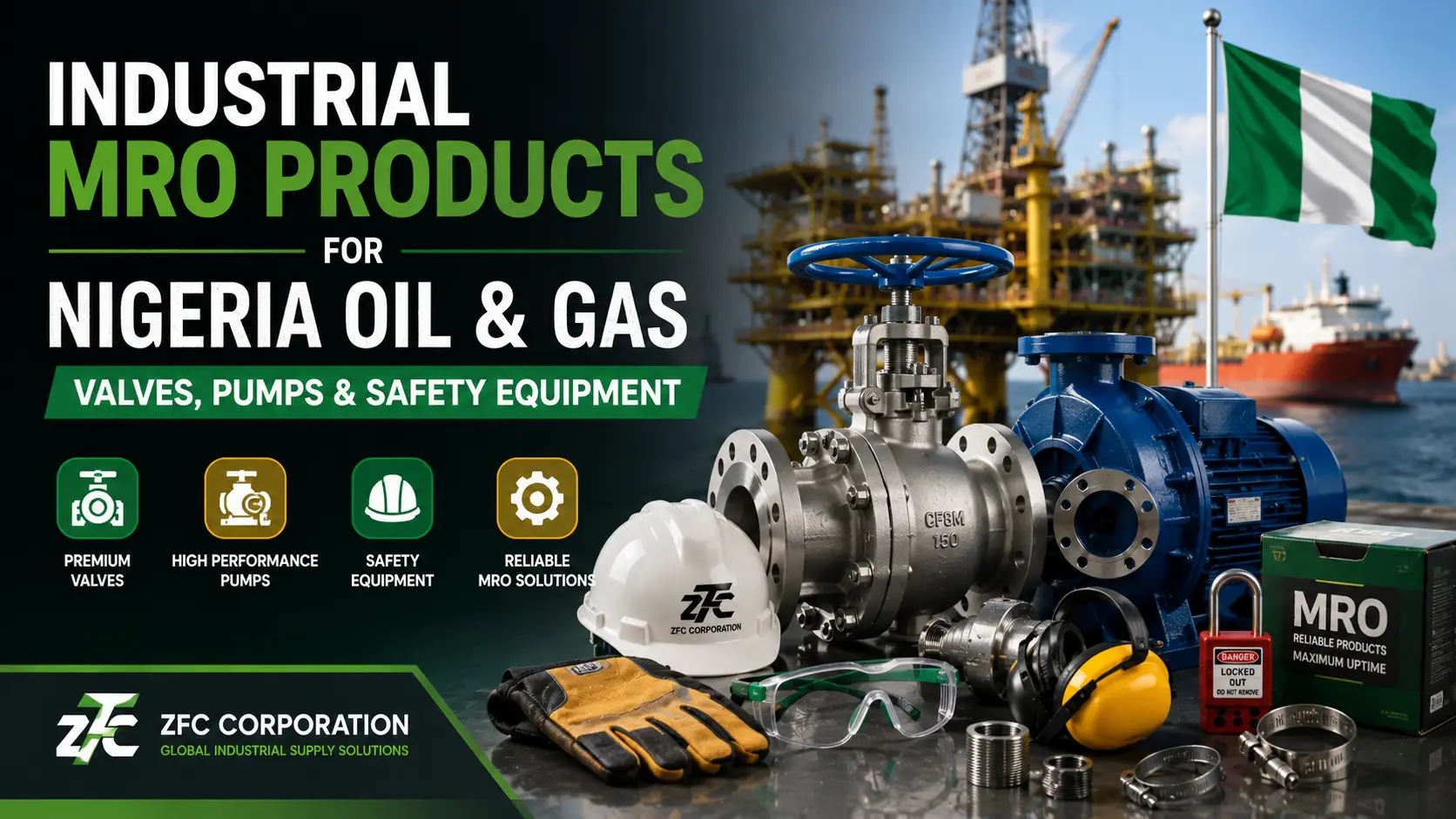
MRO products Nigeria oil gas operations rely on are more than just items on a purchase order for procurement managers and maintenance engineers in Nigeria's energy industry. They provide a basis for equipment reliability, production continuity, and asset integrity. Whether it's offshore platforms in the Niger Delta or refineries in Port Harcourt, and processing terminals on Bonny Island, every facility is dependent on a consistent and reliable supply of industrial maintenance, repair and operations materials. With them, even the smallest equipment failures can become expensive unplanned downtime. In Africa, Nigeria is the biggest oil producer, according to the International Energy Agency (IEA), further underscoring the size and importance of maintenance supply chains in the country's upstream, midstream and downstream oil and gas activities.
Request a Quote: Get fast, reliable access to compliant MRO products for your oil and gas operations.
What Are MRO Products in Oil & Gas?
Maintenance, Repair, and Operations (MRO) products are industrial materials, parts, and supplies that are used to maintain and repair equipment and facilities and are not part of the final product. These materials play a crucial role in the oil and gas industry, ensuring the efficient and safe operation of production assets.
The energy industry is one of the broad applications of MRO products. These range from a basic gasket, fastener bolt, rotating equipment components, instrumentation sensors, electrical switchgear, safety systems, to hydraulic seals. The common denominator is that they both contribute to the decrease in equipment reliability and uptime.
MRO products: These are supplies that are used to maintain, repair and operate industrial equipment, facilities and production systems. These are needed to ensure the reliability and functionality of the assets but are not part of the end product.
Why MRO Procurement Matters in Nigeria
The Nigerian oil and gas industry is faced with a difficult and complex environment. They include deep water offshore rigs in the Gulf of Guinea, onshore production stations in the Niger Delta, inland refineries in Warri and export terminals in Escravos and Onne. Every setting has its own purchasing and supply issues.
The lack of effective management in the supply chain of MROs in the oil and gas industry carries a number of risks for the operators: unplanned equipment downtime, deferred maintenance backlogs, production losses and safety incidents. The consequences of a day of unpredicted downtime can be millions of dollars in lost production in a sector where that's the case.
Here are some of the factors that must be taken into consideration in effective MRO procurement in Nigeria:
Due to international suppliers and OEMs, the lead times are long.
Duties and customs clearance at Nigeria ports
The risk of counterfeit and sub-standard products in local markets. Risk of counterfeit and sub-standard product in local market.
Local content requirements as per NCDMB guidelines
Managing multiple suppliers in a disjoined industrial supply chain.
In the event of unexpected breakdowns, emergency procurement needs are met.
Essential MRO Product Categories
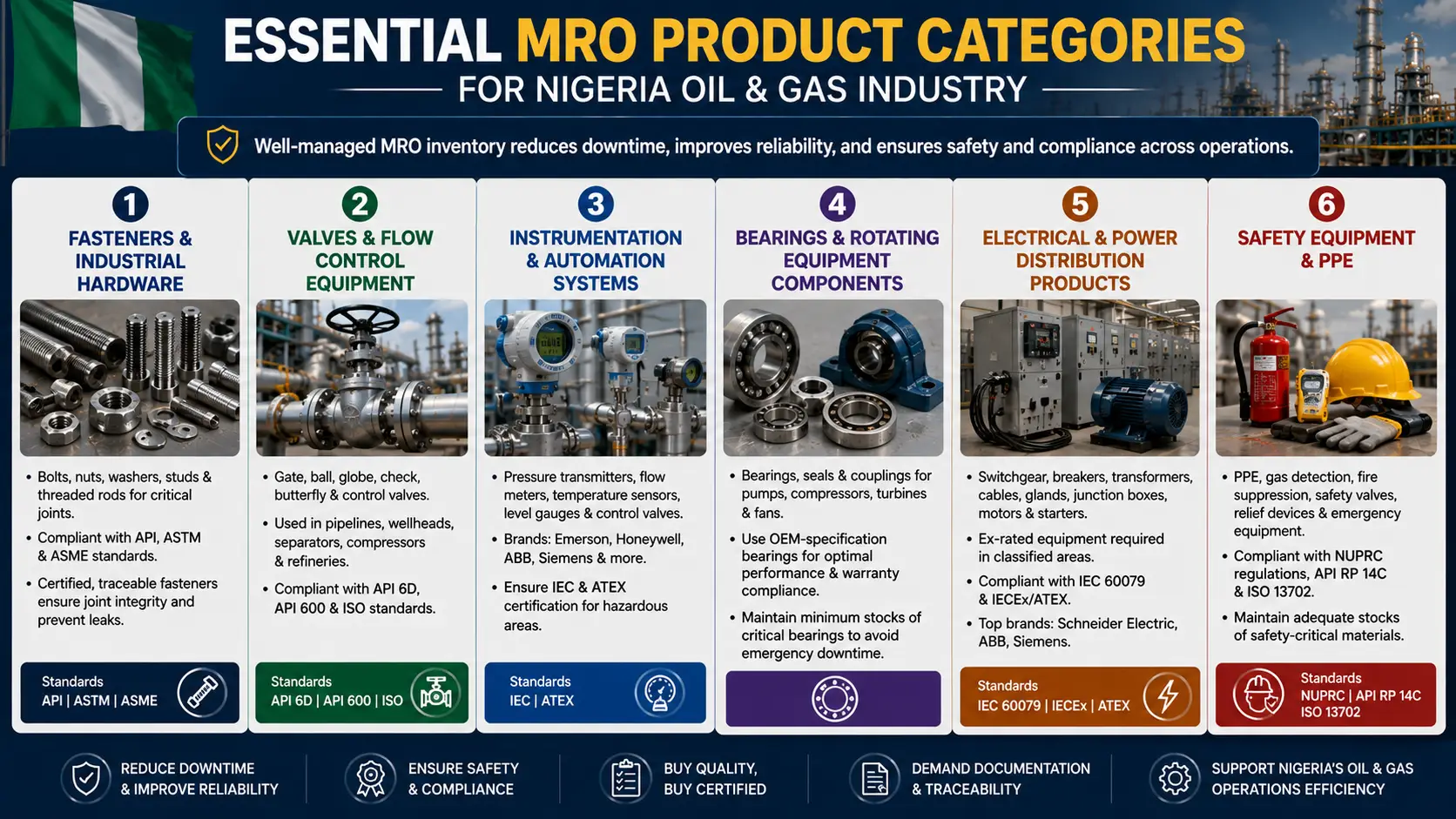
These are some of the product categories that drive the operations of MRO products in Nigeria oil gas industry. Procurement staff should have a well-defined policy on inventory on all the categories to reduce the risk of downtime.
Fasteners and Industrial Hardware
One of the highest volume MRO products used in oil and gas plants are fasteners. They feature bolts, nuts, washers, studs and threaded rods in compliance with API, ASTM, and ASME standards. High pressure and high temperature applications demand certified and traceable fasteners to ensure the integrity of the joints and to prevent leaks. An inferior and/or fake fastener is a serious safety and equipment integrity hazard.
See our Industrial Fasteners page for detailed sourcing advice.
Valves and Flow Control Equipment
Valves are essential parts of MRO for all the process systems in the oil and gas industry such as pipelines, wellheads, separators, compressors and refineries. Common valves include gate valves, ball valves, globe valves, check valves, butterfly valves and control valves. Upstream and downstream applications require compliance to API 6D, API 600 and ISO standards. Industrial valves procurement should come with documentation, material traceability certificate and pressure test reports.
View our complete list of Valves on our Valves Pillar page for specifications and sourcing assistance.
Instrumentation and Automation Systems
Process monitoring and control systems rely on instrumentation products like pressure transmitters, flow meters, temperature sensors, level gauges and control valves, which are vital to the oil and gas facility. Upstream and downstream instrumentation systems are broadly specified by brands such as Emerson, Honeywell, ABB and Siemens. When buying equipment for hazardous areas, procurement should check IEC & ATEX certification.
Bearings and Rotating Equipment Components
High quality bearings, seals, and couplings are essential to the rotation of equipment including pumps, compressors, turbines and fans. Products manufactured by the various well-known bearing manufacturers are in use across Nigeria's oil industry. OEM-specification bearings are essential to ensure equipment performance and compliance with the warranty. Critical bearings used in high-run equipment should have minimum stocks in the procurement team, to prevent emergency downtime.
If you're looking for maintenance parts for your pumps, check out our Pumps Pillar page.
Electrical and Power Distribution Products
Electrical MRO products are made up of switchgear, circuit breakers, transformers, cables, cable glands, junction boxes, motors and motor starters. An Ex-rated (explosion-proof) device must be used in classified areas within oil and gas applications. Obligation to IEC 60079 and IECEx/Atex Certification is required. Among the top-specified brands for electrical MRO uses in Nigeria's energy projects are Schneider Electric, ABB and Siemens.
Safety Equipment and PPE
Some other key MRO products consist of safety equipment such as PPE, gas detection systems, fire suppressing materials, safety valves, pressure relief devices and emergency response equipment. The facilities must meet with the NUPRC safety regulation and the international safety standard like API RP 14C and ISO 13702. Safety-critical material is a regulatory and operational requirement to maintain adequate stocks.
See our Safety Pillar page for the full range of safety materials.
Challenges of MRO Sourcing in Nigeria
Despite the increasing industrialization and development of supply chain, industrial procurement in Nigeria still has some challenges apparent that affects the reliability of operations and the effectiveness of procurement.
Challenge | Impact | Mitigation Strategy |
Long import lead times | Extended equipment downtime | Strategic buffer stock planning |
Counterfeit product risk | Equipment failure, safety risk | Approved vendor lists & traceability |
Customs clearance delays | Supply chain disruption | Pre-clearance and bonded warehousing |
Fragmented supplier base | High procurement costs | Supplier consolidation programs |
Limited local OEM presence | Poor technical support | Authorized distributor networks |
Inadequate inventory data | Overstocking or shortages | Digital inventory management systems |
How to Select Reliable MRO Suppliers
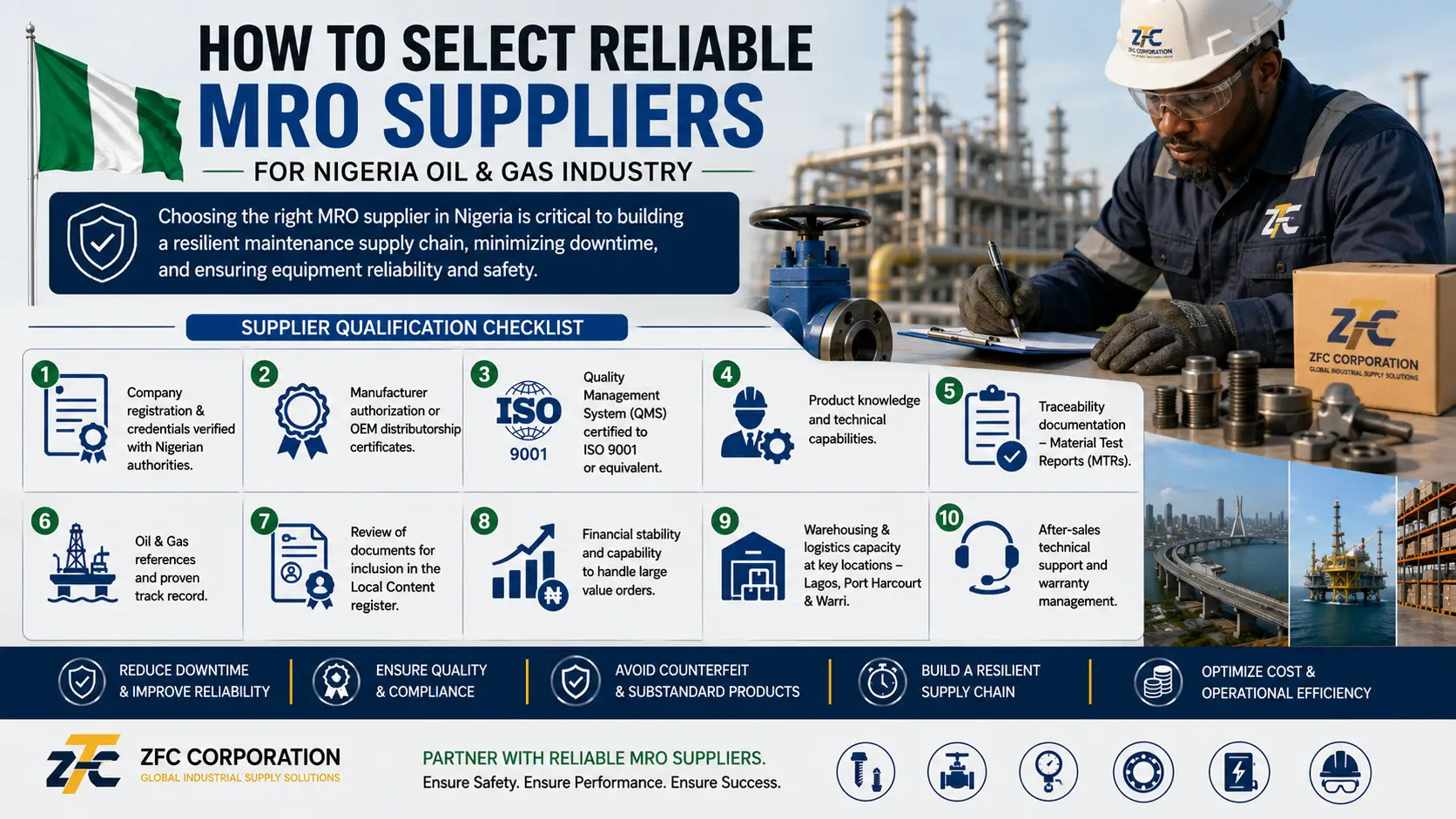
Making the right MRO supplier decision in Nigeria is one of the most crucial decisions that can be made in establishing a resilient maintenance supply chain. If the wrong supplier is used, there is the risk of introducing counterfeit products, incurring expensive delays or technical specification failures of critical equipment.
Supplier Qualification Checklist
Earlier, the company was registered and its credentials were verified with the Nigerian authorities. Earlier, the company's registration and credentials were verified with the Nigerian authorities.
Authorizations from a manufacturer or OEM distributor:
A quality management system (QMS) is an ISO 9001 or similar certification system. A quality management system (QMS) is a system certified to ISO 9001 or similar.
Knowledge of product and technical skills
Traceability documentation – material test reports (MTRs)
Oil & Gas references & track record
Assessment of various documents for inclusion in the Local Content register The business is financially stable, and in a position to accept large orders.
The business is financially secure and able to take on large orders.
Warehousing and Logistics at strategically important sites including Lagos, Port Harcourt and Warri.
After-sales technical support and handling of warranty.
OEM vs Aftermarket MRO Products
One of the most important maintenance sourcing decisions is choosing to get OEM (Original Equipment Manufacturer) parts or aftermarket options. Both are valid options in an effective MRO strategy, but it is important to select the option carefully based on criticality, equipment warranty and TCO.
Factor | OEM Parts | Aftermarket Parts |
Compatibility | Guaranteed by manufacturer | May vary; requires verification |
Price | Typically higher | Often lower cost |
Lead Time | Can be long for specialized parts | May be faster from local stock |
Warranty Impact | Preserves OEM warranty | May void equipment warranty |
Traceability | Full OEM traceability | Requires verified documentation |
Recommended For | Critical rotating equipment | Non-critical consumables and hardware |
Crucial components like centrifugal pumps, compressors, turbines, and process control systems are best suited for OEM specified parts, whether they come from a brand such as Flowserve, Parker Hannifin, John Crane, or Spirax Sarco. For non-critical consumables, fasteners and for general industrial hardware, after-market alternatives that have been quality verified will provide a reduction in cost with no loss of reliability.
Inventory Management Best Practices
Proper MRO inventory management is directly associated with the uptime of equipment and maintenance efficiency of oil and gas operations. Stocking that is either under-stocked or over-stocked causes down-time or ties up capital and warehouse space.
ABC Classification of MRO Inventory
A-Class (Critical Spares): Parts that if failed, cause the complete shutdown of the operation. Don't run out of buffer stock. They can be used for pump impellers, bearing sets for critical rotors, control valve actuators.
B-Class (Operational Spares): Parts that are moderately critical and have a moderate lead time. Stock that is based on consumption rate and lead time analysis.
C-Class (Consumables): Items like gaskets and O-rings, lubricants, fasteners, filters, etc., that are used in high volume, but low cost. Continue to hold renewal agreements with suppliers.
KPI Monitoring Framework
Follow these important Key Performance Indicators to maximize your MRO supply chain:
Inventory Turnover Rate: Active MRO stock – 2x – 4x per year
Fill Rate: Percentage of MRO orders that are fulfilled from stock, on initial request.
Emergency Order Rate: Monitor and minimize unplanned procurement: Emergency Order Rate
Lead Time Compliance: Now, monitor supplier on-time delivery performance with Lead Time Compliance.
Obsolescence Rate: Slow-moving and redundant stock should be identified and eliminated – this is referred to as the “Obsolescence Rate”.
Total MRO Spend: Track spend trends and opportunities for consolidation
Digital Procurement and Asset Management
Digital tools are reshaping procurement processes in the oil industry in Nigeria. The use of digital tools in procurement services is revolutionizing maintenance supply chains in Nigeria. The emergence of Enterprise Asset Management (EAM) systems, digital procurement platforms, and predictive maintenance tools is paving the way for more proactive and data-driven MRO strategies.
Important technologies are being adopted such as:
EAM Systems: These systems are integrated solutions such as SAP PM or IBM Maximo that manage spare parts, maintenance schedules and inventory.
e-Procurement Platforms: Digital supplier portals that feature automated spend tracking and spending approval work and requisition.
Predictive Maintenance Tools: IoT sensors and condition monitoring systems that make equipment data-driven MRO procurement decisions
Inventory Optimization Software: Ensure optimal stock levels by leveraging AI-based demand forecasting with Inventory Optimization Software and prevent issues like stockouts.
Supplier Portals: Supplier Portals: Instantaneous order status, supplier delivery tracking and supplier performance scorecard.
Procurement Method | Advantages | Limitations |
Manual/Paper-based | Low implementation cost | Slow, error-prone, poor visibility |
Spreadsheet-based | Familiar, flexible | No real-time data, hard to scale |
e-Procurement Platform | Faster approvals, full audit trail | Requires system integration |
EAM-Integrated MRO | Linked to maintenance planning | High implementation cost |
AI-Driven Procurement | Predictive, data-driven sourcing | Requires quality data foundation |
Counterfeit Parts Prevention
The procurement market in Nigeria is a big risk due to counterfeit industrial goods. Inadequate or unauthorized components may lead to equipment failure, safety issues, production losses, and environmental issues. Industrial products are a major source of counterfeit products, and there are some regulations by Standards Organization of Nigeria (SON) and NUPRC to address the issue; however, procurement teams must take proactive moves.
Counterfeit Prevention Checklist
Consult only on approved vendor lists (AVL) that have been authorized by the OEM.
Ask for and check certificates of conformance, MTRs and test reports
Perform incoming quality checks on important MRO components
Where possible, use unique product identification e.g. serial numbers, QR codes.
Provide a training program for procurement and receiving personnel on how to identify counterfeit identification.
Have a supplier blacklist of known counterfeit suppliers or non-compliant vendor.
Purchase from third party inspection agencies if necessary for orders that are high value or critical.
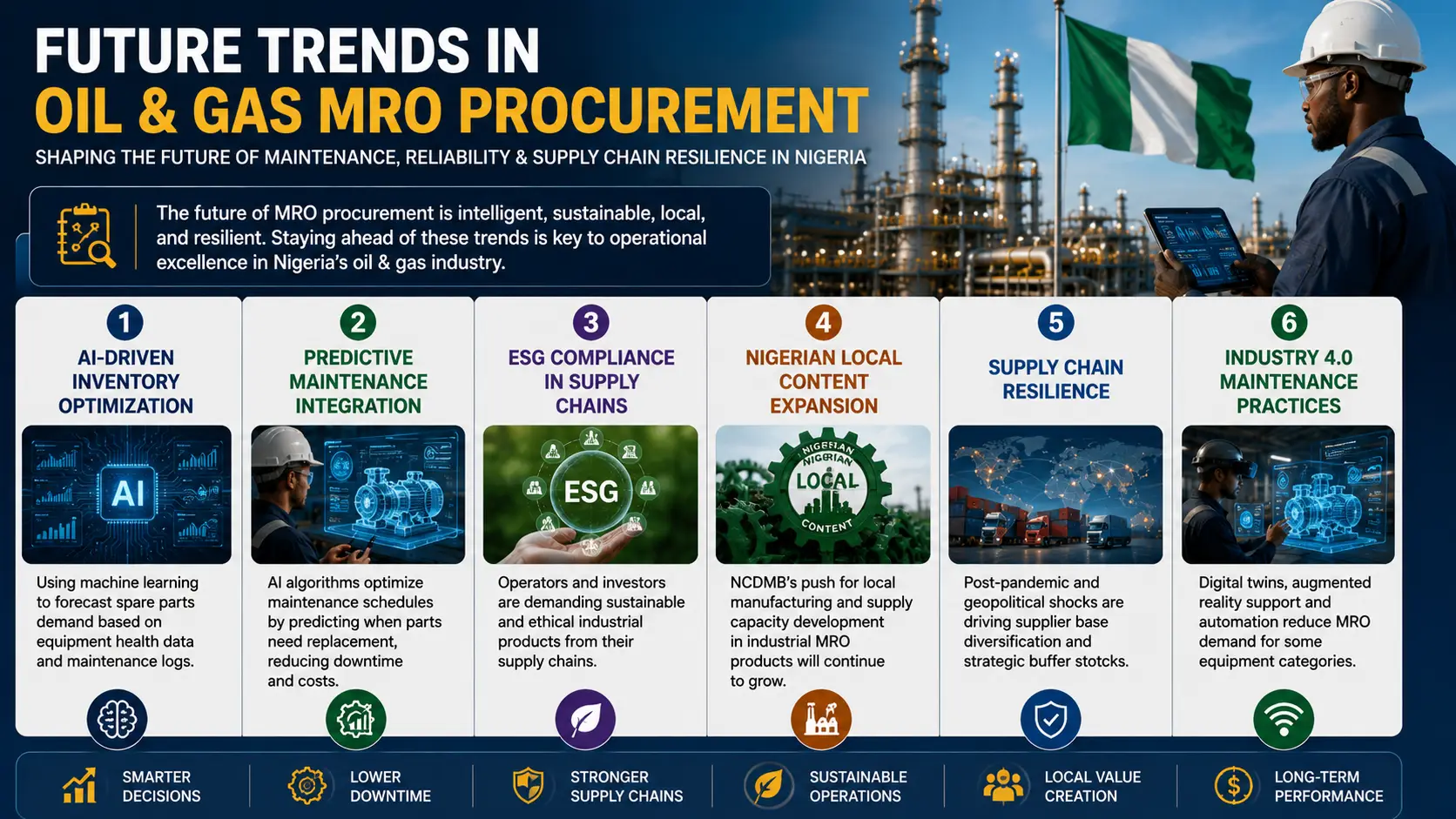
Future Trends in Oil & Gas MRO Procurement
Several trends are converging and ready to change the future of oilfield maintenance supplies procurement in Nigeria – here's what procurement teams need to be getting ready for.
AI-Driven Inventory Optimization: Using machine learning to forecast the need for spare parts, driven by equipment health data and maintenance logs.
Predictive Maintenance Integration: AI algorithms that optimize maintenance schedules by anticipating when parts need to be replaced.
ESG Compliance in Supply Chains: Expectations of operators and investors for sustainable and ethical industrial products from the suppliers in the supply chain are increasing.
Nigerian Local Content Expansion: NCDMB's push on Local Content Expansion in Nigeria for development of local manufacturing and supply capacity in industrial MRO products will be an issue for continued pressure.
Supply Chain Resilience: Post-pandemic and geopolitical shocks pushing for diversification of supplier base and strategic buffer stocks.
Industry 4.0 Maintenance Practices: Digital twins, augmented reality maintenance support and automation that lower MRO demand for some equipment categories, are examples of Industry 4.0 Maintenance Practices.
Frequently Asked Questions
What is the meaning of MRO products in the oil and gas industry?
MRO products involve petroleum and gas plant supplies that are provided for the maintenance, repair and operations of industrial assets. These involve fasteners, valves, instrumentation, bearings, electrical parts, seals, gaskets, safety equipment and spares for preventive and corrective maintenance.
What are the most important MRO products for offshore platforms?
Some of the most important MRO products for offshore platforms are valves and flow control equipment, instrumentation and control systems, mechanical seals and bearings, rotating equipment components, electrical switchgear and safety systems. These are usually referred to as "critical spares" and are generally required to be kept on site to reduce downtime in remote offshore sites.
How to select the right MRO supplier in Nigeria?
As you choose an MRO supplier in Nigeria, check their product certification, OEM authorization, quality management system, local content compliance, traceability documentation, their warehousing facilities and experience in the oil and gas industry. Suppliers in close proximity to major industrial centers like Lagos, Port Harcourt and Warri will be able to provide quicker delivery and technical assistance.
What are the ways companies can prevent the use of counterfeit MRO parts?
To prevent the purchase of counterfeit parts, it is important to keep approved vendor lists, inquire for certificates of conformance and material traceability documents, perform incoming inspections on critical parts, ensure that only vendors with validated OEM authorizations are used, and educate procurement personnel on the signs of counterfeit parts.
What is critical spares in oil & gas maintenance?
Critical spares are parts that if they were to fail, there would be a substantial loss in production, a safety hazard or damage to the equipment. Examples of these include pump impellers and compressor seals, turbine blades, control valve actuators, or safety relief valves. The quantities of these must always be kept at the minimum levels, irrespective of the cost.
What are the benefits of digital procurement in use for MRO efficiency?
Digital procurement platforms boost the efficiency of MRO by simplifying approval processes, offering real-time order visibility, analytics, supplier management and eliminating paper-based mistakes. Combined with EAM systems, digital procurement offers automatic reordering based on equipment condition and maintenance schedules, which is demand-driven.
Does "OEM" always have to be the preferred choice of parts for oil and gas MRO?
OEM parts are necessary for things such as pressure containing parts, rotating equipment and parts that are under manufacturer's warranties. After market parts that meet quality requirements can be used for non-critical consumables, general hardware and standard fasteners to minimize procurement costs without impacting reliability.
How frequently to review MRO inventory?
Quarterly review (at least) and comprehensive annual audit recommended for MRO inventory. Stock levels should be compared with consumption figures and slow-moving stocks should be marked for removal; minimum order quantities should be revised; and critical spare classifications should be revised to reflect current equipment strategies.
Conclusion
Finding a supplier is not enough to be able to handle MRO products and oil gas operations in Nigeria effectively. Requires a structured procurement plan that will include considerations of counterfeit risk, inventory management, supplier certification, local content compliance, and digital transformation. Nigeria's energy industry has been growing, and having reliable and cost-effective MRO supply chains will be a key competitive strength for all energy operators, upstream, midstream, and downstream.
From sourcing for oil and gas spares Nigeria for emergency operations to establishing a long term framework agreement for critical spares, working closely with an experienced and qualified procurement expert can save time, minimize risk and impact on the total cost of ownership.
Talk to our Specialist : Our procurement experts can assist you in finding reliable and traceable MRO products for your oil and gas business in Nigeria. Access advice from the professionals, which is specific to your facility.
Disclaimer: Brand names referenced in this article are used for informational and industry-context purposes only. No partnership, sponsorship, authorization, or commercial affiliation with any brand or manufacturer is implied. We operate as an independent procurement and sourcing service.