Types of Industrial Bearings: Complete Classification and Application Guide
The first step in preventing premature bearing failure is to know what types of industrial bearings are available. Every family is different, and loading direction, speed and misalignment will manifest themselves differently, whether as spalling, overheating or seizure. This guide categorizes the principal types of industrial bearings, tells where they fit and provides a practical way to determine which bearing type works with your machine.
Need help specifying a bearing? Request a Quote with loads, speed and environment listed, and our team will review your requirements.
1. What Is an Industrial Bearing? Core Function Explained
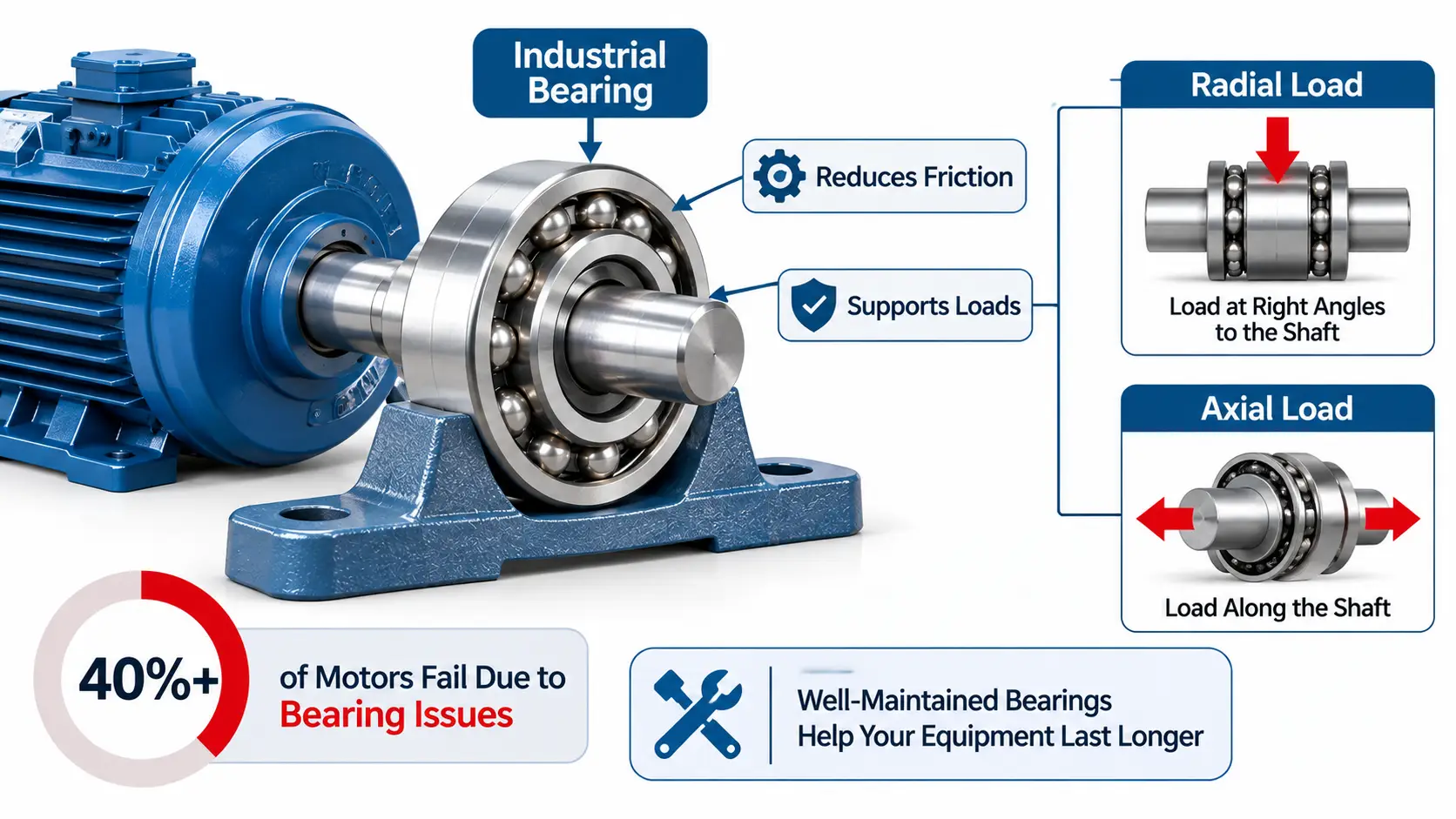
An industrial bearing is a machine element that minimizes the friction between a rotating shaft and its housing, and that also relieves radial and axial loads. The radial load is applied at right angles to the shaft, and the axial or thrust load is applied along the shaft.
Bearings are significant maintenance items because they are part of what causes about 40% or more of motors to fail. As background, read our MRO basics.
2. Bearing Classification Framework: Ball, Roller, and Plain Families
This bearing classification guide sorts designs into the ball, roller and plain families, mounted units. Ball bearings touch at a point and roller bearings touch along a line.
Factor | Ball Bearings | Roller Bearings |
|---|---|---|
Contact | Point | Line |
Friction | Lower | Higher |
Load capacity | Moderate | High |
Speed | High | Lower |
Shock resistance | Moderate | Better |
The primary distinction between ball bearings and roller bearings is this. This is the basic difference between ball bearings and roller bearings. Discover similar components in our mechanical components range.
3. Ball Bearing Types: Designs and Applications
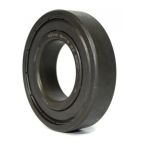
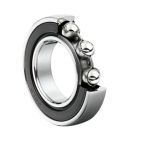
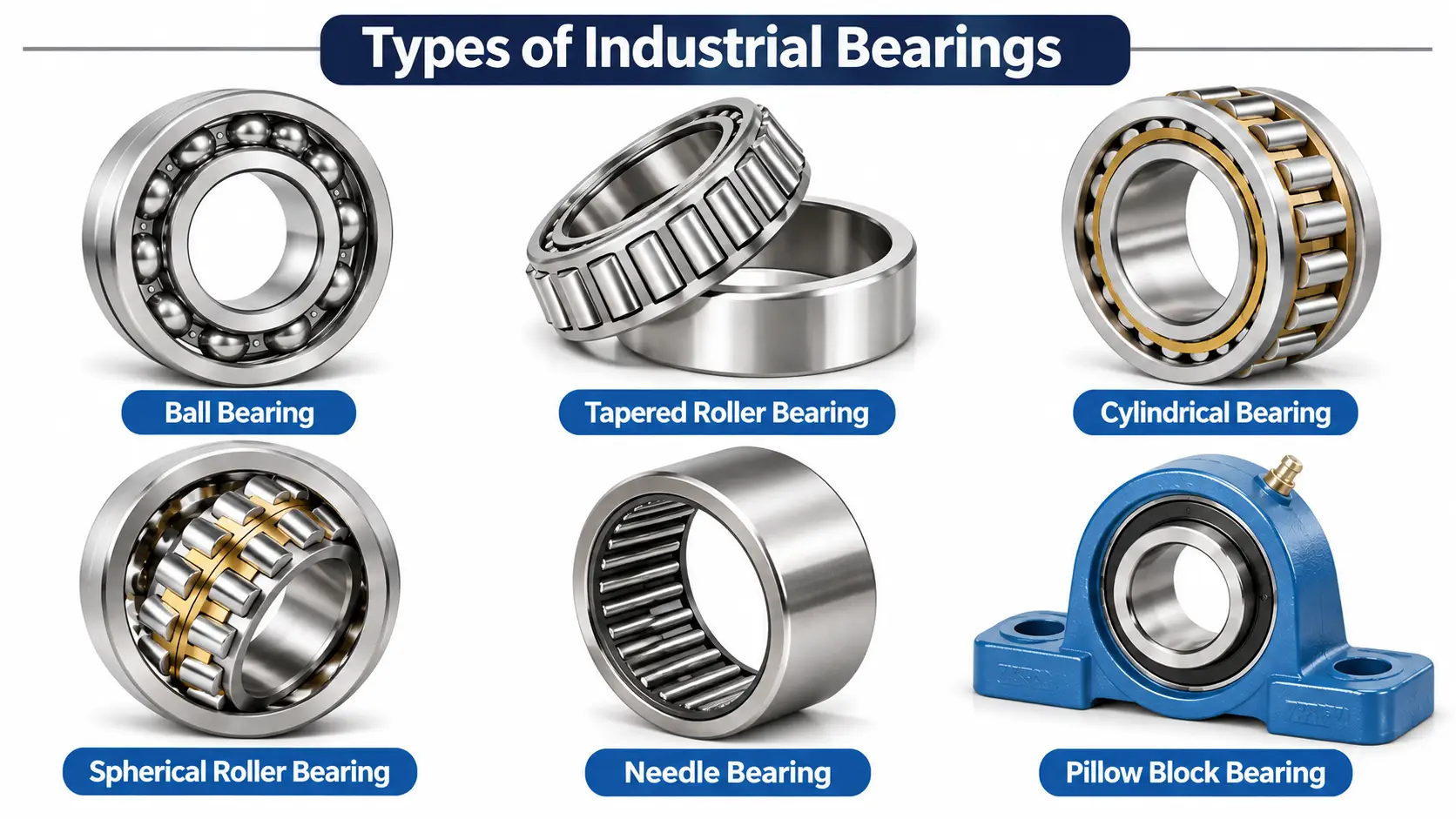
Deep groove ball bearings: standard bearings of moderate axial load in both directions at high speed and with radial load. Electric motors and fans are examples of deep groove ball bearings.
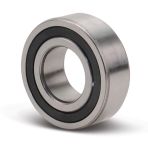
Angular contact ball bearings: They are used to carry combined loads, high axial load in one direction and are most commonly used as a pair.
Self-aligning ball bearings: can accept some misalignment of the shafts.
Deep groove or hybrid ceramic bearing are often the choice for bearing types used for high speed electric motor application. Make size comparisons from various manufacturers like SNR. For most of the light to medium duty, these types of ball bearings are used.
4. Roller Bearing Types: Designs and Applications
Heavy radial load and high speed: cylindrical roller bearings. Examples of the use of cylindrical roller bearing are gearboxes, large motors.
Spherical roller bearings: spherical roller bearing suitable for shock, deflection and misalignment, such as vibrating screens and crushers.
Tapered roller bearings : both radial and axial load. The gearboxes and wheel hubs are among the applications for tapered roller bearings.
Needle roller bearings: when high load capacity is required in small radial space, e.g. planetary gears.
There are various groups that provide these types of roller bearings, including Schaeffler and FAG and INA ranges.
5. Thrust Bearing Types for Axial Load Duty
Types of thrust bearings carry predominantly axial load. Thrust ball bearings are used for light duty, slower speed, cylindrical roller thrust bearings are used for high axial load and spherical roller thrust bearings are used for heavy axial load and some misalignment.
These fit vertical shafts and screw drives; take into account the type of thrust bearings used in the vertical pump and turbine shafts. Duty of Pump shaft is covered by our submersible pump guide.
6. Plain Bearings and Bushings: Sliding Contact Alternatives
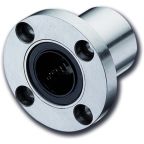
Plain bearings are the bearing that features sliding elements. They are suitable for heavy loads, low vibration rate, high quiet running and narrow radius. When comparing plain bushings with rolling element bearings, the rolling type typically has a lower start-up friction, and the plain type is more shock resistant and can resist dirt. For linear and sliding motion systems, see makers such as Ewellix.
7. Mounted Bearing Units: Pillow Block and Flange Types
Pillow block bearing units: fitted to a parallel surface and are found on conveyors and fans.
Flange units: bolt the unit to a facing at right angles.
Cartridge units: fit into a bore.
Insert bearings and housing are also offered in a bearing unit for ease of installation and replacement, with sphered housings providing misalignment allowance. In pillow block bearing unit selection vs flange bearing unit selection, the first step is to match up the mounting surface. Explore our bearings category.
8. Comparison Table: All Bearing Types at a Glance
Type | Radial | Axial | Misalignment | Speed | Typical Use |
|---|---|---|---|---|---|
Deep groove ball | Medium | Light, both ways | Low | High | Motors, fans |
Angular contact | Medium | High, one way | Low | High | Spindles, pumps |
Cylindrical roller | Very high | Limited | Low | High | Gearboxes |
Spherical roller | Very high | Moderate | High | Medium | Crushers, screens |
Tapered roller | High | High, one way | Low | Medium | Wheel hubs |
Needle roller | High | None | Low | Medium | Compact assemblies |
Thrust | None | Very high | None | Low | Vertical shafts |
This is a summary of the types of industrial bearings and their load carrying capacity. Couplings and lubricants are in our general industrial products.
9. How to Match a Bearing Type to Your Application
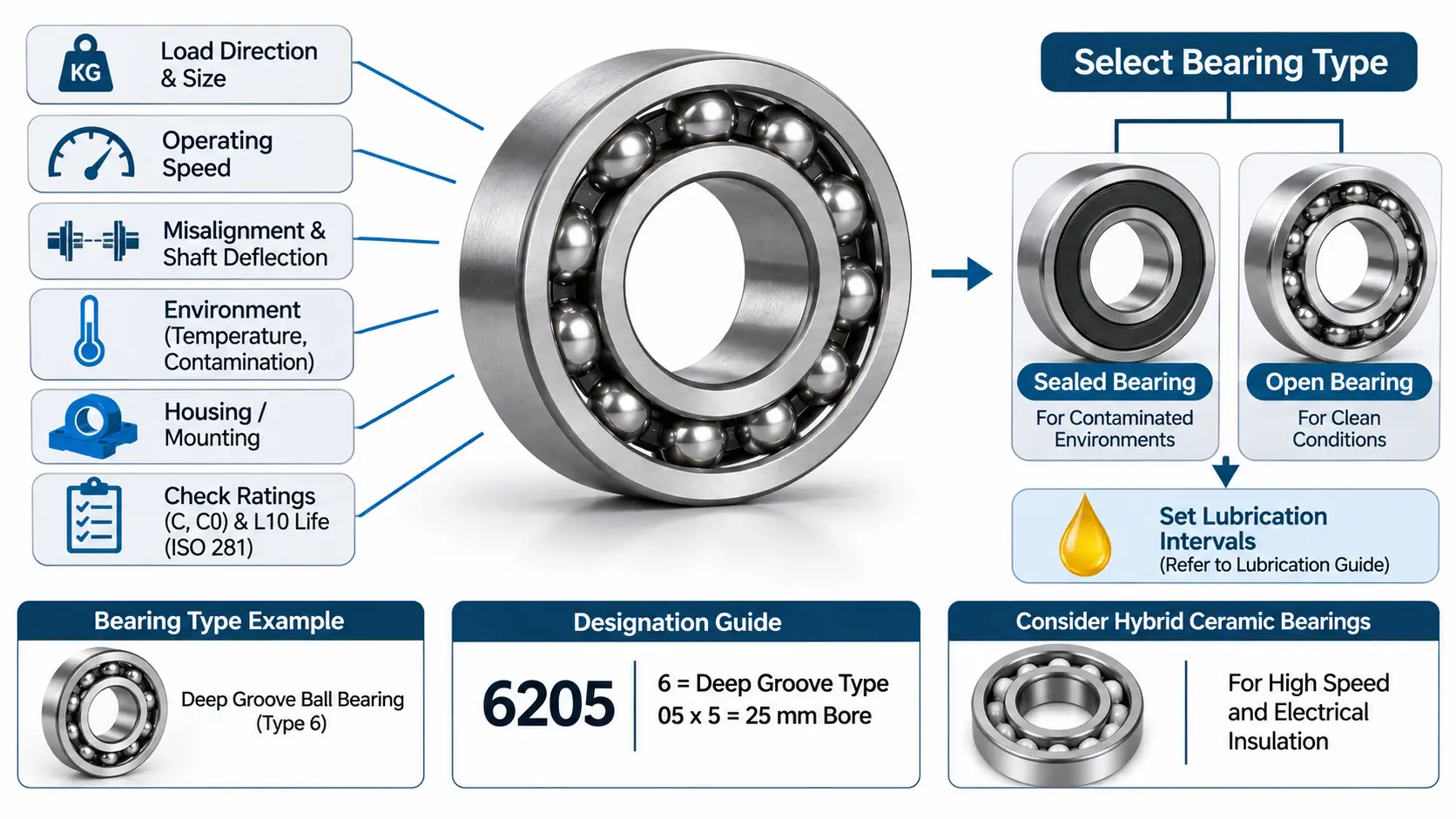
Be able to determine the direction and size of a load.
Compare the operating speed to the speed rating.
Measure misalignment and deflection of shafts.
Assess the environment: closed or open, contaminated or not, temperature. The safety suits are C3 suits, which are suitable for hot running motors.
Select housing/mounting.
Check dynamic (C) and static (C0) rating and L10 life according to ISO 281.
Select sealed or open bearings and lubrication intervals according to the contamination level; refer to our lubrication products guide. High speed and electrical insulation are appropriate for hybrid ceramic bearings. The first number in a designation (6) indicates the type (deep groove) and the last two numbers multiplied by 5 represent the bore in mm (25).
10. Frequently Asked Questions
What are the main types of industrial bearings?
Mounted units and ball, roller and plain bearings. Shop our range of bearings.
What is the difference between ball bearings and roller bearings?
Point contact is used for ball bearings to provide high speed, low friction. Line contact used for heavier load and shock are the roller bearings.
Which bearing type handles both radial and axial loads?
Angular contact ball bearings and tapered roller bearings. Deep groove bearings can accept a small amount of axial load.
When should I use a spherical roller bearing?
When heavy radial load, moderate axial load and misalignment are required, such as vibrating screen, crusher and long conveyor span.
What are pillow block bearings used for?
They are used for rotation of shafts on parallel mounting surfaces such as conveyors, fans and agricultural machinery.
11. Conclusion
Load direction, speed, misalignment and environment are the criteria for selecting between the different types of industrial bearings. Lubrication and Sealing planning, Plan matrix, verify ratings. Selecting mechanical seals is also required for pump shafts – read our mechanical seals guide.
Brand names are used for identification only and imply no partnership or endorsement by Z&F Corporation. Verify ratings against current manufacturer catalogues.
Need help choosing a bearing type? Talk to Our Specialist and we will help identify suitable products.