Types of Pipeline Flanges: Designs, Faces, Standards and Applications
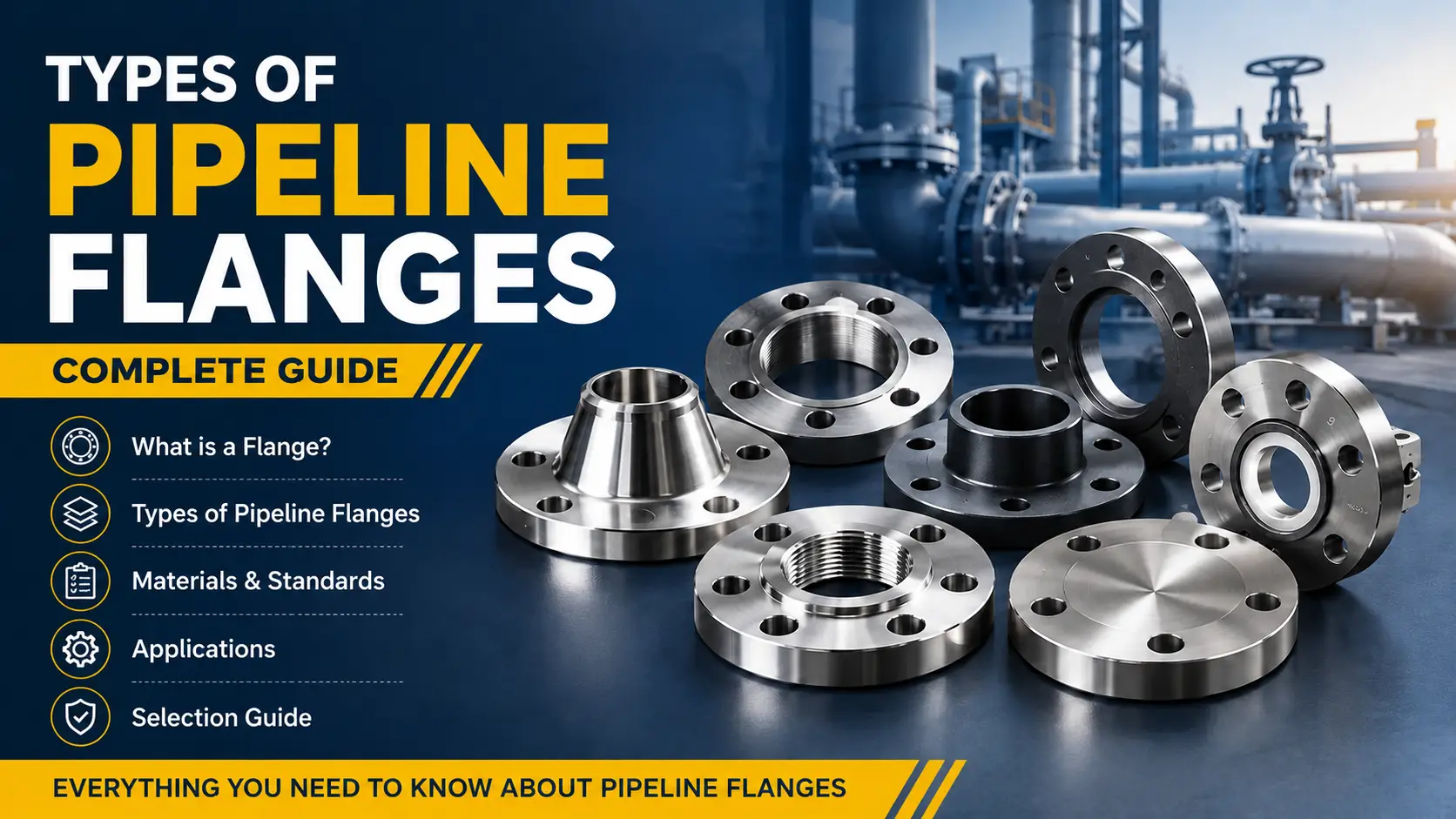
Engineers or buyers can determine safe and compatible piping connections by understanding the various types of pipeline flanges. The typical designs include weld neck, slip-on, socket weld, threaded, lap joint and blind flanges. When choosing a flange, you need to make sure that it fits the nominal size, has the right pressure class, is made from the appropriate material, has the correct facing, bore, pipe schedule, gasket, and bolting and adheres to the correct dimensional standard.
Need help sourcing pipeline flanges or piping components?
Send us your required size, standard, material, pressure class, facing and application details.
Request a Quote
Quick answer: The six main types of pipeline flanges are weld neck, slip-on, socket weld, threaded, lap joint and blind flanges. Each uses a different connection arrangement and must be selected according to the piping design, operating conditions and project specification.
What Is a Pipeline Flange?
A pipeline flange is a mechanical component that is used to join a pipe to another pipe, valve, pump, vessel and/or item of process equipment. A complete flanged joint usually consists of two compatible flanges (A1 and A2), a gasket and the stud bolts and nuts. It can generally be taken apart for inspection, maintenance or equipment changes, in contrast to a permanently welded connection.
The flange design and flange face are separate features. Weld neck and slip-on describe how the component connects to the pipe, while raised face, flat face and ring type joint describe its gasket-seating surface.
Main Types of Pipeline Flanges
Flange type | Connection method | Typical application |
|---|---|---|
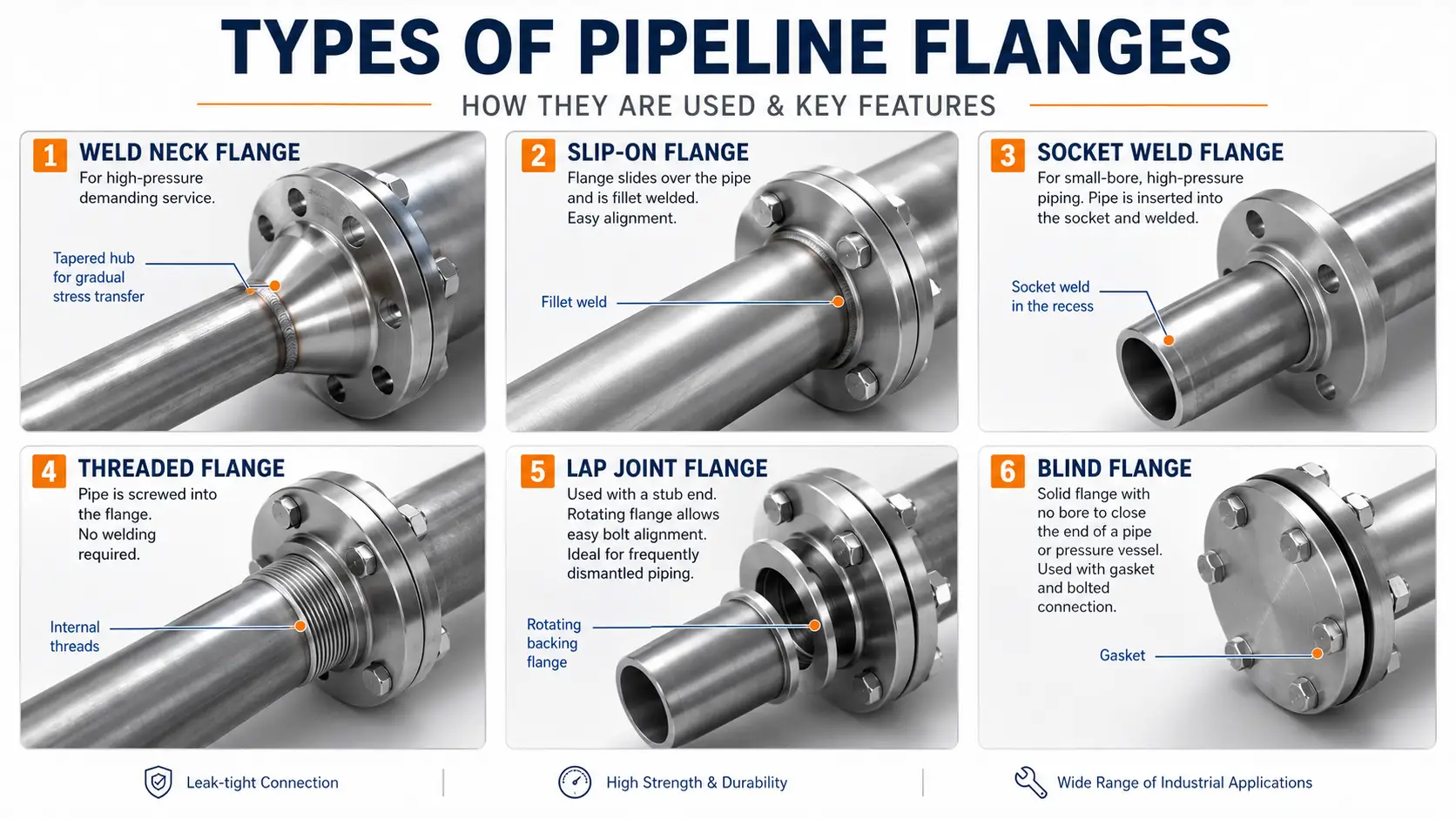
Weld neck | Butt-welded to the pipe through a tapered hub | Demanding pressure, temperature or cyclic service |
Slip-on | Fits over the pipe and is welded in place | General industrial piping where permitted |
Socket weld | Pipe enters a socket and receives a fillet weld | Suitable small-bore piping applications |
Threaded | Screws onto matching external pipe threads | Services where welding is unsuitable or unnecessary |
Lap joint | Used with a stub end and loose backing flange | Systems requiring alignment or regular dismantling |
Blind | Bolts to an open flanged connection | Closing or isolating pipe and equipment openings |
How the Different Flange Designs Work
Weld Neck and Slip-On Flanges
A weld neck flange has a tapered hub that transfers stress gradually into the pipe. It is butt-welded and is commonly considered for demanding service. A newly developed slip on flange slides over the pipe prior to welding. It may streamline alignment, but must be evaluated for suitability based on the piping code, loads and operating conditions.
When comparing weld neck and slip on flange gasket design, many factors should be considered beyond just the cost of acquisition. Welding method, inspection, fatigue, temperature, pressure and installation access can all influence the decision.
Socket Weld, Threaded and Lap Joint Flanges
A socket weld flange is a flange with a recess on the end of the pipe and is normally used with appropriate small bore services. A threaded flange is not welded, but there are limitations to its application and compatibility of threads.
A lap joint flange works with a stub end. The backing flange can rotate, making bolt-hole alignment easier. It can be useful where piping is dismantled regularly or where the backing flange does not contact the process fluid.
Blind Flanges
A blind flange has no centre bore. It closes a pipe end, vessel nozzle or equipment opening and may provide access for future maintenance. Pressure loading on a blind flange can be significant, so its dimensions, material, rating, bolting and gasket must match the design requirements.
Flange Faces: RF, FF and RTJ
There are raised face (RF), flat face (FF) and ring type joint (RTJ) main flange faces. An RF flange has a raised gasket-seating area. An FF flange has a flat sealing surface. The RTJ flange has a precision-machined groove to fit a metallic ring gasket.
Important: Do not assume that flange faces can be swapped out. The mating flanges, gasket, bolting and equipment connection must form a compatible joint under the applicable engineering specification.
Pressure Classes and Flange Standards
For the standard, size, and material, ASME pressure classes may feature 150, 300, 400, 600, 900, 1500 and 2500. A class number is NOT a pressure value. Pressure is not allowed, depending on material and temperature, contact with the applicable table for pressure/temperature is required.
Generally, flanges are covered by ASME B16.5 up to NPS 24 and specified larger ones are covered by ASME B16.47. The steel flanges are designated by PN according to EN 1092-1 and also there is another international designation system in ISO 7005-1. Editions and project requirements should be verified before procurement because ASME Class and PN values are not automatically interchangeable.
Applications and Related Piping Components
The types of pipe flanges and applications vary across oil and gas, chemical processing, water treatment, power generation and industrial utilities. Flanged systems may connect pumps, valves, heat exchangers and other equipment. Buyers can explore ZF Corporation’s piping and fittings category when researching related components.
Examples of equipment used within piping systems include the DFT DSV sanitary check valve and DFT FBC insert wafer check valve . These products should not be assumed to have a particular end connection without checking their complete model-specific documentation.
The term “flange” is also used outside process piping. For example, the Agilent 1CP001A rack-mount flange kit and Agilent 1CP012A rack-mount flange kit are instrument-mounting accessories, not pressure-containing pipeline flanges.
How to Select the Correct Flange
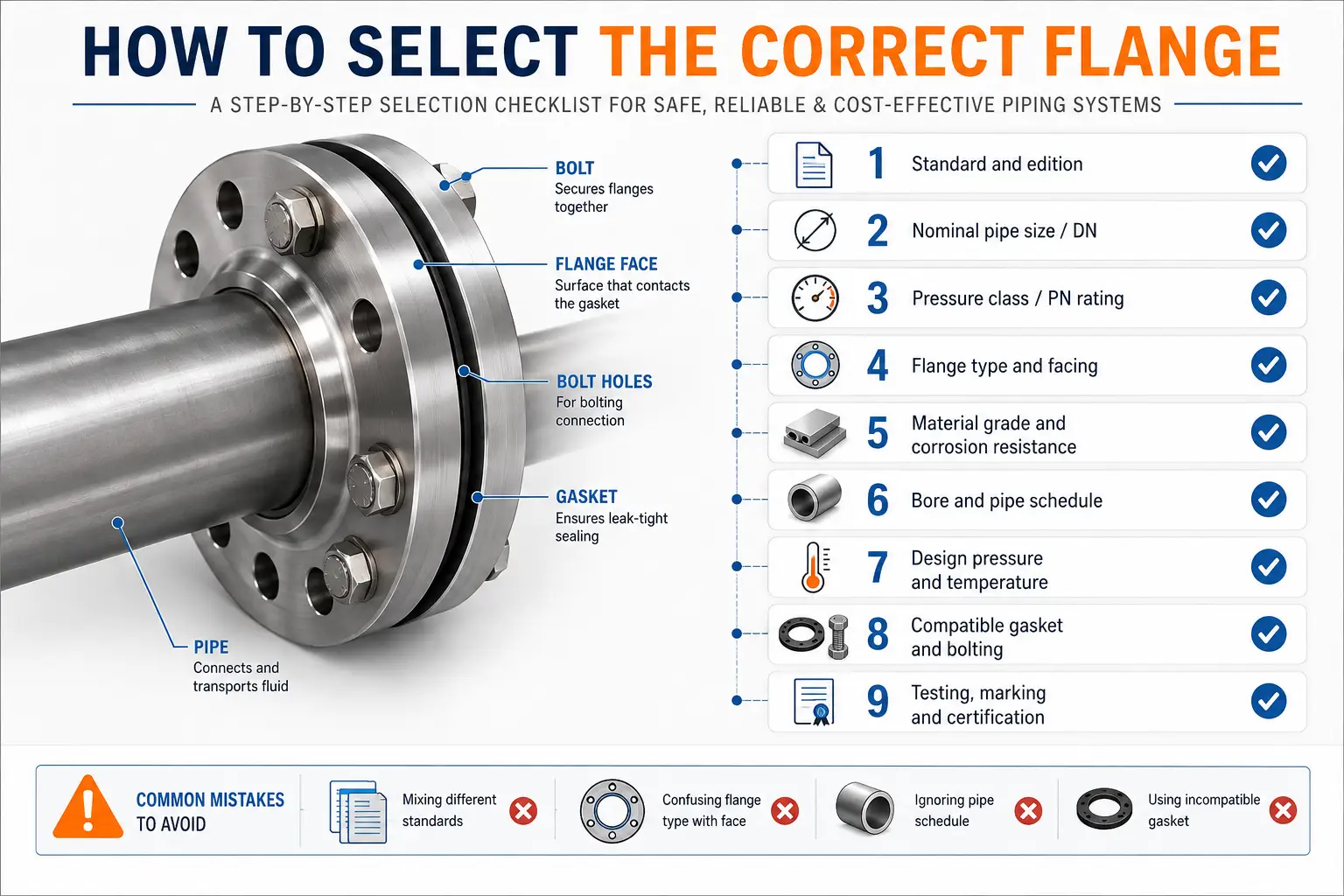
Learning how to select the right pipe flange requires a complete specification. Before comparing types of pipeline flanges, record:
Applicable standard and required edition
Nominal pipe size or DN
Pressure class or PN rating
Flange type and facing
Material grade and corrosion requirements
Bore and matching pipe schedule
Design pressure and temperature
Compatible gasket and bolting
Testing, marking and certification requirements
Common mistakes include mixing dimensional standards, confusing flange type with flange face, ignoring the pipe schedule and selecting an incompatible gasket. The mating flange should always be verified before an order is placed.
Frequently Asked Questions
What are the six main types of pipeline flanges?
They are weld neck, slip-on, socket weld, threaded, lap joint and blind flanges. Specialist designs also exist for particular equipment and measurement duties.
Which flange is used for high-pressure piping?
Weld neck flanges are commonly specified for demanding service, but no design is universally suitable. Pressure, temperature, loads, cycles, material and the applicable piping code must all be evaluated.
What information belongs in a flange RFQ?
Include the standard, size, pressure class or PN, type, face, material, bore, pipe schedule, quantity, certification and inspection requirements.
Final Selection Advice
The correct choice among the types of pipeline flanges depends on the complete piping design rather than size or class alone. Verify the standard, dimensions, rating, material, face, gasket, bolting and mating connection against current project documents before purchasing.
Have a flange or piping-component requirement?
Share your size, standard, class, material, facing and application details with ZF Corporation’s independent sourcing team.
Talk to Our Specialist
Disclaimer: Z&F Corporation is not affiliated with, authorized by, endorsed by, or acting as an official representative of any manufacturer, brand, or trademark owner referenced on this website. All product names, trademarks, brand names, logos, and manufacturer references are the property of their respective owners and are used solely for identification, reference, and compatibility purposes.