Hydraulic Hoses & Fittings UK : Selection Guide for Industrial, Construction & Hydraulic Systems
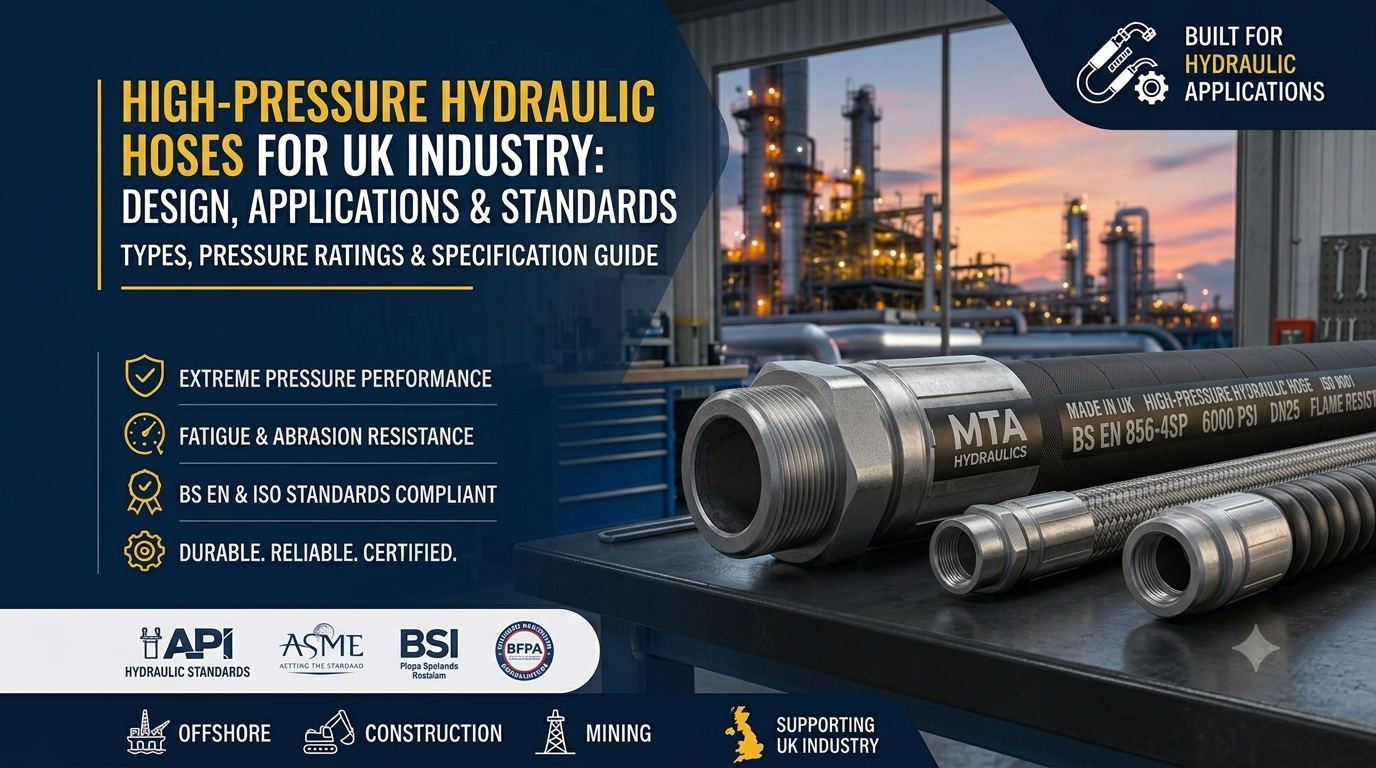
In all sectors of industry, a reliable flow of pressurized fluid is essential to maintaining the operational efficiency of plant, machines and production systems. One of the most technically significant decisions for hydraulic hoses fittings UK procurement teams and engineers is to choose the right hydraulic hoses fittings. From assembly to make in Birmingham, to replacement of hose runs on offshore rigs in Aberdeen, and maintenance on construction plant throughout England and Scotland, the type, fitting standard, pressure rating and material combination is the key to reliable plant availability or an expensive and potentially dangerous failure. Everything you need to know about making informed, compliant and cost-effective procurement decisions is in this selection guide.
Hydraulic hoses and fittings are parts that are used to move and manage high pressure hydraulic fluids in equipment and machinery. They install pumps, valves, cylinders and other hydraulic equipment safely and efficiently.
What Are Hydraulic Hoses and Fittings?
Hydraulic hoses and fittings are the soft, flexible "blood vessels" of the hydraulic system. Hoses are used to carry pressurized fluid between components, including pumps, valves, actuators, cylinders, and motors, around obstacles and distances where rigid pipework is not able to go. Just like the hose, the selection of fittings will be as important as the terminal connecting parts between hose ends and system components, as these fittings are used to ensure a leak-free connection.
The British Fluid Power Association (BFPA) notes that fluid power technologies, such as hydraulic systems, are applied across the UK's manufacturing, construction, transportation, energy and industrial sectors, playing a key role in thousands of critical applications, with hose reliability affecting productivity and safety.
A full hydraulic hose assembly would consist of:
Inner tube — is the tube that contains the hydraulic fluid; should be able to withstand the chemical effects of the fluid used
Reinforcement layer(s) — steel wire braid or spiral layers that withstand the internal pressure.
Abrasion protection, UV protection, ozone protection, chemical protection, mechanical damage protection: Outer cover.
Secure end fittings — crimped and/or re-usable or push-fit; secure to system ports.
For more information on hydraulic system components and selection criteria – including pumps, valves, actuators and circuit design.
Types of Hydraulic Hoses: Selection Matrix
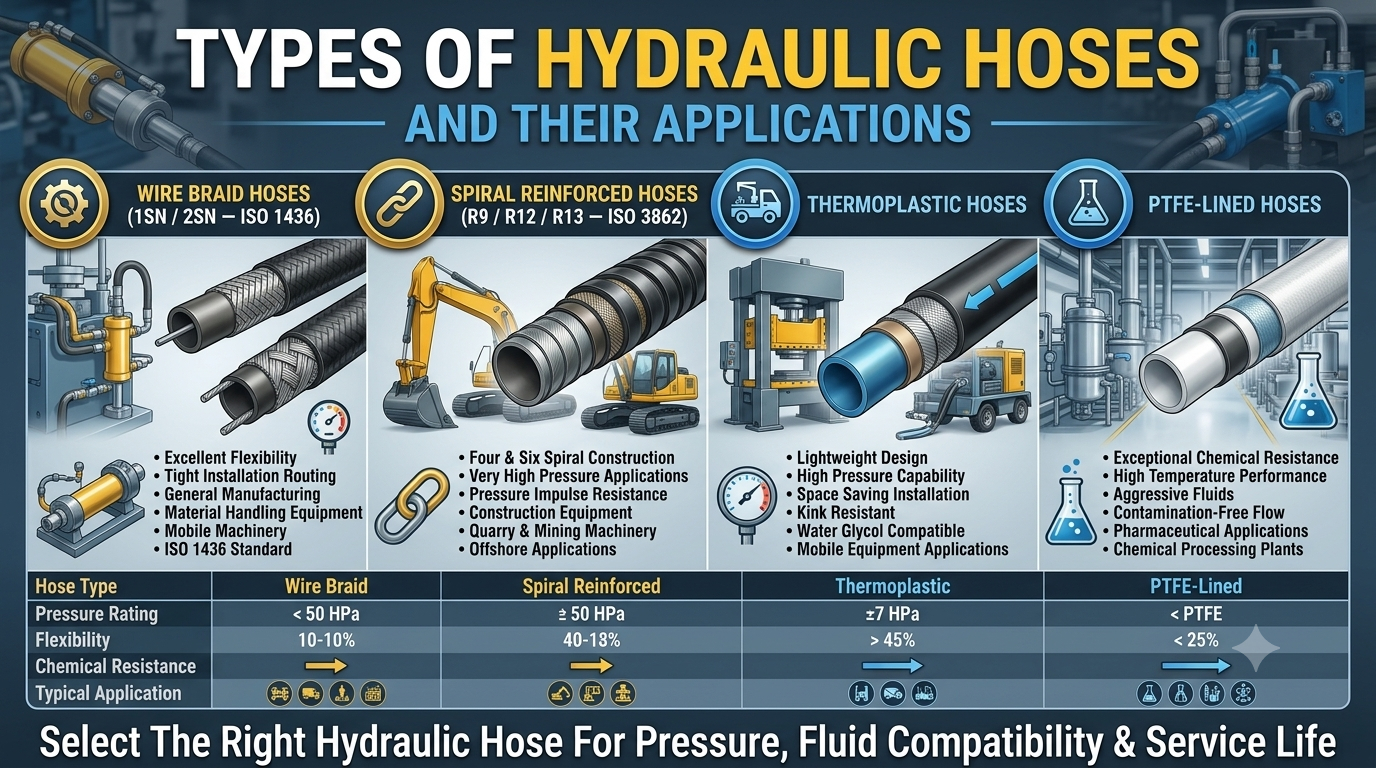
Not all hydraulic hoses are equal. The construction, reinforcement layers, and inner tube materials vary greatly between the types of hose; many hose failures are caused by the wrong hose being chosen. The table below outlines the main industrial hydraulic hoses used in industry throughout the UK.
Hose Type | Max Pressure | Flexibility | Typical Application |
1-wire braid (1SN/R1) | Up to 225 bar | Excellent | Low/medium pressure, tight routing |
2-wire braid (2SN/R2) | Up to 400 bar | Good | General industrial hydraulics |
4-spiral (R9/4SP) | Up to 420 bar | Moderate | Heavy plant, excavators |
6-spiral (R12/R13) | Up to 690 bar | Low | Very high-pressure systems |
Thermoplastic | Up to 700 bar | Very good | Compact, high-pressure, low weight |
PTFE-lined | Up to 700 bar | Moderate | Chemical-resistant, high-temp |
Wire Braid Hoses (1SN / 2SN — ISO 1436)
Single and twin steel wire braid hoses are the workhorses of standard hydraulic hose assemblies UK industrial applications. They offer excellent flexibility for tight installation routing and are widely used in general manufacturing, material handling, and mobile equipment.
Spiral Reinforced Hoses (R9 / R12 / R13 — ISO 3862)
Four and six-spiral hoses are specified for heavy plant, excavators, and industrial presses operating at very high working pressures. Their multi-layer steel spiral reinforcement resists pressure impulse fatigue — making them the preferred choice on construction fleets, quarrying equipment, and offshore machinery.
Thermoplastic Hoses
Thermoplastic hoses deliver very high pressure ratings in a compact, lightweight assembly — advantages valued on mobile equipment and in space-constrained industrial installations. They resist kinking and are compatible with a wide range of hydraulic fluids, including water-glycol and phosphate ester types.
PTFE-Lined Hoses
Polytetrafluoroethylene-lined hoses provide exceptional chemical resistance and wide temperature tolerance. They are specified in applications involving aggressive hydraulic fluids, high-temperature environments, or where fluid contamination from hose inner tube degradation must be eliminated.
Hydraulic Fitting Standards: BSP, JIC, and ORFS Compared
One of the greatest causes of compatibility issues and hydraulic leaks on UK industrial sites is fitting selection. There are three manufacturers that dominate the hydraulic hose fittings UK procurement, BSP, JIC and ORFS. It is crucial to have an understanding of their differences for proper selection.
Factor | BSP | JIC | ORFS |
Thread standard | British Standard Pipe | SAE 37° flare | O-ring face seal |
Sealing method | Taper thread / bonded seal | Metal-to-metal flare cone | Elastomeric O-ring |
Leak resistance | Good | Good | Excellent |
Typical pressure range | Low to high | Medium to high | High to very high |
Common use (UK) | Standard UK hydraulics | Mobile, off-highway | High-pressure industrial |
Vibration resistance | Moderate | Moderate | High |
UK standard prevalence | Very common | Common | Increasing |
BSP Hydraulic Fittings
BSP (British Standard Pipe) hydraulic fittings remain the most widely used connection standard across UK hydraulic systems. Available in parallel (BSPP) and taper (BSPT) thread forms, BSP fittings are compatible with the majority of UK-manufactured hydraulic equipment, power packs, and valves. They seal via a compression seal at the thread or with a bonded Dowty seal on parallel thread ports.
The British Standards Institution (BSI) defines BSP thread dimensions under BS 2779 and related standards. For UK facilities procuring replacement fittings or designing new circuits, BSP hydraulic fittings should always be the default selection unless the OEM specifies otherwise. For related connector types and specifications, see our Pipe Fittings Article which covers thread standards, sealing methods, and material options in depth.
JIC Hydraulic Fittings
The 37-degree flared cone interface, as specified in SAE J514, is the standard for JIC fittings, which are regularly employed in mobile hydraulic equipment, agricultural machinery and North America origin plant. JIC fittings provide adequate resistance to loosening due to vibration but are not interchangeable with BSP threads. Before ordering replacement assemblies, procurement teams need to check if they are required to order OEM equipment with either JIC or BSP connections.
ORFS Hydraulic Fittings
O-Ring Face Seal (ORFS) fittings are the most leak-tight of the three main standards, suitable for high pressure hydraulic hoses and for critical circuits in offshore and process industry applications. The flat-face O-ring seal prevents the vibration caused metal-to-metal contact point which can leak on threaded connections.
To find hydraulic system guidance for oil & gas facilities in the UK, where leak elimination is a safety and environmental issue.
How to Select the Correct Hydraulic Hose: A Procurement Framework
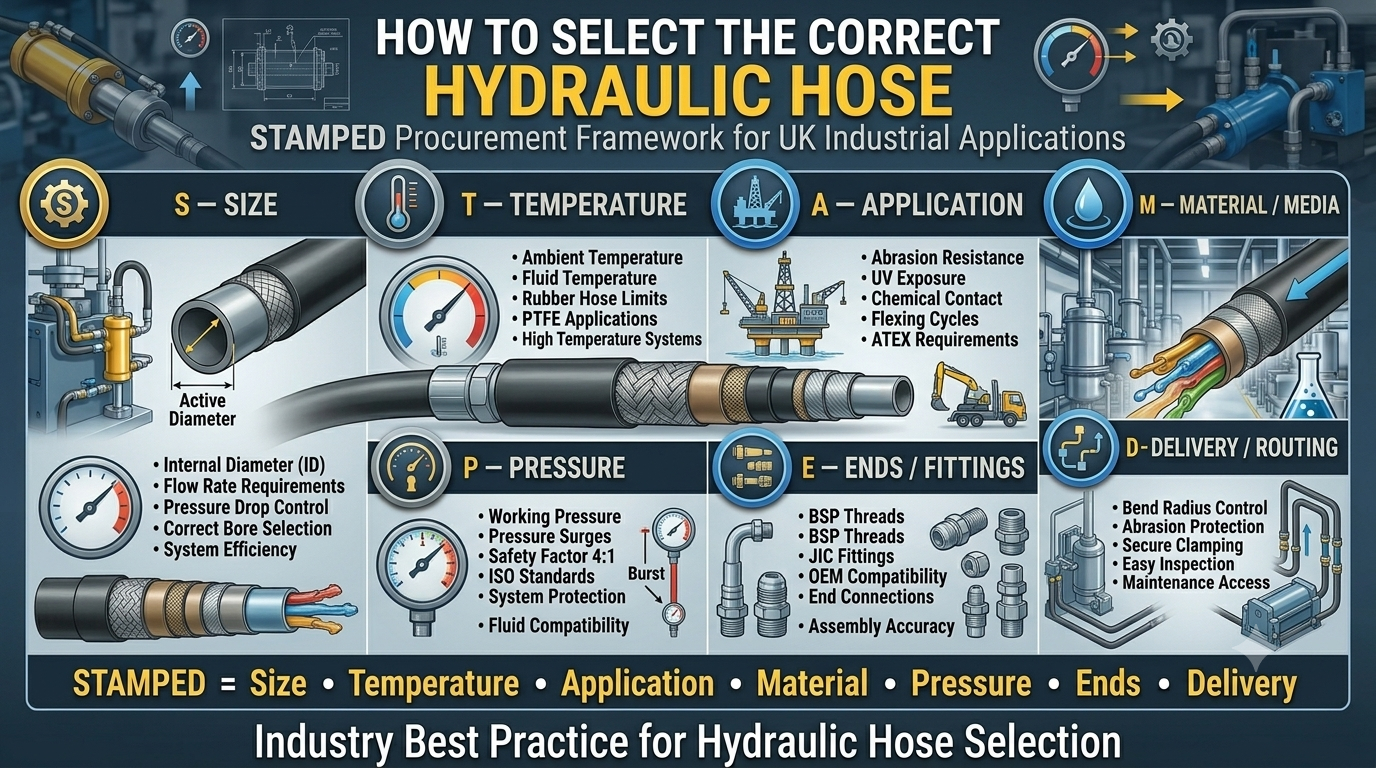
The selection guide for hydraulic hoses UK framework below outlines a logical method for specifying hoses for new hydraulic systems and for replacement of failed assemblies that are similar in design. Follow the industry standard selection checklist endorsed by the British Fluid Power Association (BFPA) – STAMPED.
S — Size
Verify the system flow rate and allowable pressure drop will use a hose of the proper internal diameter (ID). Too small hoses cause excessive velocity, heat, and hoses to wear out. Use manufacturer flow charts to determine appropriate bore for a given flow rate in your systems.
T — Temperature
State the hoses that are rated for the full ambient and fluid temperature they will be exposed to in the system. For high temperature use, standard rubber hydraulic hoses are limited to –40C to +100C, while PTFE lined and thermoplastic hoses can function at higher temperatures.
A — Application
Take into account the installation environment, such as abrasion exposure, UV, ozone, chemical contact, flexing cycles and regulatory requirements. Special cover materials and fire resistant hoses may be necessary for offshore or ATEX-zone installation.
M — Material / Media
Ensure that the inner tube material of the hose is suitable for the hydraulic fluid used (mineral oil, water-glycol, phosphate ester or biodegradable fluid). Swelling, degradation and fluid contamination occur when incompatible inner tube materials are used.
P — Pressure
Hose working pressure rating should be higher than the maximum operating pressure of the system (including pressure surges due to valve operation or system shock). The standard for the hydraulic hose industry for standard hydraulic hoses is a minimum 4:1 safety factor (burst pressure to working pressure) under ISO 6945 and BS EN ISO 1436.
E — Ends / Fittings
Check the type of fitting, standard thread and end configuration of both ends of the fitting to be assembled. Assemblies that are mixed standard, such as BSP on one end and JIC on the other, are standard on many pieces of equipment with mixed OEM heritage and must be requested.
D — Delivery / Routing
Carefully plan hose routing. Provide sufficient space for flexibility and movement at fittings without stress, avoid bends below minimum bend radius, avoid abrasion at fittings contact points with sleeving or clamps, make fittings accessible for inspection and replacement.
Industries Using Hydraulic Hoses and Fittings Across the UK
Construction and Plant
The biggest application-based market for hydraulic fittings for construction equipment UK is the hydraulic application in hydraulic excavators, piling rigs, telehandlers and mobile cranes used on construction sites in the UK. Construction is one of the toughest places for hose reliability due to high-cycle pressure impulse loads, abrasion and impact exposure, and the continuous-duty requirements. Several hydraulic service networks operate across the UK service locations throughout the UK for fast replacement of hoses.
Oil and Gas
High pressure hose fittings UK to meet very strict leak-free and fire-resistance standards are required for offshore platforms in the North Sea and for onshore process facilities at Grangemouth, Teesside and in Aberdeen. Applications such as wellhead equipment, BOP stacks, subsea controls, and process isolation valves are controlled by hydraulic systems and failures of the hose could have harsh safety and environmental consequences.
Manufacturing and Industrial Automation
High cycle fatigue life, cleanliness hydraulic hose assemblies are used throughout Birmingham and the wider UK Midlands in press brakes, injection moulding machines, robot arms and material handling systems. Hydroscand and Parker Hannifin provide factory-made assemblies to OEM and MRO requirements to manufacturing facilities throughout the UK.
Agriculture and Forestry
Hydraulic hose assemblies UK are used on agricultural machinery all over England, Wales, and Scotland, and they must be strong enough to withstand cold mud and exposure to UV rays in the field. Most of the agriculture hydraulic replacements are for braid hose in standard ISO sizes.
Mining and Quarrying
In the quarrying sector of the UK, drilling rigs, loaders and crushing equipment require high pressure spiral hoses that are capable of continuous vibration, abrasion and shock loading. A fast hose replacement capability is essential to minimize production downtime in a quarry.
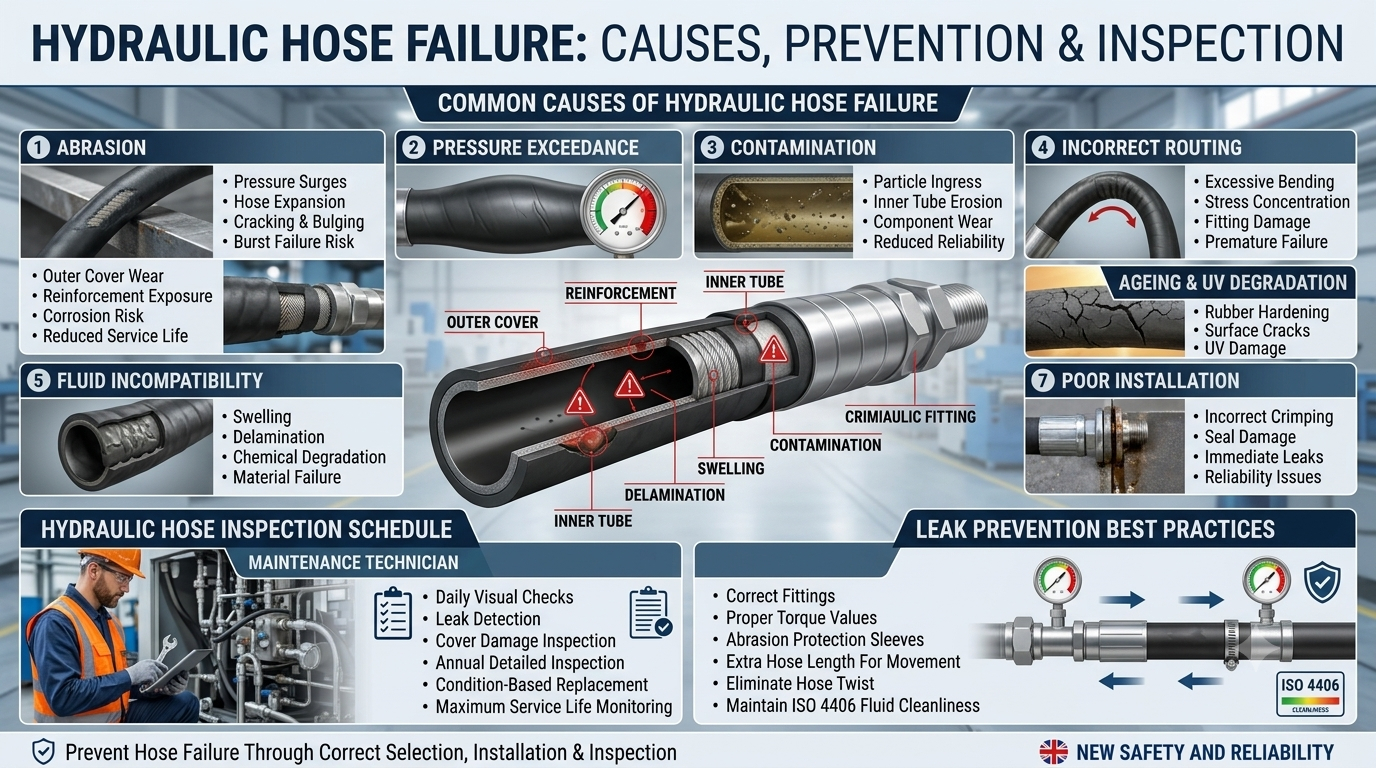
Hydraulic Hose Failure: Causes, Prevention, and Inspection
Common Causes of Hydraulic Hose Failure
Knowing about failure mechanisms gives procurement teams a better understanding of choosing the right hose and determining the right maintenance schedule:
Abrasion — friction against other parts, edges, or ground surfaces reduces the life of outer cover and allows reinforcement to corrode.
Pressure exceedance — Over time, these hoses will begin to display signs of wear and tear, such as cracks and bulges that occur when the pressure exceeds the hose's working pressure rating, or due to repeated pressure surges.
Contamination — particulate contamination in the fluid leads to erosion of the inner tube and in-situ components.
Incorrect routing — stress concentration occurs at the fitting crimp zone when bending below the minimum bend radius or routing under tension.
Fluid incompatibility — Chemical attack on the inner tube due to fluid incompatibility; swelling, delamination and progressive deterioration occur.
Ageing and UV degradation — rubber compounds harden and crack with age, especially when exposed to outdoor or high temperatures applications
Poor installation — the wrong crimp specification, under- or over torqued fittings or damaged sealing faces provides an immediate or latent leak path
Hydraulic Hose Inspection Schedule
The Health and Safety Executive (HSE) and the British Fluid Power Association (BFPA) both suggest that hydraulic hose assemblies should be the subject of documented inspection program. Key inspection activity is comprised of:
Daily visual checks — look for any visible leaks, fittings that are weeping oil, damage to the outer cover and kinking.
Periodic detailed inspection — cover for cracking or abrasion and hose routing for changes that cause stress should be done periodically (at least every 12 months).
Condition-based replacement — Replace any hose that is in any way deteriorated, no matter what the age of the hose is.
Time-based replacement — Set the maximum service life (MSL) for critical applications based on time, even if the hose appears to be fine; many OEMs have a standard MSL of 6 years for rubber hose assemblies.
Preventing Hydraulic Hose Leaks
The following are best practices for leak prevention:
Install fittings that are compatible with the hose and adhere to the manufacturer's crimp data.
Use the correct torque values for threaded fittings, use manufacturer tables, not estimates.
Use spring guards, spiral wrap or sleeve protectors to prevent abrasion of hoses at contact points.
Add at least 10% extra length of hose at each end to allow for movement and thermal expansion.
Eliminate twist at installation by using swivel fittings or 45/90° adaptor fittings.
To keep hydraulic fluid clean to ISO 4406 target cleanliness levels.
UK Standards and Compliance for Hydraulic Hoses
UK procurement of hydraulic hoses and fittings must reference the applicable standards to ensure fitness for purpose and legal compliance under UK health and safety legislation.
When purchasing hydraulic hoses and fittings in the UK, it is important to comply with the relevant standards, ensuring that the products are fit for purpose and conform to UK health and safety regulations.
In the UK key standards are relevant, which include:
BS EN ISO 1436 — Solid rubber hydraulic hoses and hose assemblies, wire braid reinforced (with wire up to 10mm diameter)
BS EN ISO 3862 — The rubber hydraulic hoses, spiral reinforced, high and very high pressure are covered by the following standard.
BS EN ISO 11237 — Compact wire braid hydraulic hoses.
BS EN ISO 6945 — This standard covers hose assemblies for hydraulic applications and defines their dimensions and requirements.
BS EN ISO 8434 — Metallic tube connections for fluid power, including ORFS and other types of fittings.
Pressure Systems Safety Regulations 2000 (PSSR 2000) — UK Legislation to ensure safe design, installation and maintenance of pressure systems
The British Standards Institution (BSI), Institution of Mechanical Engineers (IMechE) and Engineering Construction Industry Training Board (ECITB) all have guidance materials for engineers and procurement teams in the hydraulic industry in the UK.
Hydraulic Hose Assemblies: Make vs Buy
The maintenance team and MRO buyer in the UK are often required to make a choice between fabricating hose assemblies in-house with a workshop crimp machine, or buying them from a specialist hydraulic hose supplier UK.
In-House Assembly
The benefits of in-house crimping are:
Immediate response for unplanned break down events.
Stock flexibility – keep stock of hose and fittings apart.
High volume routine assemblies may be eligible for potential cost savings.
Requirements and risks:
Crimp machine required to be calibrated and maintained.
Training and use of manufacturer crimp data – incorrect crimps are the cause of fitting pull off under pressure – operators must be trained.
A record of assembly should be kept for traceability purposes.
Factory-Made Assemblies
The factory-made assemblies are pressure tested, traceable and produced with a consistent quality from suppliers like Parker Hannifin, Gates, Pirtek, and Hydroscand. Where safety is paramount and liability is to be avoided, such as in offshore, high-pressure or ATEX classified applications, it is generally preferable to factory assemble components, with full documentation, to minimize risk and liability.
People Also Ask: Quick Answers
What is the difference between BSP and JIC fittings?
BSP fittings are made to the British Standard Pipe threads standard and are the most common fitting standard in all UK hydraulic systems. JIC fittings are standard on mobile or North American equipment and have a 37-degree flared seating. The two standards cannot be substituted for each other.
How many psi is the pressure rating of a hydraulic hose?
The working pressure rating of the hose should be greater than the maximum operating pressure of the system including shock spiking. The minimum 4:1 safety factor is generally used for the burst pressure and working pressure, following industry practice and BS EN ISO hose standards.
When should hydraulic hoses be changed?
Replacing should be done based on condition – as per routine inspections. Some OEMs stipulate that rubber hose assemblies have a maximum service life of 6 years, however they appear to be in good condition. Replacement of hose should be considered if any parts are visibly deteriorated.
Do the UK use BSP fittings?
Yes. BSP hydraulic fittings are the most common connection standard in use throughout UK hydraulic equipment, and fit most British-made machinery and power units.
What are ORFS fittings used for?
O-Ring Face Seal (ORFS) fittings offer very good leak protection in high-pressure and vibrated hydraulic circuits. They are the preferred choice in process-industry applications with demanding requirements, in oil and gas and in offshore applications where absolute zero-leak performance is the requirement.
Is it possible to repair hydraulic hoses?
Hydraulic hoses and fittings are seldom repaired and are always replaced when damaged. Hose inserts and other such field repair items cannot restore the original pressure rating or structural integrity of the assembly, and are extremely dangerous to use on pressurized assemblies.
Summary
It's more than just a match of the bore size and pressure rating that is required in hydraulic hoses specification UK industrial operations require. The reliability of a hose assembly in service depends on the following factors, which are all standard issues: compatibility of fluid and temperature, routing, quality of installation and monitoring.
Whether it's for new equipment installation, creating a maintenance stock program, or investigating a persistent leak issue on critical plant, the structured approach outlined within this guide (STAMPED selection, standards compliance and condition based maintenance) lays the foundations for better decisions and longer hose life.
To learn more, visit our Hydraulic Equipment Pillar, Pipe Fittings Article and our Oil & Gas Page for more technical information on hydraulic systems, fluid connectors, and industry maintenance in the UK.
DISCLAIMER: Z&F Corporation is not affiliated with, authorized by, endorsed by, or acting as an official representative of any manufacturer, brand, or trademark owner referenced on this website. All product names, trademarks, brand names, logos, and manufacturer references are the property of their respective owners and are used solely for identification, reference, and compatibility purposes.