What Is a Residual Current Device (RCD)? A Beginner's Guide for New Buyers
If you're new to specifying electrical protection — perhaps stepping into a facilities or procurement role for the first time — the residual current device (RCD) is one of the first components worth understanding properly. It's a small, unassuming part of the distribution board, but it does a specific safety job that a standard circuit breaker cannot do on its own. This guide explains what an RCD is, how it works, where it's used, and the basic types you'll come across as a new buyer.
Need help choosing the right RCD for your site?
Definition & Purpose
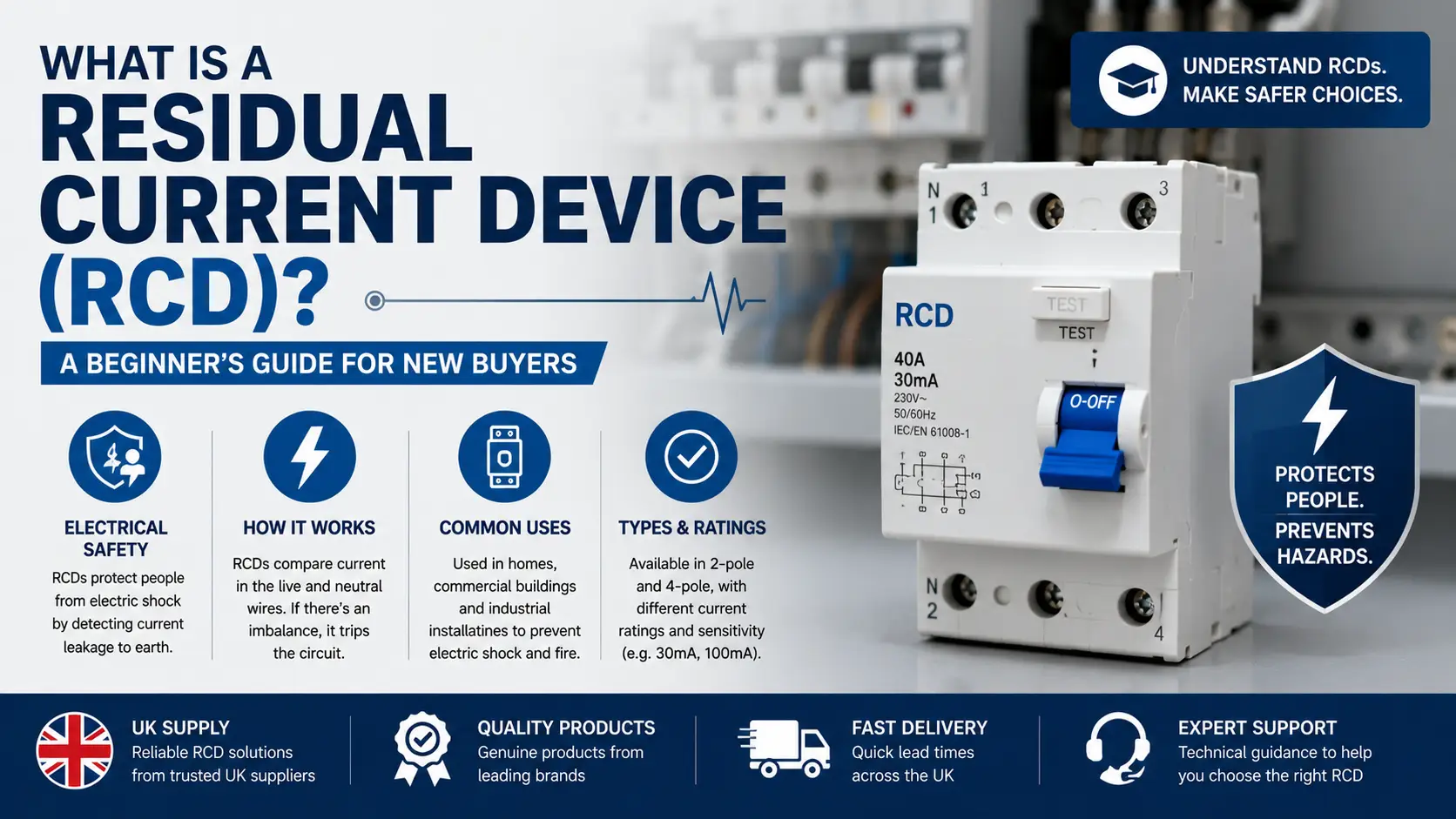
A residual current device (RCD) is a safety device that continuously monitors the current flowing into a circuit against the current flowing back out. If there's a difference — because current is leaking to earth through a fault, damaged cable, or a person accidentally becoming part of the circuit — the RCD disconnects the supply within milliseconds. Its job is fundamentally different from an MCB: an MCB protects the cable and connected equipment from overload and short-circuit current, while an RCD protects people from electric shock.
How It Works
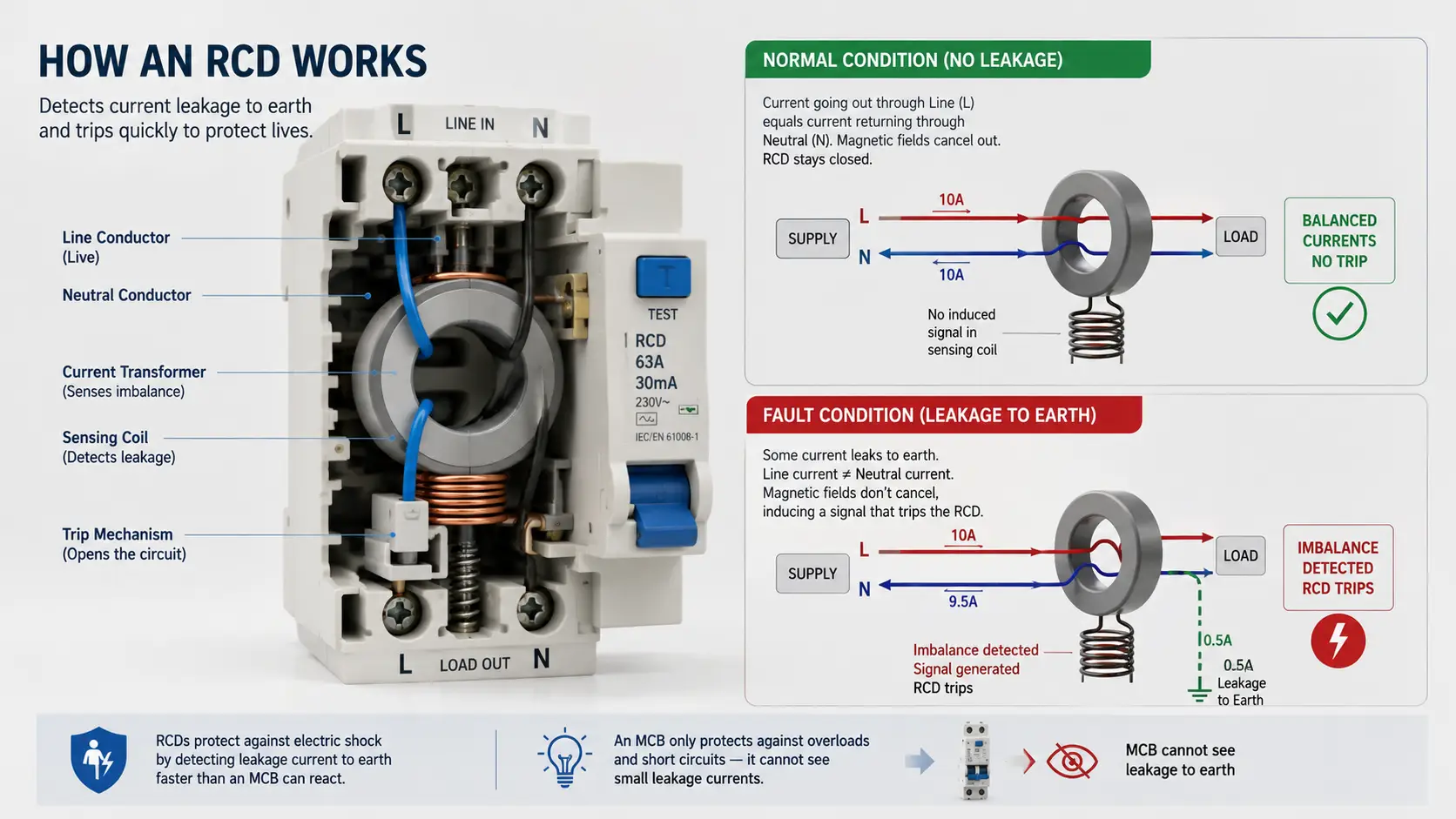
Inside an RCD, both the line and neutral conductors pass through a small current transformer. Under normal, healthy conditions, the current going out through line equals the current returning through neutral, so the magnetic fields they generate cancel out. If some current is leaking to earth instead of returning through neutral, the fields no longer cancel, inducing a small signal in a sensing coil that trips the device. This is why an RCD can detect a fault an MCB simply can't see — the total current draw might still be well within the MCB's rating even while a dangerous leakage current is present.
Where It's Used
RCDs are specified wherever there's an increased risk of electric shock: socket outlets, circuits supplying portable equipment, outdoor and bathroom circuits, and increasingly as a general requirement across final circuits in the 18th Edition wiring regulations (BS 7671). In industrial and commercial settings, they're commonly found protecting welfare facilities, workshop socket circuits, and any equipment used in damp or conductive environments — water treatment works being a good example of a site where RCD protection is applied extensively, given the combination of washdown areas, submersible pumps and outdoor plant.
As a new buyer, it helps to remember that an RCD is a requirement layered on top of, not instead of, standard overcurrent protection. A distribution board typically pairs each RCD (or a single upstream RCD covering several ways) with MCBs for individual circuits, so when you're pricing up a board refurbishment or new installation, RCD protection is usually one line item among several rather than a standalone purchase. If you're unsure whether a particular circuit needs RCD protection, BS 7671 Section 411 is the reference point your electrician or panel builder will be working to — as a procurement contact, it's enough to know the requirement exists and to ask the question early rather than after the board has been built.
Basic Types
Type | Detects | Typical Use |
|---|---|---|
Type AC | Sinusoidal AC residual current only | Basic domestic/light commercial circuits (increasingly superseded) |
Type A | AC plus pulsating DC residual current | Circuits with electronic loads (most modern general-purpose use) |
Type F | Type A plus higher-frequency residual currents | Circuits with variable speed drives or single-phase inverters |
Type B | Type F plus smooth DC residual current | EV charging points and three-phase inverter/drive circuits |
RCD, RCBO or RCCB — Getting the Terms Straight
If you're new to this product area, the overlapping terminology is the first stumbling block. Here's the short version: RCD is the general umbrella term for any device that trips on residual (earth leakage) current. RCCB (residual current circuit breaker) is a standalone device that provides earth fault protection only — it does not protect against overload or short-circuit current, so it must be fitted alongside a separate MCB. RCBO (residual current breaker with overcurrent protection) combines both functions — earth leakage detection and overload/short-circuit protection — in a single DIN-rail device, effectively an MCB and RCD in one housing. Many new installations now favour RCBOs per circuit rather than a single RCCB covering a whole board, because a fault on one circuit only trips that circuit rather than taking out every socket on the board at once.
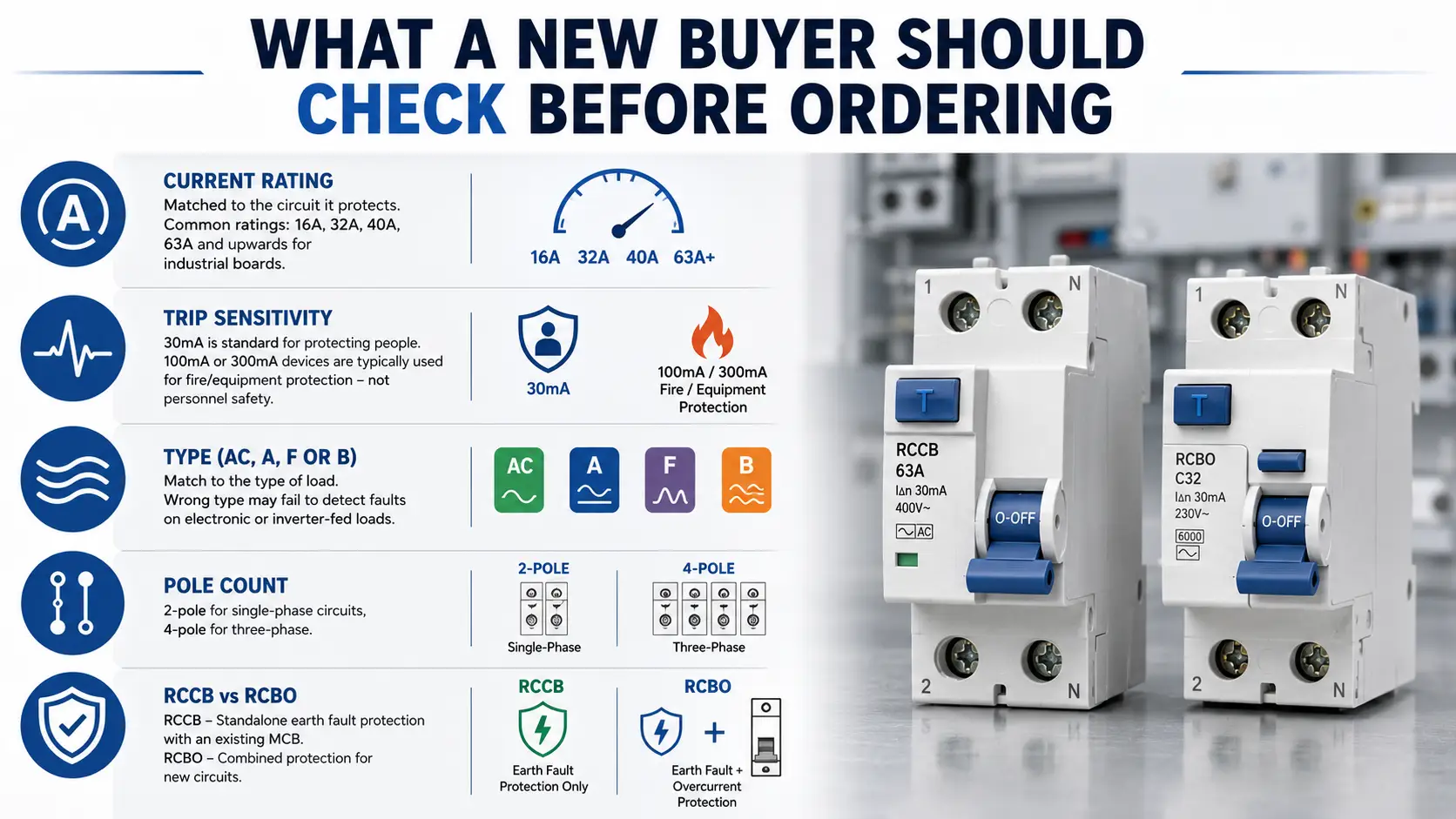
What a New Buyer Should Check Before Ordering
Current rating — matched to the circuit it protects (commonly 16A, 32A, 40A, 63A and upwards for industrial boards).
Trip sensitivity — 30mA is the standard for protecting people; 100mA or 300mA devices are typically used for fire/equipment protection rather than personnel safety, so don't assume a higher mA rating is simply "better".
Type (AC, A, F or B) — matched to the type of load, as covered above; getting this wrong won't necessarily stop the device tripping, but it may fail to detect the actual fault current present on a circuit with electronic or inverter-fed loads.
Pole count — 2-pole for single-phase circuits, 4-pole for three-phase.
RCCB vs RCBO — decide whether you need standalone earth fault protection alongside an existing MCB, or a combined device for a new circuit.
Brands We Supply for RCD Protection
ABB is our core stocked range for residual current devices, covering the FH200 and F200 series across the common current ratings, sensitivities and pole counts. Panel builds often pull in accessories from other manufacturers too, so here's what's genuinely on the shelf:
Brand | What We Stock | Brand Page |
|---|---|---|
ABB | Full RCCB and RCD-with-overload range, 16A–63A, 2 and 4-pole, Type AC and A | |
Allen Bradley | Auxiliary contacts, contactors and broader automation components for the same panel build |
Related Categories
Category | Description | Link |
|---|---|---|
Residual Current Devices | Full ABB residual current device range by current rating, sensitivity and pole count | |
Auxiliary Contacts | Auxiliary contact blocks for signalling RCD trip status |
Frequently Asked Questions
What is a residual current device (RCD) used for?
An RCD protects people from electric shock by detecting current leaking to earth and disconnecting the supply within milliseconds, complementing the overload and short-circuit protection provided by an MCB.
How do I choose between Allen-Bradley and ABB residual current devices?
As a new buyer, the choice usually comes down to what standard your panel builder or existing installation already uses; both brands offer comparable current ratings, sensitivities and pole configurations.
What standards apply to residual current devices (BS EN 61009)?
RCBOs (combined RCD and overcurrent protection in one device) are tested to BS EN 61009; standalone RCCBs are tested to BS EN 61008, and both sit within the wider requirements of BS 7671.
Can ZF Corporation source obsolete or discontinued residual current devices?
Yes — we can cross-reference discontinued RCD/RCCB part numbers to current equivalents where an older distribution board is being repaired rather than replaced.
What is the typical lead time for a residual current device in the UK?
Common current ratings and sensitivities (30mA being the most widely specified) are typically available from stock; less common combinations may carry a short lead time.
Conclusion
An RCD isn't a substitute for an MCB — it's a complementary safety device that catches the one thing an MCB can't: current leaking somewhere it shouldn't. Understanding the type (AC, A, F or B) that matches your load is the key thing to get right as a new buyer.
Ready to browse RCDs for your project?
Related guides: BS EN 61009 Explained (RCBO Standard) | More Industry Insights
Browse Our Product Range
DISCLAIMER: Z&F Corporation is not affiliated with, authorized by, endorsed by, or acting as an official representative of any manufacturer, brand, or trademark owner referenced on this website. All product names, trademarks, brand names, logos, and manufacturer references are the property of their respective owners and are used solely for identification, reference, and compatibility purposes.