Centrifugal Pumps UK: Industrial Buyer's Guide
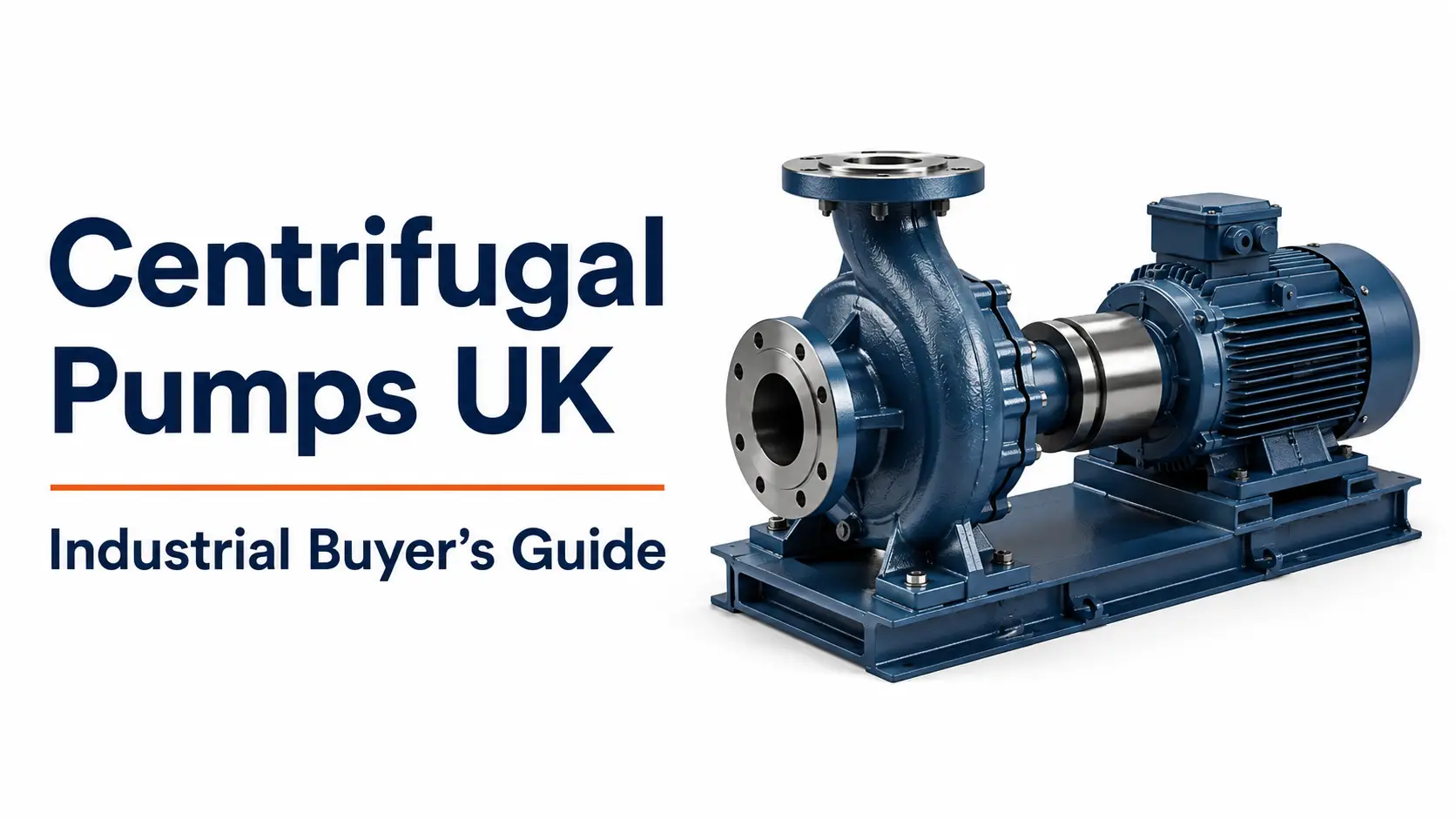
What is a centrifugal pump? A centrifugal pump is a dynamic mechanical mechanism which uses an engine or electric motor to impart rotational kinetic energy to a fluid that is then transformed into hydrodynamic energy and used to move the fluid. It uses a rotating impeller in a volute casing to create velocity and pressure of the fluid for continuous fluid transfer in a process pipeline.
Looking for a facility with fluid handling equipment? Specify your flow, head pressure and fluid viscosity needs and get a technical quote that matches your exact requirements.
How a Centrifugal Pump Works
The mechanical working of industrial centrifugal pumps UK plants used starts from the hydrodynamic theories. Fluid is fed into the pump suction eye axially and trapped by the rotating blades of the internal impeller. The centrifugal force created by the spinning of the fluid from the motor is responsible for the fluid moving radially outwards into the expanding volute casing.
The principle of Bernoulli is used, with the potential of converting high velocity kinetic energy to static pressure energy before the discharge. Heavy duty shaft bearings, dynamic seals and wear rings are key mechanical components that enable the fluid to move continuously and efficiently. If you are looking for a dependable flow system, check all of our industrial pumps used in manufacturing, chemical processing and utility systems.
Types of Centrifugal Pumps
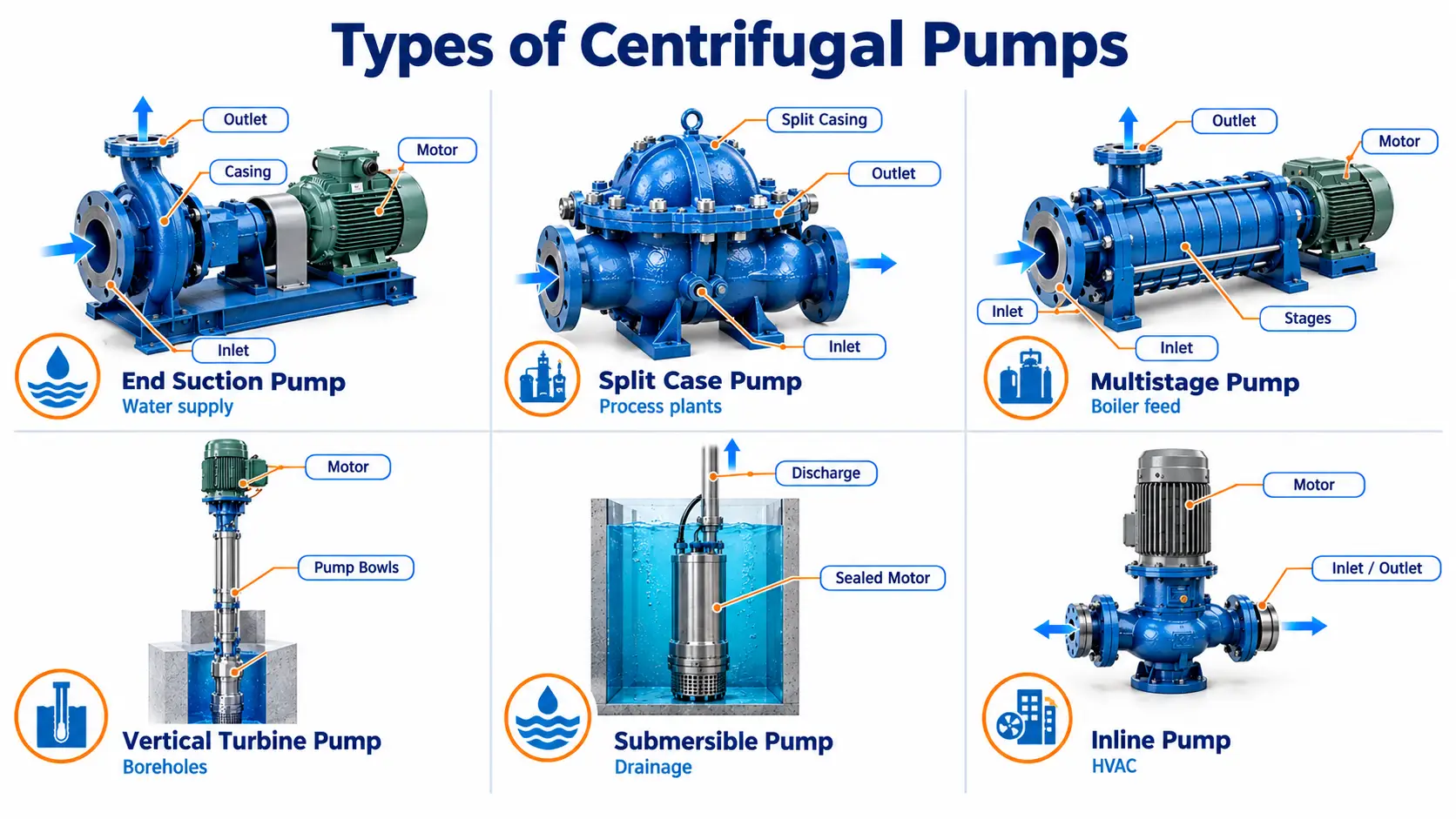
The proper pump architecture depends on matching hydraulic requirements of the system with mechanical designs. The table below details the main set-ups at processing plants:
|
Pump Type |
Flow Capacity |
Head Capability |
Best Application |
|---|---|---|---|
|
End-Suction |
Up to 1,500 m³/h |
Moderate (Up to 150 m) |
General water transfer, HVAC, light industrial fluids |
|
Vertical Turbine |
Up to 10,000 m³/h |
High (Up to 300 m) |
Deep-well extraction, cooling towers, raw water intake |
|
Multistage |
Moderate (Up to 800 m³/h) |
Very High (Up to 1,000+ m) |
Boiler feed water, reverse osmosis, high-pressure washing |
|
Self-Priming |
Up to 1,200 m³/h |
Moderate (Up to 90 m) |
Sump drainage, industrial effluent, entrained gas transfer |
End-Suction Centrifugal Pumps
The most popular design for centrifugal pumps UK factories use is end-suction. These units use an axial suction inlet and radial top discharge for economical transfer of clean liquid and low viscosity chemical.
Vertical Turbine Pumps
Vertical turbine pumps are suited for use in high capacity situations where suction lift is not feasible or the size of the footprint is restricted, using submerged impellers mounted on a vertical pump shaft.
Multistage Centrifugal Pumps
Multistage pumps can be used to increase the fluid pressure by stacking several impellers on a single shaft. They provide high head pressure for boiler feed water and high pressure washing loops.
Self-Priming Pumps
Self-priming units have an internal liquid reservoir that will automatically withdraw the air from the suction line during start-up cycles without referring to external foot valves.
For specialized fluid systems, review our complete selection of heavy-duty industrial pumps engineered for continuous-duty operation.
Pump Sizing: Flow, Head, NPSH & Power
A complete centrifugal pump selection guide is based on accurate hydraulic calculations to prevent cavitation and early mechanical wear. For a detailed breakdown of different pump mechanics, review our technical guide on industrial pump technologies.
Flow Rate (m³/h or GPM)
The Flow Rate is the amount of liquid needed through the system per unit of time at peak process demand.
Total Dynamic Head (TDH)
The total equivalent head the pump has to lift the fluid is called the TDH, which includes the head due to static elevation, the surface pressure differential, and head due to pipe friction losses.
NPSH Available vs NPSH Required
A correct NPSH calculation ensures no fluid vaporisation which is destructive. The Net Positive Suction Head Available ($NPSH_A$) from the piping system should be greater than the Net Positive Suction Head Required ($NPSH_R$) by the manufacturer with a minimum margin of 0.5 to 1.0 metres:
NPSH_A = P_s + H_s - P_v - H_f > NPSH_R
Power Calculation & Motor Sizing
Absorbed power is the value of fluid density ($\rho$), acceleration due to gravity ($g$), flow rate ($Q$), and total dynamic head ($H$) divided by pump efficiency ($\eta$):
P (kW) = (\rho \times g \times Q \times H) / (3600 \times \eta \times 1000)
Best Efficiency Point (BEP)
Choosing a pump at its Best Efficiency Point (BEP) will reduce hydraulic radial thrust, shaft deflection, noise and vibration
Material Selection for Industrial Service
In fact, the choice of metallurgy is determined by two factors: corrosion resistance and mechanical strength. The following Comparison Matrix correlates materials to fluid characteristics:
|
Material |
Corrosion Resistance |
Temperature Range |
Recommended Media |
|---|---|---|---|
|
Cast Iron (GG25) |
Low |
-10°C to 120°C |
Potable water, HVAC chilled water, glycol loops |
|
Stainless Steel 316 |
High |
-40°C to 250°C |
Organic acids, demineralized water, food-grade media |
|
Duplex SS (2205) |
Very High |
-50°C to 300°C |
Brine, sea water, mild sour gas condensate |
|
Exotic (Hastelloy/Titanium) |
Extreme |
-50°C to 400°C+ |
Concentrated sulfuric/hydrochloric acids, hot chlor-alkali |
Body and Impeller Materials
For non-corrosive utility water, cast iron is the material used, while Grade 316 stainless steel and Duplex alloys are used to stop pitting in chemical process lines. For rugged severe-duty applications, explore engineered solutions like Buffalo Pump units built for aggressive chemical processing.
Seal Options (Mechanical vs Packing)
Mechanical seals come in a variety of types: single, double cartridge, or gas-purged, all of which prevent fluid leakage to atmosphere. Packing procedures are still limited to the non-hazardous water services where small controlled leakage is allowed for cooling in the cooling shaft.
Standards & Compliance (UK + International)
Compliance means safety and dimensional interchangeability in industrial operating sites around the UK:
|
Standard |
Industry Scope |
Key Requirement |
|---|---|---|
|
API 610 |
Oil & Gas, Petrochemical |
Heavy-duty 20-year service life, centerline body mounting, cartridge seals |
|
ISO 5199 |
Chemical, Heavy Industrial |
Dimensional standardization, 17,500-hour bearing life, mechanical seal chambers |
|
BS 5151 |
General UK Processing |
British Standard for single-stage centrifugal pumps with end-suction layout |
Pressure-retaining pump casings that are used in Great Britain at pressures above 0.5 bar must meet the requirements of the Pressure Equipment (Safety) Regulations 2016 (PE(S)R). For electric motor drives, Hazardous installations with flammable hydro-carbon installations need Zone 1 or Zone 2 Certification (ATEX Directive 2014/34/EU). For portable utility transfer, a 230V electric centrifugal pump provides compact, reliable fluid movement.
Applications in UK Industry
High efficiency industrial centrifugal pumps UK suppliers supply are vital to key manufacturing industries in Great Britain:
-
Oil & Gas: Transfer and handling of crude oil and produced water at offshore support facilities, across Aberdeen's chemical cluster at Teesside, and Humber's refineries.
-
Chemical Processing: Aggressive solvent and acid transfer across major processing complexes in Grangemouth and Ellesmere Port. To compare positive displacement options for chemicals, see our chemical pump selection comparison.
-
Water & Wastewater: Utility lines that transport municipal sewage and distribute clean water.
-
Power Generation: High pressure boiler feed water and turbine cooling water circulation.
Common Failure Modes & Maintenance
Preventive maintenance reduces the occurrence of unplanned downtime. Failure modes consist of:
-
Cavitation: When $NPSH_A < NPSH_R, the vapor bubbles collapse violently against the impeller leading to pitting of metal surfaces.
-
Mechanical Seal Failure: Caused by dry running, crystallization of the fluid or extreme thermal shock.
-
Bearing Wear & Misalignment: Due to pipe strain or dynamic imbalance, which results in increased vibration of the shaft.
For specialized plant vacuum and air extraction systems running alongside fluid lines, integrate a specialized Airtech vacuum pump unit to maintain complete process control.
Procurement Checklist: 8 Parameters Before RFQ
Prior to requesting a quotation on a centrifugal pump from a UK supplier, a technical specification checklist should be filled in:
|
Parameter |
Specification Options |
Why It Matters |
|---|---|---|
|
Fluid Characteristics |
Clean water, sour crude, acid, slurry |
Determines corrosion/erosion resistance and metallurgy selection |
|
Flow Rate & Head |
m³/h, GPM / TDH in metres |
Establishes hydraulic duty point and impeller diameter sizing |
|
Fluid Viscosity & SG |
cSt / Specific Gravity ratio |
Viscous fluids require power correction factors per Hydraulic Institute standards |
|
Operating Temp |
Min / Normal / Max (°C) |
Dictates thermal expansion allowances, seal elastomer selection, and casing rating |
|
NPSH Available |
Metres absolute ($NPSH_A$) |
Must exceed pump $NPSH_R$ to prevent destructive acoustic cavitation |
|
Materials |
Cast iron, SS316, Duplex, Hastelloy |
Ensures long-term chemical compatibility and structural casing strength |
|
Seal Type |
Single/Double mechanical, packing |
Ensures zero atmospheric leakage compliance for toxic/hazardous media |
|
Compliance |
PE(S)R 2016, ATEX, API 610, ISO 5199 |
Mandatory for UK site safety and legal regulatory operation |
For compact chemical sampling or laboratory bench transfer lines, an off-the-shelf 110V centrifugal transfer pump provides a self-contained, versatile fluid transfer package.
Frequently Asked Questions (FAQ)
What is the difference between a centrifugal pump and a positive displacement pump?
With the centrifugal pump, the flow is variable with the pressure and is produced by a rotating impeller that imparts kinetic velocity to the fluid. Pumps that are positive displacement hold a fixed volume of fluid and pump a constant amount of fluid per unit of time, even when the head pressure changes.
How do I calculate NPSH for a centrifugal pump?
Net Positive Suction Head Available ($NPSH_A$) is calculated as the difference between the absolute suction pressure and the sum of the fluid vapor pressure and the suction pipe friction loss ($NPSH_A = P_s + H_s - P_v - H_f$).
What is cavitation in a centrifugal pump?
Cavitation is created when the fluid pressure drops below the vapor pressure at the impeller eye and vapor bubbles are formed, which collapse under the increased discharge pressure resulting in extensive metal erosion and noise.
What is the difference between API 610 and ISO 5199 pumps?
API 610 covers the high duty pumps used in the refinery that must be extremely safe and that will last for 20 years. The standard ISO 5199 is used for general chemical process pumps, having moderate pressure ratings and standardized dimensions.
What regulations govern industrial pumps in the UK?
Pump casings with a pressure rating greater than 0.5 bar must meet the requirements of the UK Pressure Equipment (Safety) Regulations 2016 (PE(S)R). Explosive area pumps must meet the ATEX Directive.
When should I choose a multistage centrifugal pump?
Use a multistage centrifugal pump when the required total dynamic head (TDH) is more than ~150 metres, for example, in boiler feed water, high pressure washing, reverse osmosis filters.
How does fluid viscosity affect centrifugal pump performance?
A high fluid viscosity (>100 cSt) will cause increased disc friction and a decrease in head pressure and flow capacity, as well as a substantial increase in the absorbed motor shaft power which results in performance de-rating.
What is the Best Efficiency Point (BEP)?
The Best Efficiency Point (BEP) is the point on a pump performance curve at which the pump is most efficient in energy transfer, thus with the lowest radial dynamic loads and vibration.
Should I use a mechanical seal or gland packing?
Ensure that mechanical seals are used on hazardous, flammable or aggressive chemicals to prevent leaks. Use of a clean water system with a limited amount of controlled cooling leakage is permitted and is considered reserve gland packing.
How do I prevent water hammer in centrifugal pump systems?
Install slow close check valves, soft-start variable speed drives (VSDs) or surge anticipation valves downstream of the pump discharge outlet to prevent water hammer.
Conclusion
Choosing high performance industrial centrifugal pumps UK operations depend on involves a combination of several factors such as hydraulic duty points, metallurgy compatibility, and regulatory requirements. When engineered correctly, flow rate, TDH, NPSH margins, and compliance certifications such as PE(S)R 2016 will ensure that systems operate in the most efficient manner and avoid unplanned system downtime due to maintenance issues.
Looking for a centrifugal pump expert who can match your process specification? Contact our trusted fluid handling experts today to ensure that you are matching products and getting advice on technical solutions independently.