High Tensile Bolts UK Industrial: Complete Guide for Structural, Mechanical & Heavy-Duty Applications
High tensile bolts UK industrial buyers would depend on are not interchangeable with standard fasteners. The number of the grade on the head of the bolt is not a bureaucratic detail. It is a matter of difference between a joint which will maintain its integrity when fully loaded and one which may fail, either during assembly, at vibration, or at the worst possible time during service. The first step in every serious fastener procurement decision is to understand which bolt grade, coating and certification your application truly requires for procurement engineers, maintenance managers and building contractors all across the UK.
Demand for certified structural fasteners remains high in the UK as a result of investment in infrastructure. High strength bolting remains in demand due to continuing investment in transport, energy, manufacturing and industrial infrastructure, according to 2025 figures published by the UK Construction Products Association (CPA) and infrastructure investment reports. The challenge for buyers is not finding high tensile bolts UK industrial projects can use. It is identifying the correct grade, coating, and compliance standard for the specific application, and sourcing them from a supplier with the documentation to back up what they are selling.
This guide covers everything UK industrial buyers need to make that decision: bolt grade comparison, tensile and yield strength specifications, coating options, applicable UK and international standards, application-specific selection guidance, and a practical supplier evaluation checklist. The British Standards Institution (BSI), the Steel Construction Institute (SCI), and the Institution of Mechanical Engineers (IMechE) all publish guidance that underpins best practice in UK industrial fastener procurement, and this guide draws on those sources throughout.
What Are High Tensile Bolts and How Are They Different from Standard Fasteners?
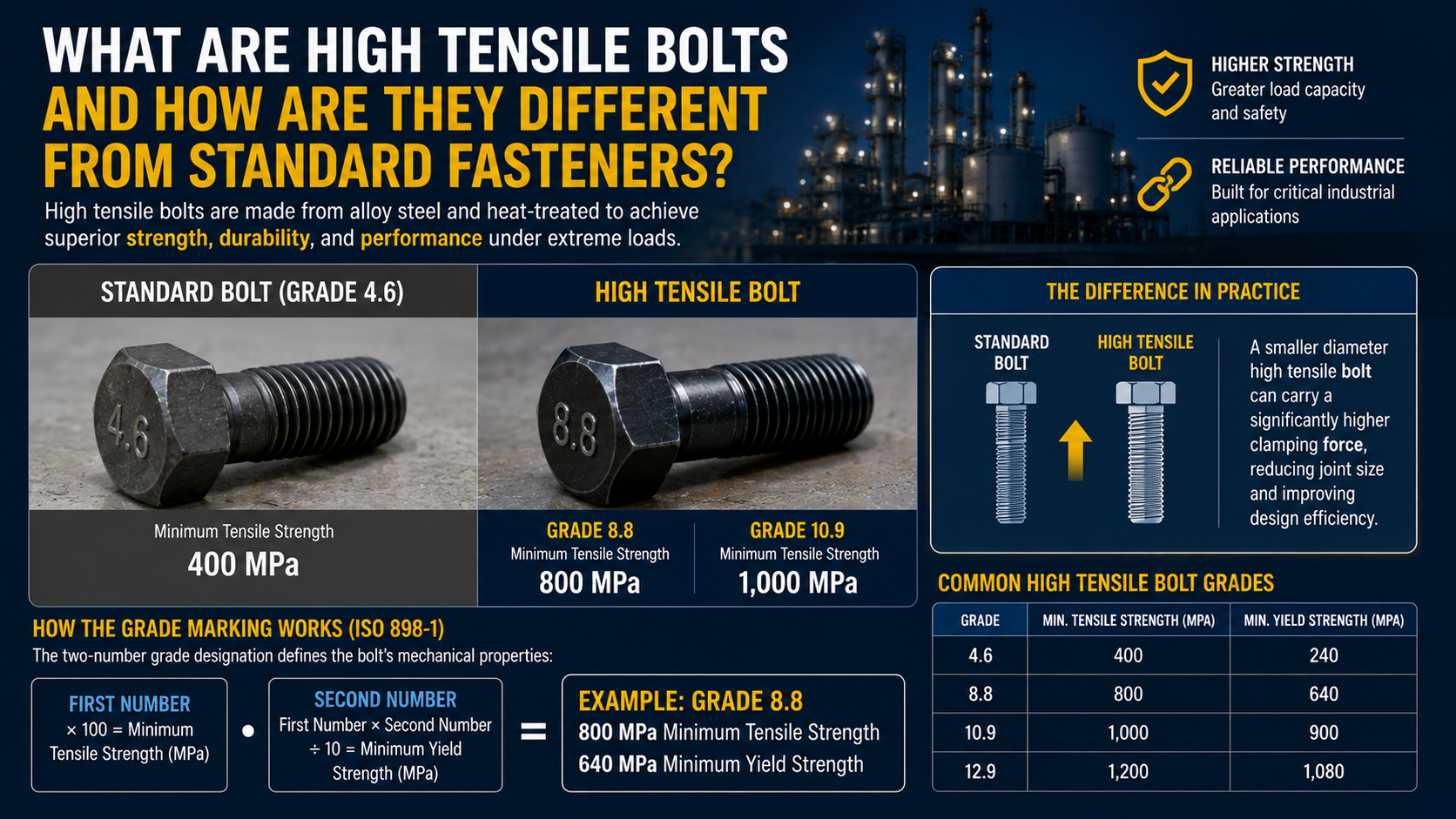
A high tensile bolt is manufactured from alloy steel and heat-treated to achieve tensile and yield strengths significantly above those of standard mild steel fasteners. The heat treatment process, typically quenching and tempering, aligns the grain structure of the steel in a way that dramatically increases both the load it can carry before yielding and the load at which it will ultimately fracture.
The difference in practice is substantial. A standard grade 4.6 bolt has a minimum tensile strength of 400 MPa. A grade 8.8 high tensile bolt delivers a minimum of 800 MPa. A grade 10.9 bolt reaches 1,000 MPa minimum. That is not a marginal improvement. It means a smaller diameter bolt can carry a significantly higher clamping force, which affects both joint design and the physical size of the fastener needed for the application.
The grade marking system for high tensile bolts UK industrial buyers will encounter follows ISO 898-1, which defines property classes for carbon and alloy steel bolts. The two-number grade designation tells you everything you need to know about the bolt's mechanical properties: the first number multiplied by 100 gives the minimum tensile strength in MPa, and the first number multiplied by the second divided by 10 gives the minimum yield strength. Grade 8.8 means 800 MPa minimum tensile strength and 640 MPa minimum yield strength. Grade 10.9 means 1,000 MPa and 900 MPa respectively.
High Tensile Bolt Grades Compared: 8.8, 10.9, and 12.9
The common mistake made by most buyers of bolts when comparing grades is that they don't consider the yield strength, which is the more important of the two numbers for most bolted joint applications. The values of yield strength correspond to the load at which the bolt has sustained permanent deformation. In an optimally designed bolted joint, the bolt is preloaded to a percentage of its yield strength. This "preload" is essential to ensure clamping during service loading for the joint. If the yield strength is exceeded, the bolt will permanently deform, joint integrity will be lost and preload will be lost.
High Tensile Bolt Grade Comparison Table
Grade | Min Tensile Strength | Min Yield Strength | Material | Best Applications |
Grade 4.6 | 400 MPa | 240 MPa | Low carbon steel | General purpose, non-critical fastening |
Grade 8.8 | 800 MPa | 640 MPa | Medium carbon alloy steel | Standard industrial, structural, machinery |
Grade 10.9 | 1,000 MPa | 900 MPa | Alloy steel, heat treated | Heavy industrial equipment, critical joints |
Grade 12.9 | 1,200 MPa | 1,080 MPa | Alloy steel, high temp treated | Maximum load, tooling, motorsport, aerospace |
ASTM A325 | 827 MPa | 635 MPa | Medium carbon steel | Structural steel connections (US standard equiv.) |
ASTM A490 | 1,034 MPa | 896 MPa | Alloy steel | Heavy structural connections |
Grade 8.8 is the workhorse of UK industrial fastening. It covers the vast majority of general machinery assembly, manufacturing plant installations, and structural connections where the load requirements do not justify the step up to 10.9. Grade 10.9 bolts for industrial machinery UK buyers specify are the standard choice for heavy equipment assembly, flanged pipe connections under pressure, and critical structural joints where the bolt count or size must be minimized without sacrificing joint integrity.
Grade 12.9 deserves a specific mention: it delivers the highest mechanical strength in the standard property class system, but it is also the most notch-sensitive grade. That means it is more susceptible to hydrogen embrittlement, more sensitive to surface defects, and requires more careful handling during installation. Using grade 12.9 bolts in applications where grade 10.9 will do is not conservative engineering. It is over-specification that introduces brittleness risk without a corresponding benefit.
UK and International Standards for High Tensile Industrial Bolts
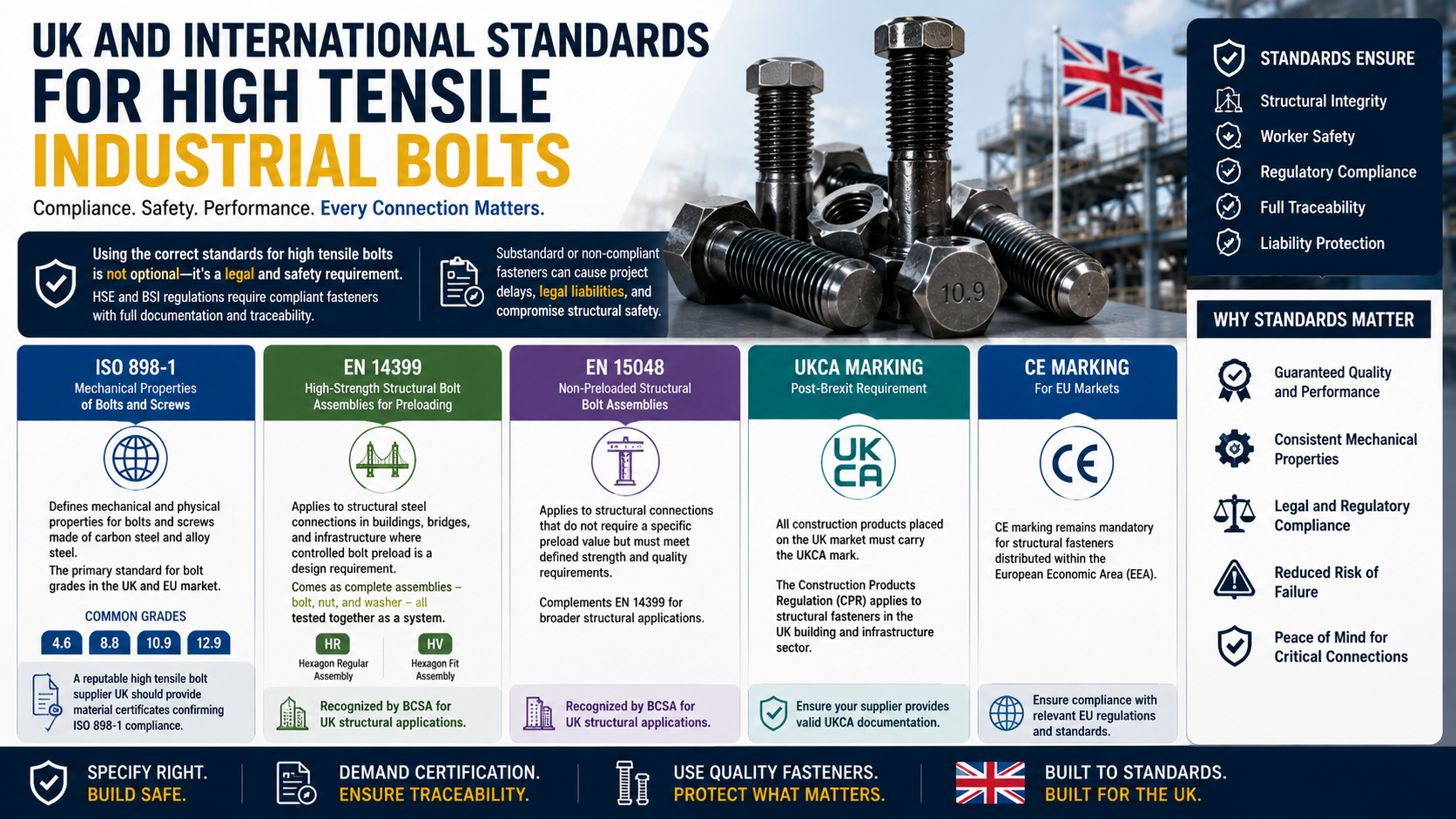
When it comes to bolted connections on UK industrial procurement applications, it's not an option to be unaware of which standards to use when connections are structurally or safety critical. Both the Health and Safety Executive (HSE) and the BSI have requirements which impact the specification of fasteners, their documentation and traceability in regulated settings. A substandard component or one not supplied by a standard that has a guarantee of providing compliance documentation has liability issues that far exceed the cost of the bolt.
ISO 898-1
Bolts and screws of carbon steel and alloy steel have been defined by ISO 898-1 regarding their mechanical and physical properties. It is the main standard for the range of grades (4.6, 8.8, 10.9, 12.9) throughout the EU and UK market.
EN 14399
EN 14399 covers high-strength structural bolt assemblies for preloading. This is the standard that applies to structural steel connections in buildings, bridges, and infrastructure where controlled bolt preload is a design requirement. Structural bolts UK construction and civil engineering projects specify under EN 14399 come as complete assemblies including the bolt, nut, and washer, all tested together as a system. The HR (hexagon regular) and HV (hexagon fit) designations within EN 14399 identify the specific assembly type.
EN 15048
EN 15048 covers non-preloaded structural bolt assemblies. Where EN 14399 governs controlled-preload structural connections, EN 15048 applies to structural connections that do not require a specific preload value but still need to meet defined strength and quality requirements. Both standards are recognized by the British Constructional Steelwork Association (BCSA) as appropriate for UK structural applications.
UKCA and CE Marking
Post-Brexit, all construction products brought onto the UK market will need to be branded with the UKCA mark not the CE mark. The Construction Products Regulation (CPR) applies to structural fasteners in the UK building and infrastructure sector, and as such, it is a procurement requirement, rather than good practice, to ensure that your supplier's products have valid UKCA documentation.
Coating Selection: Protecting High Tensile Bolts in Industrial Environments
A high tensile bolt's base material is alloy (iron based) steel and will corrode if it is not treated to protect its surface. For any application that requires exposure to the outdoors, in wet conditions, contact with chemicals or marine conditions, the coating selection is as critical as the grade selection. But most importantly, the coating shouldn't affect the mechanical components of the bolt — something that many high tensile bolts UK industrial buyers can overlook.
Hot dip galvanizing deserves special attention as the bolt is dipped into the molten zinc at about 450 deg. C. This temperature is higher than the tempering temperature used during manufacture of grade 12.9 bolts, and it can decrease the hardness and strength to below the minimum rated values. That is why, in general, hot dip galvanized grade 12.9 fasteners are not acceptable and that is why it is important to consider grade compatibility when specifying a hot dip galvanized high tensile fastener.
Coating Comparison for High Tensile Industrial Bolts
Coating Type | Corrosion Protection | Best Environment | Typical Thickness |
Zinc electroplating | Moderate (200-500 hours salt spray) | Indoor, controlled environments | 5-25 microns |
Hot dip galvanizing | Excellent (1,000+ hours salt spray) | Outdoor, industrial, construction | 45-85 microns (may affect thread fit) |
Mechanical galvanizing | Good (500-700 hours) | Grades 10.9 and below, outdoor use | 25-75 microns |
Delta-Tone / Delta-Seal | Excellent (1,000+ hours) | Critical fasteners, offshore, chemical | 6-10 microns composite |
Plain self-color (oiled) | Minimal (indoor only) | Internal machinery, protected environments | Oil film only |
Stainless steel (A2/A4) | Excellent corrosion resistance | Food, pharma, marine (lower strength) | N/A — material property |
Hydrogen embrittlement is the other coating-related risk specific to high tensile fasteners. Electroplating processes involve hydrogen absorption into the steel, and for high-strength grades (10.9 and above) this can cause delayed fracture under load. Reputable industrial fastener suppliers UK market should be able to confirm that their electroplated high-strength bolts have been baked after plating to drive off absorbed hydrogen, as required by the applicable standards.
Application-Specific Selection Guide for UK Industrial Buyers
Depending on the application, the right high tensile bolts UK industrial specification varies. The technical framework discussed above is actually used when figuring out how the grade, coating and standards relate to your specific industry and environment.
High Tensile Bolt Application Selection Guide
Industry / Application | Recommended Grade | Coating Requirement | Key Standard |
Structural steel connections (buildings) | Grade 8.8 or 10.9 structural bolt assembly | UKCA marking, HDG or self-color | EN 14399 (preloaded) / EN 15048 |
Heavy industrial machinery assembly | Grade 10.9 | Zinc plate or Geomet (indoor), HDG (outdoor) | ISO 898-1, manufacturer torque data |
Wind turbine and energy infrastructure | Grade 10.9 or 12.9 | Hot dip galvanized or Delta-Seal | EN 14399, IEC 61400-1 design basis |
Mining conveyor and plant structure | Grade 8.8 or 10.9 | Hot dip galvanized | ISO 898-1, HSE guidance |
Food processing and pharmaceutical | A2 or A4 stainless steel (not alloy HT) | None required (material provides protection) | BS EN ISO 3506 |
Outdoor construction and civil works | Grade 8.8 | Hot dip galvanized to BS EN ISO 1461 | EN 15048, UKCA marked |
Torque Specifications and Preload: Getting Installation Right
Selecting the correct high tensile bolts UK industrial applications demand is only half the equation. Correct installation is crucial for the correct functioning of the joint. The right grade 10.9 on the wrong torque is as effective as the grade 8.8 on the correct torque in the best case and as bad as the grade 8.8 on the wrong torque in the worst case.
The engineering parameter actually holding the joint is called bolt preload, or clamping force applied when the bolt is tightened. Torque is the indirect method of preload control when installing. The amount of torque applied to the nut and bolt mechanism is dependent on the friction properties of the thread and under the bolt head which are influenced by coating type, lubrication and the surface condition. When a dry torque value is used on a lubricated bolt, the preload may be 30 – 50% greater than specified, possibly exceeding the yield strength.
The IMechE endorse the use of manufacturer torque tables rather than generic torque tables for use, which match the bolt grade, size and coating condition. The combined method (part turn from snug tight position), the direct tension indicator (DTI) washer method or the calibrated torque wrench method are all known methods and have different accuracy properties for EN 14399 structural bolt assemblies requiring controlled preload.
To maintain the safety of fastened joints that are critical to safety in UK regulated industrial environments, such as manufacturing plants and heavy engineering, documenting torque settings and bolt grades in the maintenance management system provides the traceability record expected by the Health and Safety Executive (HSE).
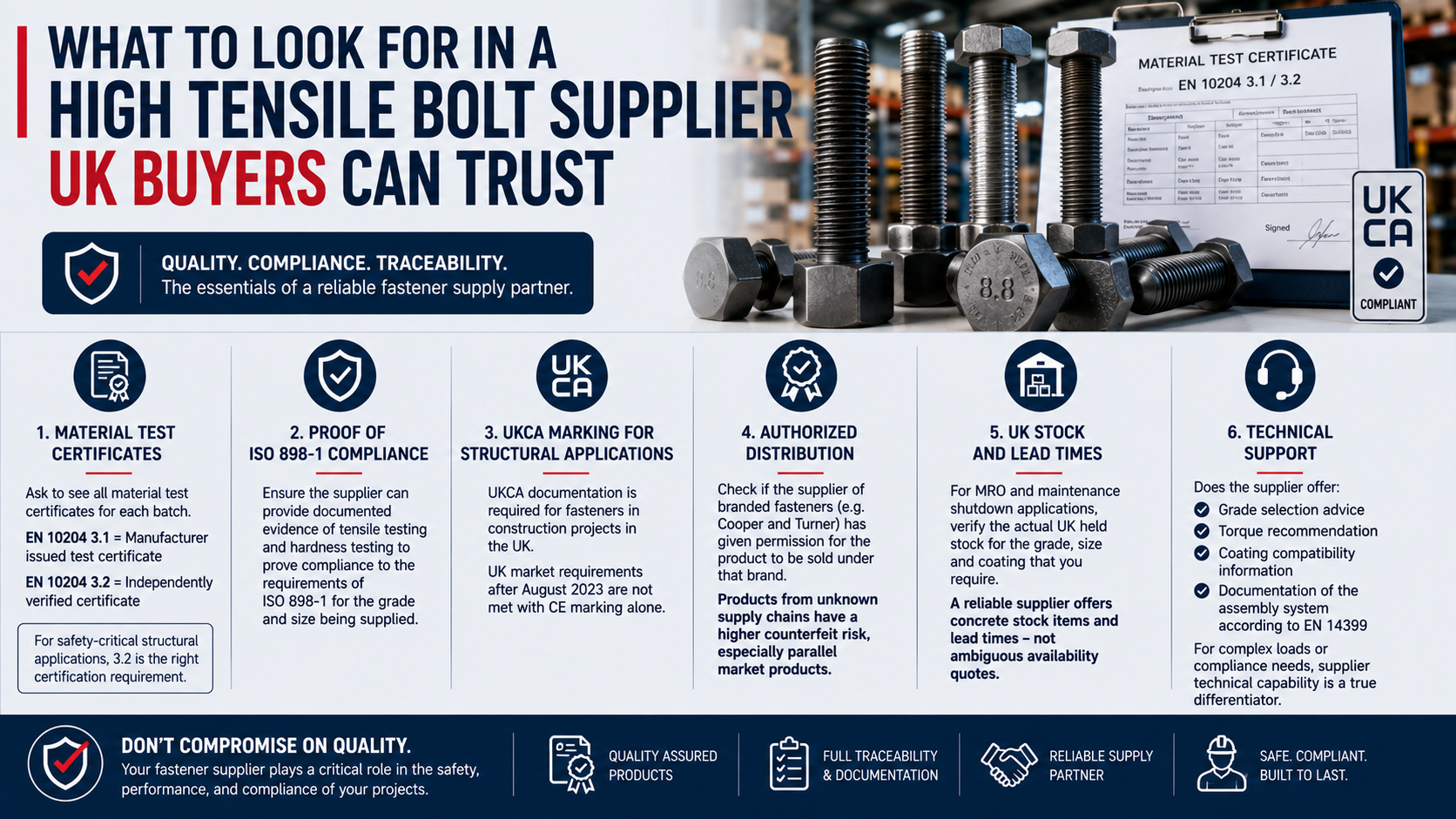
What to Look for in a High Tensile Bolt Supplier UK Buyers Can Trust
There is a well documented counterfeit product problem within the fastener supply chain both within the BSI and BCSA. This has been observed in many general industrial and structural applications where bolts have been used that have grade markings that do not correspond to the actual mechanical properties of the bolt. The danger is real. Structural connections using grade 8.8 properties are not always inspected visually, and if they are, engineering inspection may fail to detect safety-critical failure points if they were not designed with such properties.
Proof of ISO 898-1 compliance: Ensure the supplier can supply documented evidence of tensile testing and hardness testing to prove compliance to the requirements of ISO 898-1 for the grade and size being supplied.
UKCA marking for structural applications: UKCA documentation is required for fasteners in construction projects in the UK. UK market requirements after August 2023 are not met with CE marking alone.
Authorized distribution: Check if the supplier of branded fasteners has given permission for the product to be sold under that brand. Products from unknown supply chains have a higher counterfeit risk, especially parallel market products.
UK stock and lead times: For MRO and maintenance shutdown applications, verify the actual UK held stock for the grade, size and coating that you require.
Frequently Asked Questions — High Tensile Bolts UK Industrial Applications
Question | Answer |
What are high tensile bolts? | High tensile bolts are made of alloy steel and heat-treated to obtain great improvement in tensile strength and yield strength over that of ordinary mild steel bolts. Common grades are 8.8, 10.9, and 12.9, defined under ISO 898-1. |
What is the difference between grade 8.8 and 10.9 bolts? | The minimum tensile strength of Grade 8.8 bolts is 800 MPa and yield strength is 640 MPa. Grade 10.9 bolts have a tensile strength of 1,000 Mega Pascals, and a yield strength of 900 Mega Pascals. The specification is a grade 10.9 to be used in heavier industrial machinery, critical joints and applications where a higher preload is desired. |
What standards apply to high tensile bolts in the UK? | The standard ISO 898-1 covers the property classes of general fasteners. EN 14399 is for high strength structural bolt assemblies for preloading. The non-preloaded structural assemblies are covered by EN 15048. Construction products placed on the UK market must be marked with the UKCA. |
Are high tensile bolts stronger than stainless steel bolts? | Yes. The tensile strength of standard stainless steel bolts (A2-70, A4-70) is 700MPa. The high tensile alloy steel grade 8.8 has a tensile strength of 800 MPa, while grade 10.9 has a tensile strength of 1,000 MPa. The selection of stainless steel for corrosion resistance is not for maximum strength. |
What is the tensile strength of grade 8.8 bolts? | Most of the grades under ISO 898-1 specify a minimum tensile strength of 800 MPa, and a minimum proof load stress of 580 MPa for grade 8.8 bolts. |
What is the tensile strength of grade 10.9 bolts? | Grade 10.9 bolts have a minimum tensile strength of 1,000 MPa and a minimum proof load stress of 830 MPa for most thread sizes under ISO 898-1. |
What coatings are available for high tensile bolts? | Frequently used are zinc electroplating, hot dip galvanizing, mechanical galvanizing, Geomet, Dacromet, Delta-Tone and Delta-Seal coatings. It is not advisable to use hot dip galvanizing for grade 12.9 as the temperatures of tempering may affect the properties of the steel. |
Can high tensile bolts be used outdoors? | Yes, if they are coated for corrosion protection with an appropriate coating. Hot dip galvanized high tensile bolts are commonly used in the UK for various outdoor construction, industrial plant and infrastructure projects. |
What is the difference between structural bolts and standard bolts? | Structural bolts are made and tested in accordance with EN 14399 or EN 15048 for loading applications. They are supplied assembled with matched nuts and washers. Standard bolts are used for non-controlled preloading applications. |
What certifications should industrial fastener suppliers provide? | Material test certificates to EN 10204 3.1 or 3.2, ISO 898-1 compliance documents, UKCA documentation for construction use, batch traceability and authorized distributor documents for branded products. |
Which industries use high tensile bolts in the UK? | Construction & structural steel in England, Scotland and Wales, oil & gas (Aberdeen & offshore), manufacturing plant, mining, power generation, wind, transport infrastructure and heavy engineering in England, Scotland and Wales. |
How do I choose the right high tensile bolt? | Identify joint load (tensile, shear, or combined), preload requirements, operating environment and corrosion exposure, applicable standard, and whether or not there is a requirement for controlled preload. Coordinate the grade and coating to those needs. Check supplier certification prior to ordering. |
Conclusion
Sourcing high tensile bolts UK industrial projects depend on means more than matching a part number in a catalogue. The grade, coating, standard, and supplier certification are all engineering decisions with real consequences for joint integrity, safety compliance, and long-term reliability. A bolt that looks identical to the correct specification but is substandard in material or manufacture does not announce itself until it fails.
The framework in this guide gives you a structured approach: start with the load case and determine the minimum grade, choose the coating based on environmental exposure and grade compatibility, confirm the applicable UK and international standard, and evaluate your supplier against documentation and traceability criteria rather than price alone. For heavy duty bolts UK structural and industrial applications, this process takes more time than searching for the cheapest unit price. It saves significantly more time than dealing with the consequences of a fastener failure in a safety-critical application.
When selecting high tensile bolts for industrial applications, certification, traceability, standards compliance, and technical suitability should always be verified before procurement.
DISCLAIMER: Z&F Corporation is not affiliated with, authorized by, endorsed by, or acting as an official representative of any manufacturer, brand, or trademark owner referenced on this website. All product names, trademarks, brand names, logos, and manufacturer references are the property of their respective owners and are used solely for identification, reference, and compatibility purposes.