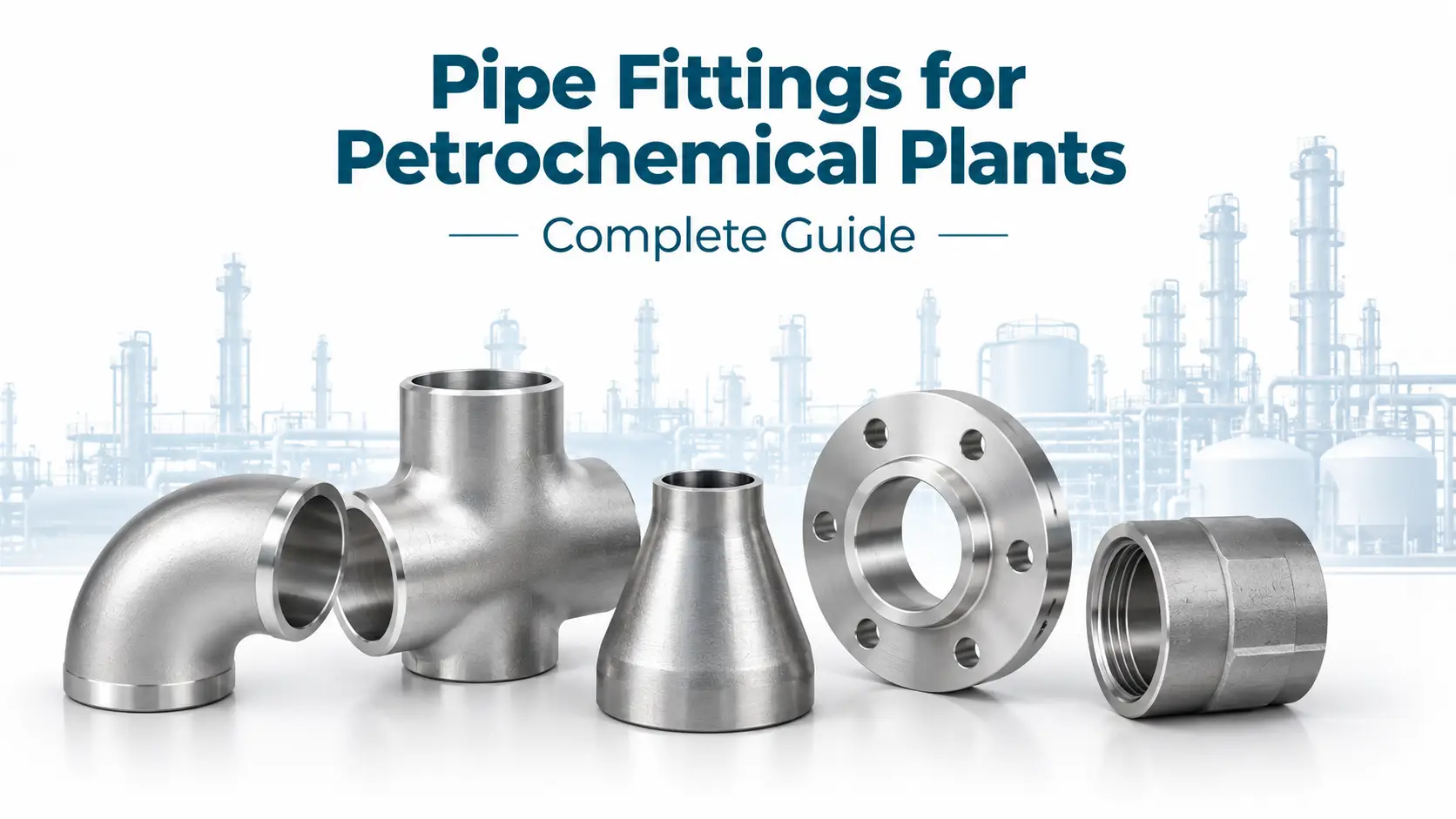
Pipe Fittings for Petrochemical Plants : Types, Materials & Industrial Applications
A wide range of connections, branches and transitions keep the piping system joined together; they are vital for every refinery, chemical plant and process facility. Choosing the right pipe fittings petrochemical is essential for plant safety, reliability, and compliance with regulations and standards, particularly in the field of petrochemicals. For all your needs ranging from maintenance shutdown at Grangemouth to sourcing replacement parts for a chemical plant in Teesside to specifying new petrochemical pipe fittings for a project in the North Sea, this overview helps you understand the various types of fittings and their material grades and standards that guarantee piping longevity in challenging hydrocarbon and chemical services.
Petrochemical Pipe Fittings are engineered components that are designed to connect, redirect, branch, reduce or terminate pipe systems that carry hydrocarbons, chemicals, steam, gases and process fluids under challenging industrial conditions.
What Are Pipe Fittings and Why Are They Critical in Petrochemical Plants?
Pipe fittings are devices used in a piping system to change direction, branch into multiple lines, vary pipe sizes, end lines safely, assemble and dismantle the system for maintenance or repair. In petrochemical plants, these fittings are installed directly within the pressure containment boundary of process systems that are laden with hydrocarbons, steam, and aggressive chemicals, where failure of any fitting would lead to a leak, fire, or even some kind of environmental incident that could have serious safety and regulatory implications.
Industrial pipe fittings are chosen to comply with the unique pressure, temperature and corrosion conditions of the particular process line, ranging from Grangemouth, Teesside, Humber to North Sea facilities. Most generally, fittings are built to ASME B16.9 (Butt weld) or ASME B16.11 (Socket weld and threaded) and provided in material grades according to ASTM specifications.
If you are looking for more information on piping system components such as flanges, valves and connection standards then view our Pipe Fittings Pillar which encompasses the complete range of pipe fittings employed throughout industrial and process applications.
Types of Pipe Fittings
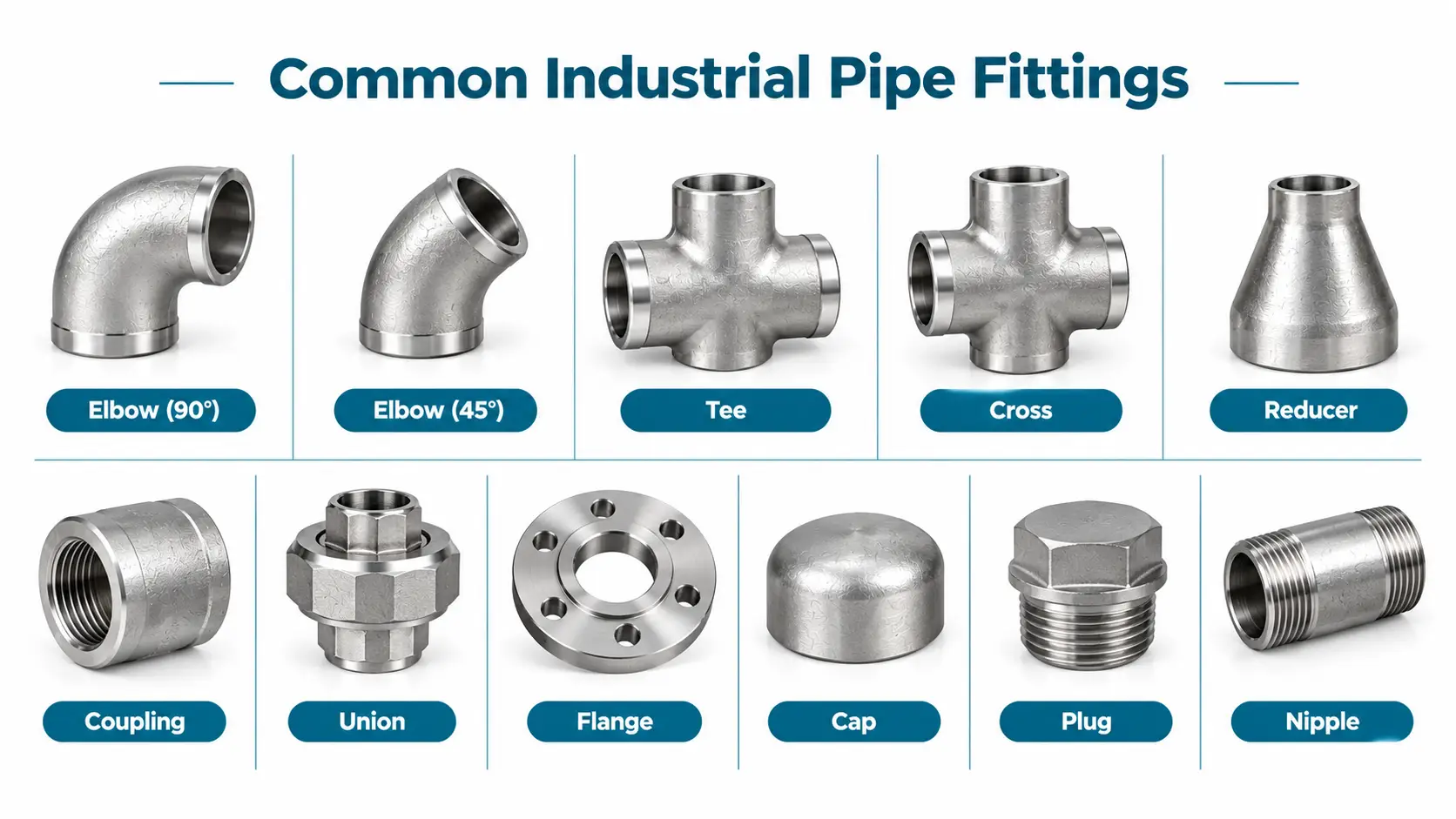
This table below provides a summary of the principle types of pipes that can be used for pipe fittings petrochemical specification, along with their purpose and common use in process pipe systems.
Fitting Type | Function | Typical Application |
Elbow (90° / 45°) | Changes direction of flow | Pipe routing around plant obstructions |
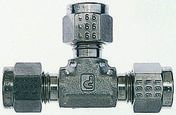
Tee (equal / reducing) | Creates a branch connection | Splitting or combining process streams |
Reducer (concentric / eccentric) | Connects two different pipe sizes | Transitioning between pipe diameters |
Cap | Closes the end of a pipe | Line termination, future tie-ins |
Cross | Four-way branch connection | Multi-directional flow distribution |
Stub End | Used with lap joint flanges | Bolted joints requiring rotation for alignment |
Coupling | Joins two pipe lengths in line | Small-bore high-pressure connections |
Union | Provides a removable joint | Maintenance access without cutting pipe |
Elbows
Elbows are used in piping to alter the direction of the flow, typically at a 45° or 90° angle. Most petrochemical process pipe lines use long radius elbows (1.5D), with this type having less erosion and pressure drop than the short radius (1D) elbow type which is used for space-constrained installations.
Tees
Process stream splits and merges are implemented using a Tee. The same size tees are used in all three outlets for equal tees and the reducing tees use a smaller branch outlet. The fittings that are most highly stressed in any system are the tees and should be carefully verified for wall thickness at the point of the branch connection under the appropriate piping design code.
Reducers
A reducer is used to join two different diameter pipes. Concentric reducers have the same centerline and are applied in vertical lines or when uniform flow distribution is desired, eccentric reducers offset the centerline and are used to prevent gas pockets, or to obtain a flat bottom for drainage of liquids, in horizontal lines.
Caps
Caps are to be used at the end of a pipe run to close the pipe and prevent process pressure from escaping. They are typically used at the end of header lines, for tie-in locations to be used later or to seal un-serviced branch connections.
Crosses
Crosses are used to join nodes together in four directions and, therefore, can be used to separate a flow and to direct one-half in one direction and the other half in another direction. They are less common than tees in current petrochemical designs because of the introduction of the extra stress concentration from the symmetrical branch geometry, but are still used on some of the older systems.
Stub Ends
Stub ends are employed in combination with lap joint flanges to form a bolted connection which is capable of turning for the alignment of bolt holes during installation. This is especially effective when the systems will be taken apart often for inspection or cleaning and/or exotic alloy pipes are being used with a lap joint flange made from carbon steel to cut material cost. See our Flanges Article for more information on Flange types used with Stub end assemblies, ANSI flange types, pressure classes and face configuration.
Couplings
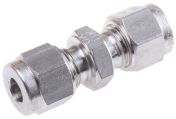
Couplings are used to connect two pipe lengths together straight. Small bore, high pressure instrument and utility connections are often designed for full or half couplings, usually as forged socket weld or threaded fittings to ASME B16.11.
Unions
Unions allow two parts of pipe to be removed without cutting, and are provided with a removable, bolted or threaded joint. They are common on instrument tubing, sample points and small bore utility connections where they need to be disconnected for maintenance periodically.
Butt Weld vs Socket Weld vs Threaded Fittings
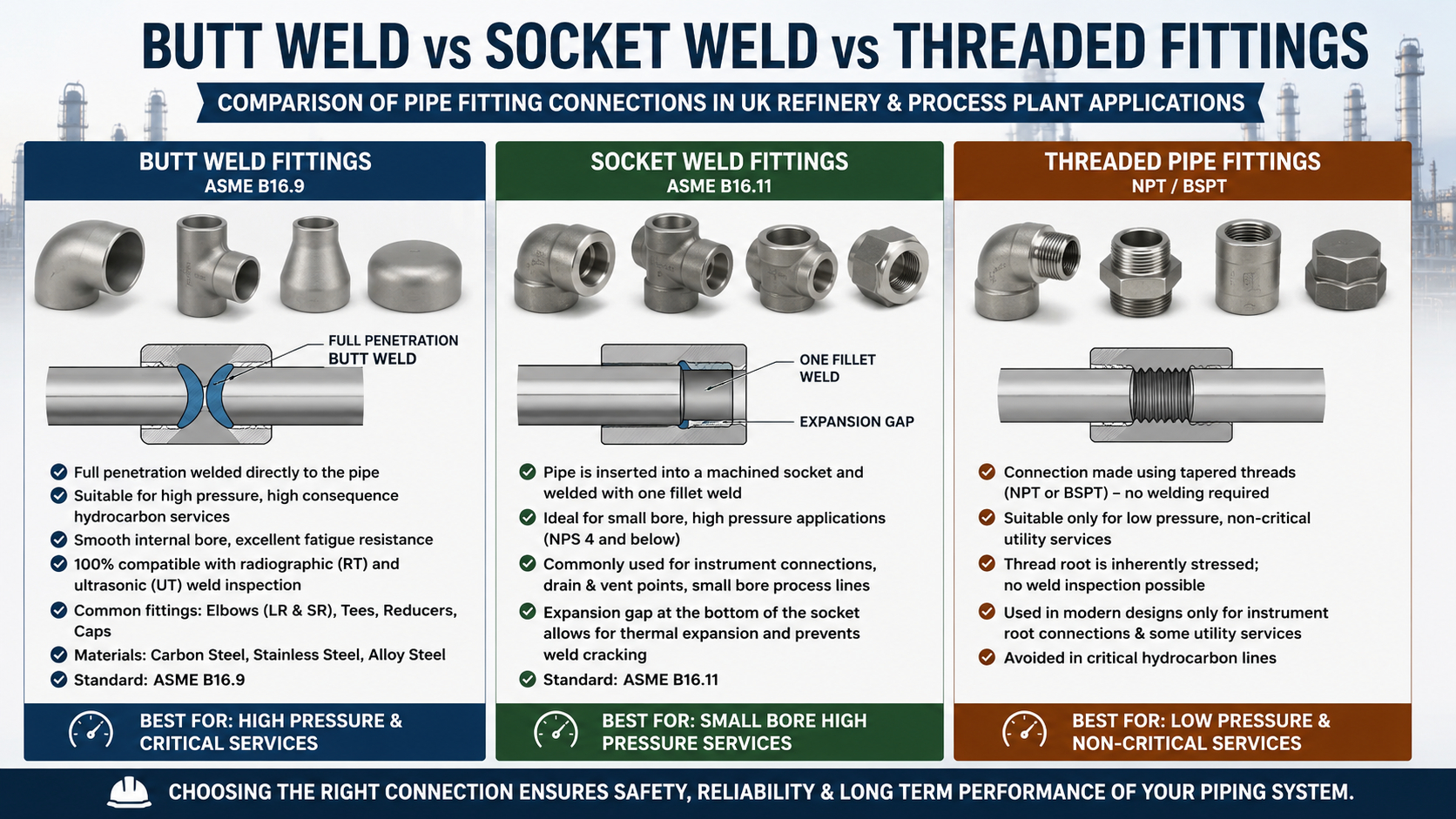
One of the most important specifications when choosing Petrochemical piping components is the type of connection that will be used. The following table shows a comparison of the three main types of pipe fitting connections used in refinery pipe fitting application.
Factor | Butt Weld | Socket Weld | Threaded |
Standard | ASME B16.9 | ASME B16.11 | ASME B16.11 |
Typical size range | NPS 1/2 and above | NPS 4 and below | NPS 4 and below |
Pressure suitability | All pressure classes | High pressure, small bore | Low to moderate pressure |
Installation method | Full penetration weld | Single fillet weld | Tapered NPT/BSPT thread |
NDT / inspection | Radiography possible | Limited NDT options | Not weld-inspectable |
Common use | Refinery process lines | Instrument & utility lines | Utility services, non-critical lines |
Butt Weld Fittings
The majority of petrochemical process piping over NPS 1/2 will be manufactured to a standard called ASME B16.9, commonly known as butt weld fittings. They are full penetration welded directly to the pipe and are essential for high pressure, high consequence hydrocarbon services for their smooth internal bore, excellent fatigue resistance and full compatibility with radiographic and ultrasonic weld inspection. Long radius elbows, tees, reducers, caps in carbon steel, stainless steel, alloy are all produced to ASME B16.9 for use in refinery and process plant.
Socket Weld Fittings
Small bore pipe lines (NPS 4 and below) of high pressure service applications are connected using socket weld fittings . The pipe end is inserted in a machined end joint and welded with one fillet weld. Forged steel fittings made for ASME B16.11 in the socket weld configuration are frequently used for instrument connections, drain and vent points and small bore high-pressure process lines. During assembly there is a small gap left at the bottom of the socket to allow for thermal expansion and weld cracking.
Threaded Pipe Fittings
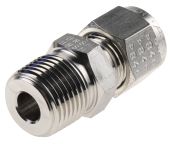
Threaded pipe fittings have either tapered NPT (National Pipe Thread) or BSPT (British Standard Pipe Thread) threads to provide a connection without welding. They can only be used for low pressure, non-critical utility services because the thread root is inherently stressed and weld inspection is not possible. In modern designs of hydrocarbon lines threaded connections are only used for instrument root connections and some utilized services, other than that they are avoided.
Pipe Fitting Materials Selection Guide
The selection of material for ASTM pipe fitting should consider the composition of the fluid that will be used in the process, service temperature, pressure, and corrosion mechanism in the service. The following table provides a summary of the most frequently-specified material grades.
Material Grade | Temp Range | Corrosion Resistance | Typical Use |
ASTM A234 WPB | -29°C to +425°C | Low | General hydrocarbon, steam, utilities |
ASTM A403 WP316L | -196°C to +425°C | High | Corrosive chemicals, sea water, hygienic |
ASTM A420 WPL6 | -46°C and below | Low | Cryogenic, LNG, low-temperature service |
Duplex (WP S31803) | -50°C to +300°C | Very high | Offshore, subsea, chloride environments |
Alloy WP11 / WP22 | Up to +600°C | Moderate | High-temperature steam, fired heaters |
ASTM A234 WPB Carbon Steel
ASTM A234 WPB is the most common specification for carbon steel pipe fittings in most hydrocarbon, steam and general process applications. WPB fittings are wrought carbon steel, designed for service in moderate temperature service, with the limit of use of the pipe seamless or welded is approximately 425℃. They are used as the norm throughout the refinery and chemical plant for non-corrosive hydrocarbon process lines.
ASTM A403 Stainless Steel
This is ASTM A403, in which the most commonly specified grade of stainless steel fittings for chemical service is WP316L wrought austenitic stainless steel. The low-carbon "L" designation is beneficial in preventing intergranular corrosion after welding, which is particularly important for process lines that transport acids, chlorides or other corrosive media. Hygienic and pharmaceutical process streams, adjacent to the product, requiring product purity are also called out for stainless steel fittings.
ASTM A420 Low Temperature Carbon Steel
Grade WPL6 according to ASTM A420 can be used for low temperature and cryogenic applications such as LNG handling, refrigerated storage tanks and cold utility lines. To ensure WPL6 fittings have sufficient toughness and to resist brittle fracture at minimum design temperatures, which is very important for any facility that is likely to be using cryogenic hydrocarbons, they are tested using Charpy impact testing at a minimum design temperature of -46°C.
Duplex Stainless Steel
Duplex stainless steel fittings (UNS S31803 / S32750) are designed to possess high strength along with very high resistance to chloride induced stress corrosion cracking (CISCC). They are specified in great detail for offshore and subsea use in the North Sea, where standard austenitic stainless steel would be prone to pitting and stress corrosion in sea water and produced fluid environments.
Alloy Steel Grades
Carbon steel becomes deficient in mechanical strength at high temperature and is therefore prohibited from use in high-temperature services like fired heater outlet, hot reheat steam lines and catalytic reactor piping, so that the use of carbon steel is not allowed for these. Such alloy grades have creep strength up to about 600°C and are critical for refinery process units that are operated at high severity.
ASME and ASTM Standards for Pipe Fittings
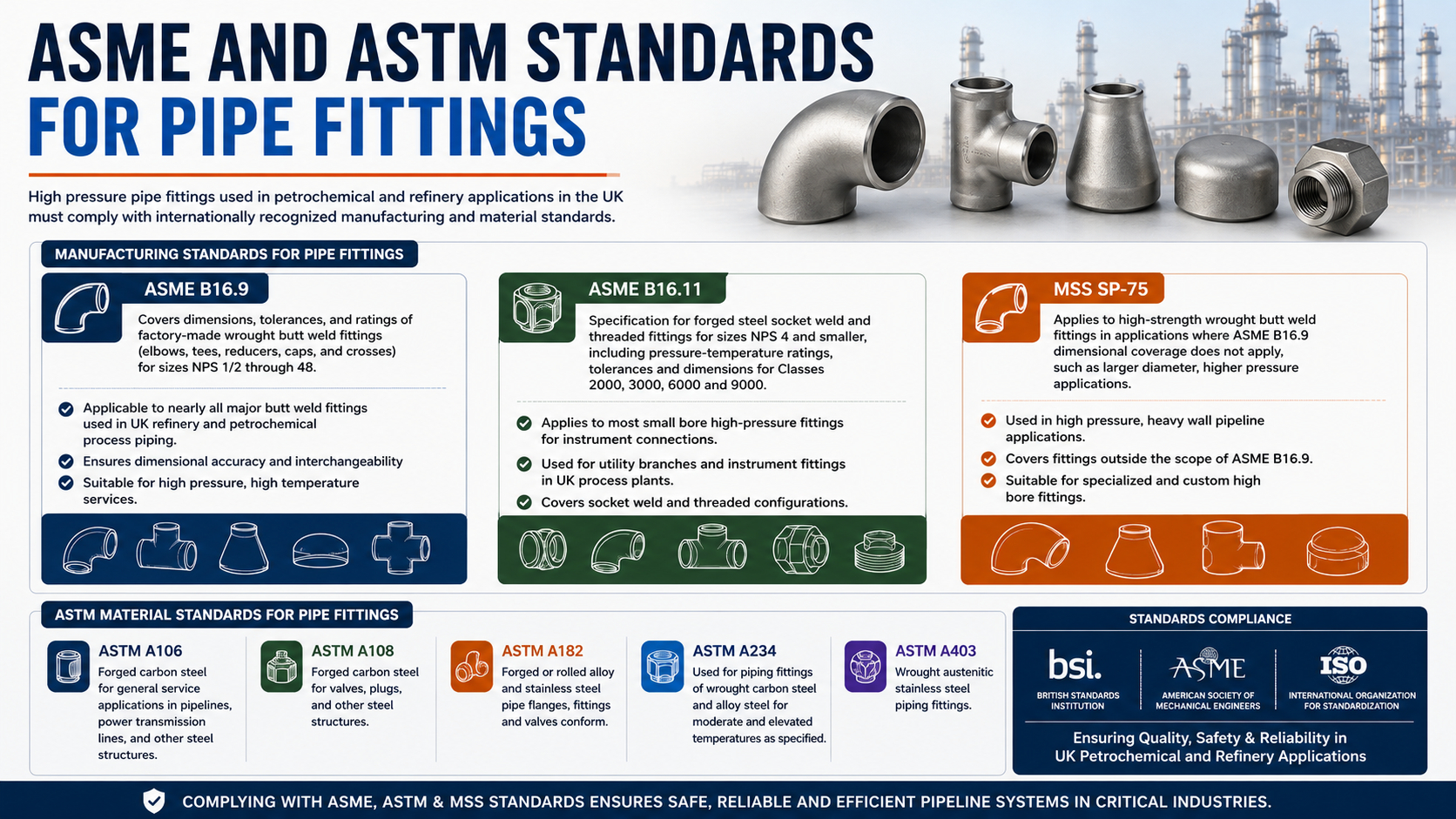
In a petrochemical service, high pressure pipe fittings must abide by recognized manufacturing and material standards as well. The important standards applicable to the fitting's manufacture, dimensions and materials are:
ASME B16.9
The standard that primarily covers the dimensions, tolerances, and ratings of factory-made wrought butt butt weld fittings (elbows, tees, reducers, caps, and crosses) for sizes NPS 1/2 through 48 is ASME B16.9. This standard applies to nearly all major butt weld fittings which are used in the in the manufacture of refinery and petrochemical process piping.
ASME B16.11
ASME B16.11 is a specification for forged steel socket weld and threaded fittings for sizes NPS 4 and smaller, including pressure-temperature ratings, tolerances and dimensions for Classes 2000, 3000, 6000 and 9000. This specification applies to most small bore high-pressure fittings for instrument connection and various utility branches of instrument fittings throughout process plants.
MSS SP-75
MSS SP-75 applies to high-strength wrought butt weld fittings in applications that are generally made where ASME B16.9 dimensional coverage do not apply, such as in larger diameter, higher pressure applications. It is used for specialized high bore fittings in high pressure heavy wall pipeline applications.
ASTM Material Standards
ASTM standards used to reference petrochemical pipe fittings are as follows:
ASTM A106 — forged carbon steel for general service applications in pipelines, power transmission lines, and other steel structures.
ASTM A108 — forged carbon steel for valves, plugs, and other steel structures.
ASTM A182 — Forged or rolled alloy and stainless steel pipe flanges, fittings and valves conform.
ASTM A234 — These are used for piping fittings of wrought carbon steel and alloy steel for moderate and elevated temperatures as specified.
ASTM A403 — wrought austenitic stainless steel piping fittings.
The standards landscape is a collective term created by the British Standards Institution (BSI), American Society of Mechanical Engineers (ASME) and International Organization for Standardization (ISO) to describe the standards that petrochemical procurement teams must adhere to when specifying compliant fittings.
Pressure and Temperature Considerations
Pipe fittings should be rated for the maximum operating pressure and temperature of the line in which they're installed, plus any upset or transient conditions. Butt weld fittings are manufactured to ASME B16.9 and the pressure rating is determined based on the wall thickness of the fitting compared to the wall thickness of the pipe, the fittings are usually supplied in the same wall thickness as the pipe (schedule) and the same pressure-temperature relationship as the pipe material itself in accordance with the relevant piping code (ASME B31.3 for process piping).
The following are important factors to consider when determining a pressure-temperature specification:
Design pressure/temperature — the fitting needs to have a rating for the entire design pressure and temperature range of the line, which includes any upset conditions.
Wall thickness matching — The thickness of the walls should be matching, and the pipe schedule to be installed should be at least equal to the connecting pipe schedule.
Reduction in allowable stress from elevated temperatures—Material group de-rating at temperature (ASME B31.3 Appendix A allowable stress tables).
Cyclic and fatigue loading — The fitting life is often shortened in services where frequent start-stop operations under cyclic and fatigue loading, such as thermal cycling and pressure fluctuation.
Under Health and Safety Executive (HSE), the Pressure Systems Safety Regulations 2000 (PSSR 2000), all pressure containing components, such as pipe fittings, are required to be designed, made and maintained to an appropriate level for the service conditions. A compliance risk is where the fitting specification is incorrect.
Pipe Fittings Used in Oil & Gas and Petrochemical Plants
In all oil and gas pipe fittings, fitting selection will depend on the requirements of upstream, midstream and downstream process systems.
Duplex and Super duplex fittings are used throughout a North Sea project in produced fluid applications where chloride level and/or sour service (H₂S) is a dominant criteria for material selection. Long radius butt weld elbows and reducers in carbon steel are highly critical components in midstream pipeline systems and are produced to close tolerances for automatic welding in pipeline construction.
The most diverse range of material grades is used in downstream refining and petrochemical units (distillation columns, catalytic crackers, reformers and associated process piping) for high-temperature and corrosive process streams, and for crude and product lines. See our Petrochemical Page for more information on other connection components that are used with these fittings, which are part of a process piping system and equipment specific to refinery and chemical plant operations.
Corrosion Resistance and Material Compatibility
Unplanned fitting replacement in a Petrochemical service is more commonly due to corrosion. The correct fitment ensures that the product will not fail, leak or cause an unplanned shutdown due to poor corrosion resistance for the process fluid.
The common corrosion modes that occur on pipe fittings in service in the petrochemical industry are:
Sulphidation — high-temperature corrosion due to sulphur in crude oil and refined products.
Chloride Stress Corrosion Cracking — occurs in chlorinated environments such as seawater and some process streams in the presence of austenitic stainless steel.
Naphthenic acid corrosion — occurs in carbon steel in crude distillation units that process acidic crude grades
Hydrogen-induced cracking — Carbon steel susceptible to H₂S service in wet environments is susceptible to HIDC.HIDC is most frequently found in sour gas processing where carbon steel is exposed to H₂S in wet applications.
CO₂ corrosion — is the corrosion of carbon steel in produced water and gas gathering systems.
The reference to material compatibility should always be made to the project's corrosion study or material selection diagram (MSD) that describes the material grades needed throughout the facility under various process conditions. With no reference to the corrosion study, a common (and expensive) procurement mistake is to make a generic material substitution.
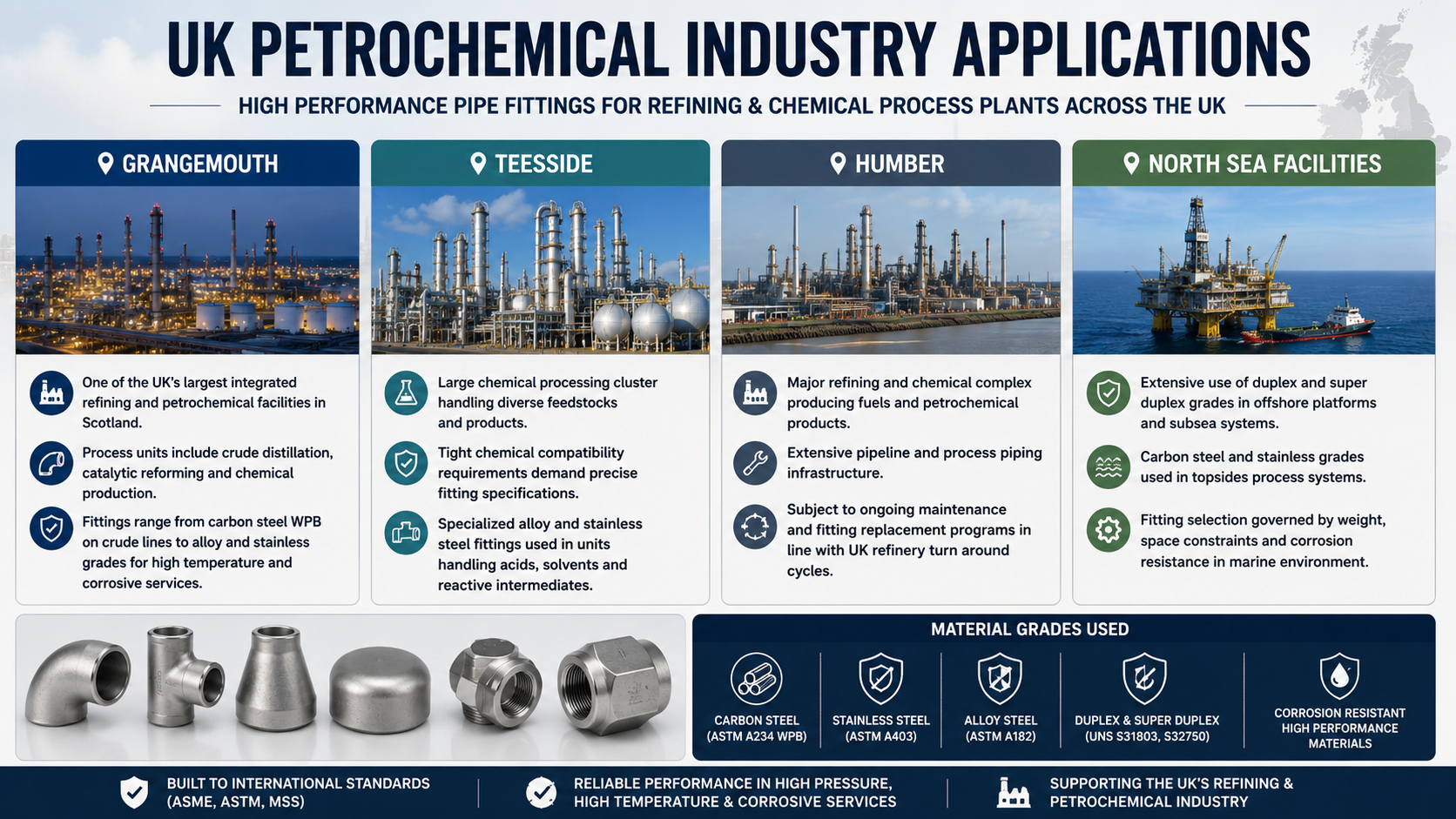
Petrochemical Industry Applications
Grangemouth
The Grangemouth refining and petrochemical facility in Scotland is one of the largest integrated process plants, containing significant process piping that includes crude distillation, catalytic reforming and chemical production units. The range of fitting specification from carbon steel WPB on crude lines to alloy and stainless grades on high temperature and corrosive process units has been covered throughout the site.
Teesside
The chemical processing cluster at Teesside is used to process a wide variety of feedstocks and products, and often has to cater to fit the specification due to very tight chemical compatibility requirements. Many Teesside process units that process acids, solvents and reactive intermediates use specialized alloy or stainless steel fittings.
Humber
The Humber refining and chemical complex is associated with a significant production of fuels and petrochemical products, pipeline and process piping infrastructure which is subject to ongoing maintenance and fitting replacement programs in line with refinery turn around cycles.
North Sea Facilities
Duplex and super duplex grades have been specified extensively on offshore platforms and subsea systems throughout the North Sea, in addition to carbon steel and stainless grades used in topsides process systems. Selection of offshore fittings is governed mainly by weight, space and corrosion resistance in marine environment.
Inspection, Testing and Quality Assurance
The following inspection and testing requirements are generally part of quality assurance of petrochemical pipe fittings:
Material certificate — EN 10204 3.1 or 3.2 certificate that confirms the chemical composition and mechanical properties of the material.
Dimensional inspection — checking to ASME B16.9 or B16.11 dimensional tolerances.
Non-destructive testing (NDT) — Radiography, ultrasonic testing or magnetic particle. inspection as appropriate for the fitting type and its importance in service.
Positive material identification (PMI) — confirmation that provided material is the same as that specified, especially in stainless and alloy fittings.
Hydrostatic or pneumatic pressure testing — verification of pressure integrity prior to installation.
Surface finish and surface cleanliness inspection — especially for stainless steel fittings in hygienic or high purity service.
The Institution of Mechanical Engineers (IMechE) and Energy Industries Council (EIC) offer advice and training for piping component inspection and quality assurance for engineers on major projects.
Common Pipe Fitting Selection Mistakes
By marking carbon steel when specifying a stainless or alloy material for the corrosion study — may result in early failure and unexpected shutdowns.
Mismatched wall thickness between fitting and connecting pipe — may cause stress concentrations and possible leak points at the weld joint
Using socket weld fittings on services prone to crevice corrosion the socket gap may collect moisture and contaminants, which can cause localized corrosion.
Ignoring low-temperature impact testing requirements — standard carbon steel fittings may fail by brittle fracture when used in services where the temperature can fall below zero.
Failing to verify PMI on stainless and alloy fittings — It is a frequent problem in all the global supply chains, alloy substitution is a common mistake that can only be identified through the testing process.
Overlooking dimensional compatibility with existing flanges and valves — especially important when purchasing replacement fittings for older plant which may have non-standard or legacy specifications.
Procurement Checklist for Industrial Buyers
For more detailed technical advice, check out our Pipe Fittings Pillar., it will be unlikely to be delayed or non-conforming. The full specification should contain:
Fitting type — square, square nut, round, square thread, round thread, or swaged.
Manufacturing standard — ASME B16.9, ASME B16.11, or MSS SP-75.
Nominal pipe size(s) — This refers to the pipe size of the pipe or pipe fitting including pipe sizes of reducers and reducing tees.
Schedule / wall thickness — same as connecting pipe specification.
Material grade — ASTM A234 WPB, A403 WP316L, A420 WPL6, duplex or alloy as indicated.
End connection type — Butt weld, socket weld, or threaded.
Heat treatment and impact testing requirements — especially for low temperature, sour service.
NDT and PMI requirements — as specified by the project specification).
Material test certificates — EN 10204 3.1 or 3.2
Quantity, packaging, and delivery location
Frequently Asked Questions
In petrochemical plants, what is the function of pipe fittings?
Pipe fittings are used to join, redirect, branch, reduce and terminate hydrocarbon, chemical, steam and gas process piping systems in extreme pressure and temperature conditions.
What are the pipe fitting materials used in refinery?
The most popular refinery pipe fittings are elbows, tees, reducers and caps in carbon steel, stainless steel or alloy steel grades, depending on the process service.
Butt weld and socket weld fittings are different in what way?
Butt welded fittings are full penetration welds that are connected to the pipe itself and are suitable for larger pipe sizes and services where weld inspection is needed for high consequences. They are single fillet welded socket weld fittings, used in small bore (NPS 4 or lower) high pressure systems.
What is ASTM A234 WPB?
ASTM A234 WPB is the most commonly used wrought carbon steel butt weld fittings applicable to moderate and elevated temperature service, for most hydrocarbon and steam piping in petrochemical plants.
What are forged steel fittings?
Forged steel fittings are made by forging (shaping) heated steel under force and have a dense, defect-free grain structure and excellent mechanical strength. A common type of forged fitting is socket weld and threaded fittings in accordance with ASME B16.11.
What is ASME B16.9?
ASME B16.9 is the primary standard for factory-made wrought butt weld fittings, such as elbows, tees, reducers, caps, and crosses, to be used for sizes NPS 1/2 through NPS 48, which includes dimensions and tolerances.
Which fittings are suitable for high pressure service?
For extreme service, butt weld construction is usually used with heavier wall schedules, and is constructed from carbon steel, alloy or stainless steel depending on the process fluid and temperature.
What is the way to choose chemical processing pipe fittings?
The selection depends on pressure rating, operating temperature, compatibility of the fluid to be pumped, the corrosion mechanism, connection type, and the applicable project piping material classes and design code (usually ASME B31.3 for process piping).
Summary: Specifying Pipe Fittings for Petrochemical Plants
When specifying pipe fittings, Petrochemical engineers and procurement teams must take care to specify the type of fitting, the fitting method, the material grade, the dimensional standard, and the compatibility with the material used for the pipe. Fitting specification is not just a cost factor; when it comes to petrochemical services, it is a serious threat to plant integrity, personnel safety, and regulatory compliance under pressure systems legislation.
The steps outlined in this guide, from selecting the appropriate type of fitting to verifying the material grade and ensuring compliance with standards, serve as a structured framework for successful and compliant sourcing, whether you're looking to create a turnaround at Grangemouth or to source stainless steel pipe fittings for a corrosive process unit at Teesside or to develop a maintenance stock program for North Sea offshore assets.
For more detailed technical advice, check out our Pipe Fittings Pillar, which covers the full spectrum of pipe fittings, or our Petrochemical Page, which details how the piping components are being used in process systems refinery and chemical plant operations, and our Flanges Article, which presents all the different types, pressure classes, and face configurations of flanges that are used in conjunction with pipe fittings.
DISCLAIMER: Z&F Corporation is not affiliated with, authorized by, endorsed by, or acting as an official representative of any manufacturer, brand, or trademark owner referenced on this website. All product names, trademarks, brand names, logos, and manufacturer references are the property of their respective owners and are used solely for identification, reference, and compatibility purposes.