Types of Industrial Valves: Functions, Applications and Selection Guide
Common types of industrial valves are gate, globe, ball, butterfly, check, control, pressure relief, diaphragm and plug valves. They are used to isolate or control equipment, protect against backflow and/or to protect pressure systems. The correct selection is only possible with the necessary process medium, pressure, temperature, pipe size, function, materials and applicable standards.
Looking for an industrial valve supplier?
Share the required function, size, pressure class, temperature, medium, material, connection and applicable standard with our independent sourcing team.
Request a Quote
The mechanical devices used to start, stop, regulate or direct liquids, gases and slurries in piping systems are known as types of industrial valves. Can be manually operated or pneumatically, electrically or hydraulically actuated.
What Is an Industrial Valve?
An industrial valve is a device that has a closure element, like a gate, disc, ball or plug, which adjusts the accessible flow path. Its body contains pressure, while the stem, seat, bonnet, seals and actuator support operation and shutoff. A broader introduction is available in this guide to industrial valves .
What Are the Types of Industrial Valves?
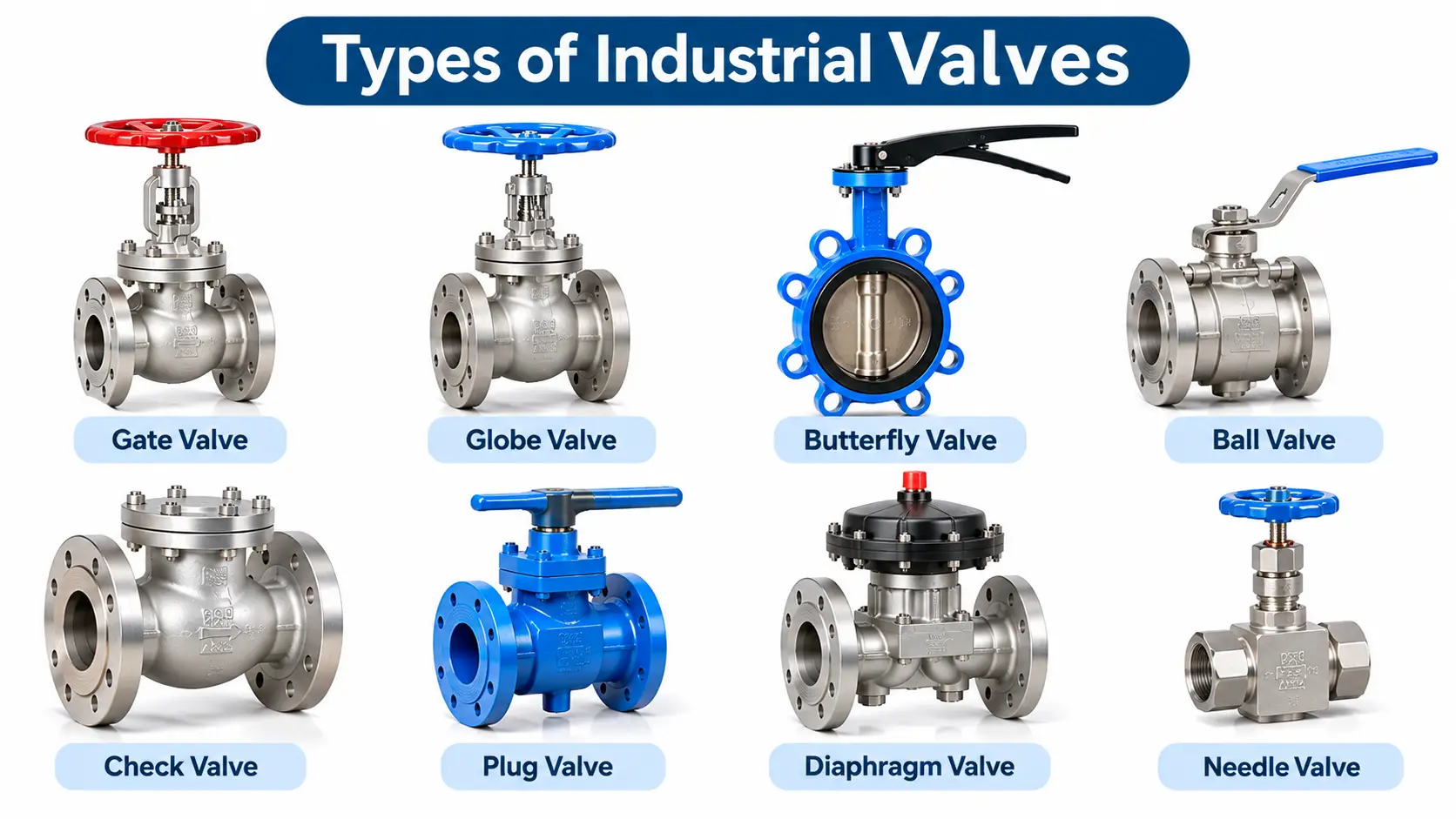
There are several ways to classify the valves, such as by function, by closure mechanism, by movement, by connection or by actuation method. Isolation valves are used to stop flow, regulating valves alter the flow rate and/or pressure, check valves are used to prevent reverse flow and safety valves protect systems from over pressure. When comparing available configurations, buyers can view the related valve products
|
Valve type |
Primary function |
Typical application |
|---|---|---|
|
Gate |
Full-open or full-closed isolation |
Water, oil and process pipelines |
|
Globe |
Throttling and regulation |
Steam, cooling water and process control |
|
Ball |
Rapid quarter-turn isolation |
Gas, liquid and chemical systems |
|
Butterfly |
Compact isolation or regulation |
Large water and utility lines |
|
Check |
Automatic backflow prevention |
Pump discharge and process piping |
|
Relief |
Overpressure protection |
Boilers, vessels and pressure systems |
Gate Valves: Full-Line Isolation
A gate valve is a valve that operates by moving a gate up and down to allow or block flow. It usually does not cause a significant restriction in flow when fully open. Generally for isolation and not for normal throttling. The various designs (wedge, parallel, rising-stem and non-rising-stem) are used for different installation and service needs. Buyers researching market options can view Neway listings for neutral product research.
Globe Valves: Throttling and Regulation
A globe valve moves a disc towards or away from a stationary seat. Its redirected flow path produces more resistance than a fully open gate valve, but it enables better throttling. The difference between gate valve and globe valve flow control is explained further in this valve comparison .
Ball Valves: Fast Quarter-Turn Shutoff
The principle of the Ball Valve is the operation of a ball-shaped object that is drilled. If its bore is lined up with the pipe, flow is allowed to pass; if the bore is 90 degrees away from the pipe, flow will be blocked.. Floating, trunnion-mounted, full-bore, reduced-bore and V-port configurations are available. This ball valve guide explains their construction in more detail.
One product example is the Apollo 4-inch valve . Product names do not guarantee suitability; refer to current documentation for pressure, temperature, materials, threaded connection and seat construction.
Butterfly Valves: Compact Large-Line Control
A butterfly valve is a type of valve that features a disc rotating inside the pipeline. There are many common types of wafer, lug and flanged bodies, as well as concentric, double-offset and triple-offset types, which meet various sealing and operating requirements. The principle butterfly valve types are different; the choice of the type of butterfly valve depends on the requirement of shut off, pressure, temperature. Suitable products may be compared through the industrial range .
Check Valves: Automatic Backflow Prevention
The basic purpose of main check valve is to allow flow in one direction and to close automatically when the flow direction changes. There are plenty of differences between swing, lift, piston and dual-plate and silent designs and how they react to velocity and pressure changes. Correct sizing can help reduce slamming and water hammer. Buyers can research related market options through Apollo listings .
Control Valves and Automated Regulation
There are a variety of different control valve types, such as globe-style, angle, three-way and characterized ball and butterfly valves. The closure element is moved by an actuator and positioner in accordance with a signal from a controller. The controls range includes products associated with automated flow and process regulation.
Solenoid valves may provide direct control or switch air supplied to an actuator. For instance, ASCO solenoid valve can be found as a 24 V DC 2 port N.C. product. The port size, pressure range, media and electrical requirements must be checked prior to use.
Pressure Relief and Safety Valves
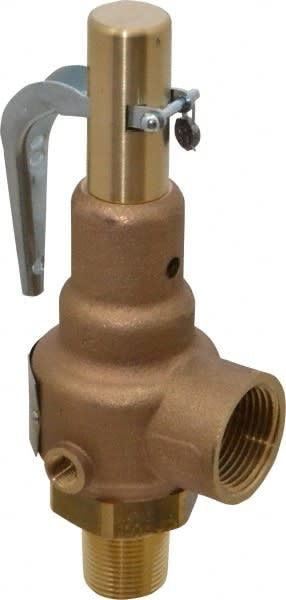
There are various types of pressure relief valves like spring loaded, pilot operated and balanced pressure relief valves. These valves are automatically operated at a set condition to safeguard the piping and equipment from over pressure. An example is the Apollo relief valve , listed with a 100 psi setting. Relief devices require application-specific sizing and compliance verification.
Buyers researching safety products can also review NABIC listings . Brand references do not imply partnership or certified or authorised distributor status.
Diaphragm, Plug, Pinch and Needle Valves
A diaphragm valve is a valve that encloses the operation mechanism from the process media by means of a flexible diaphragm. Plug valves are valves with a rotating plug, pinch valves squeeze a pliable sleeve, while needle valves offer fine control in smaller lines. These designs may suit corrosive fluids, slurries or instrumentation services. Related pneumatic technology can be researched through MAC listings .
Actuation and Digital Control
Manual valves are operated by levers, hand wheels or gear operators. Automated valves can be operated by pneumatic, electric or hydraulic actuators, which are accompanied by limit switches and positioners. Remember: A controller does not have to be an actuator. This is a VAV controller which is specifically listed without an internal actuator, for this reason control and movement parts are separated.
Materials and End Connections
These materials are commonly used in the manufacturing of bodies: cast iron, ductile iron, carbon steel, stainless steel, bronze and alloy. Selections are based on corrosion, erosion, temperature and pressure requirements as well as contamination requirements. Common valve end connection types are flanged threaded welded, socket-weld, wafer or lug and grooved connections.
Engineering note: This is not enough just a material name. Test body, trim, seat, stem and packing and gasket material to ensure they perform correctly with the actual medium, concentration and operating temperature.
Standards and Pressure-Temperature Ratings
ASME B16.34, API 600, API 6D, API 598, ISO 5208, and MSS Requirements for specific projects may apply. Pressure class is not a pressure that can be used anywhere at all for all temperatures. Engineers need to consult the relevant pressure-temperature table, material group and valve design and standard edition.
How to Select the Correct Valve
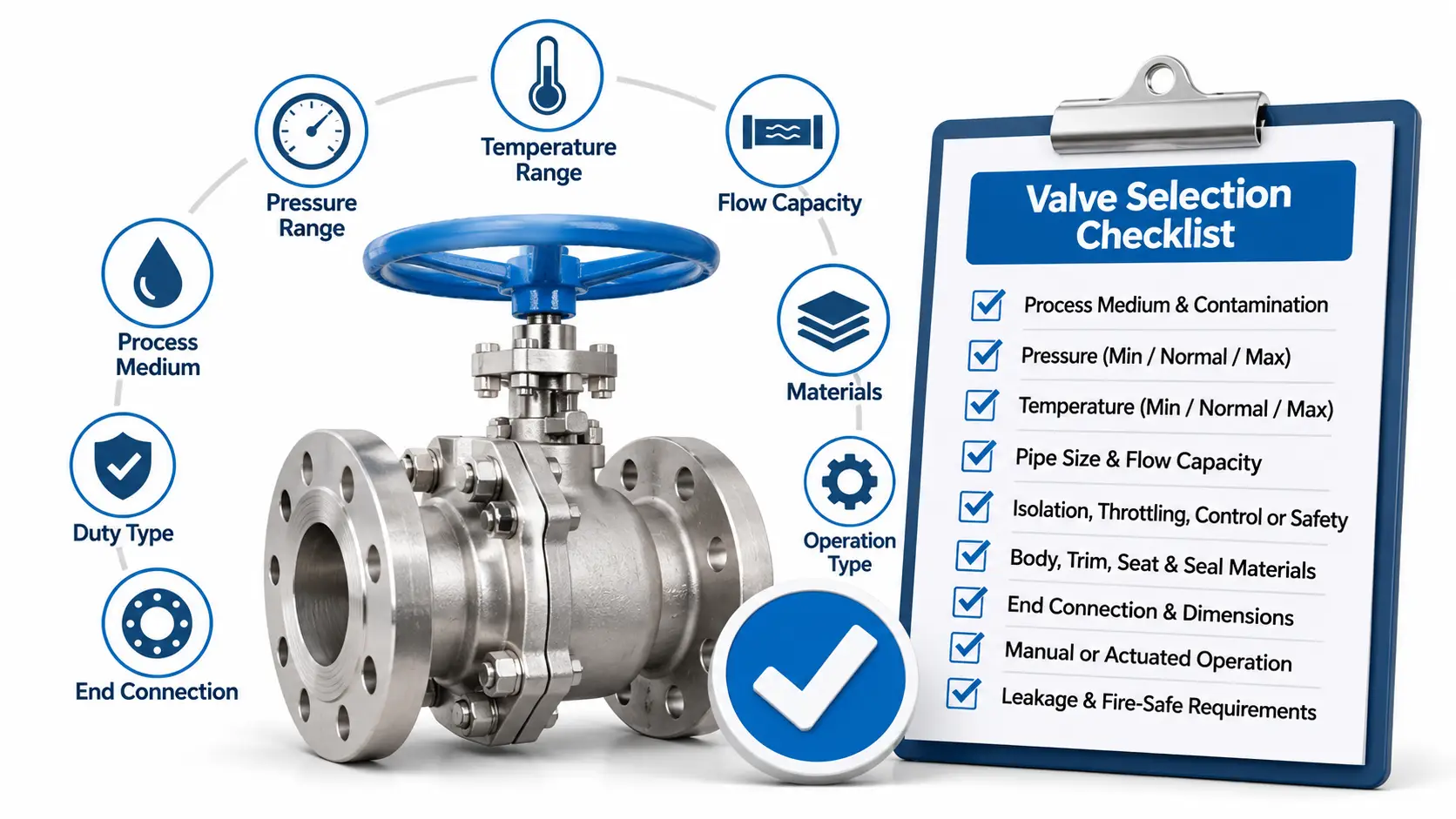
The first criteria for a valve selection is function, such as isolation, regulation, backflow prevention or safety.Before comparing the types of industrial valves, document the complete process requirement. This guide on choosing a valve provides further procurement guidance.
-
Process medium, concentration and contamination
-
Minimum, normal and maximum pressure
-
Minimum, normal and maximum temperature
-
Pipe size and required flow capacity
-
Isolation, throttling, control or safety duty
-
Body, trim, seat and seal materials
-
End connection and face-to-face dimensions
-
Manual or actuated operation
-
Leakage, fire-safe and fugitive-emission requirements
-
Assessments, certificates and record keeping
Common mistake: Not choosing a valve based on nominal pipe size and pressure class. An appropriate selection may be different in the following circumstances: Flow characteristics, differential pressure, temperature, material compatibility and shut off requirements and installation orientation.
Frequently Asked Questions
What are the main types of industrial valves?
The main categories include gate, globe, ball, butterfly, check, control, pressure relief, diaphragm, plug, pinch and needle valves.
Which valves are used for isolation?
Commonly considered valves for isolation are gate, ball, plug and some butterfly valves. Depending on the conditions of shut-off and service, the suitability can be different.
How often should valves be maintained?
The maintenance interval varies according to factors such as the type of valve, the level of service, the cycle frequency, criticality of the equipment and manufacturer's recommendations. Critical valves may need to be inspected, tested for functionality, and documented for leaks.
Conclusion
There are more than just some applications that require choosing between the different types of industrial valves. Specify the function, medium, operating range, materials, flow, actuation and standards first. Check all proposed products against the latest manufacturer's documentation and project requirements before ordering.
Have an industrial valve requirement?
Share your size, pressure, temperature, medium, materials, connection, operation and standards with ZF Corporation’s independent sourcing team.
Talk to Our Specialist
Disclaimer: This article provides general educational information and does not replace valve sizing, relief-device calculations, engineering design or a project specification. Product suitability must be verified against current standards, manufacturer documentation and site requirements. Brand references do not imply partnership or authorization.