Industrial Actuators: Types, Selection and Sizing Guide
Industrial actuators are devices that change pneumatic, electrical or hydraulic energy into controlled mechanical motion. Uses rotary, multi-turn or linear motion to automate valves, dampers and other final control elements. The right choice of actuator depends on proven torque or thrust, duty cycle, fail-safe action, mounting requirements, environmental protection and control system specifications.
Need help sourcing an actuator?
Pass your data on valve, torque or thrust, power source, fail position, mounting and control requirements to our independent sourcing team.
Request a Quote
Industrial actuators are powered actuators which create controlled linear or rotary motion to drive valves, dampers and process equipment. Depending on output, speed, safety action, operating environment and control compatibility, pneumatic, electric and hydraulic designs are chosen.
What Are Industrial Actuators?
Energy is supplied to an actuator which is used to command movement of connected equipment to a desired position. A rotary actuator is usually used to rotate a butterfly or plug valve (or ball valve) 90° degrees. The linear actuators provide linear thrust to globe valves, dampers and other linear actuators.
It can be a simple open and close motion, or continuous modulation. Before selecting an actuator, engineers should identify the function of the connected valve. ZF Corporation’s guides to industrial valves and gate valves versus globe valves explain how valve design influences actuation requirements.
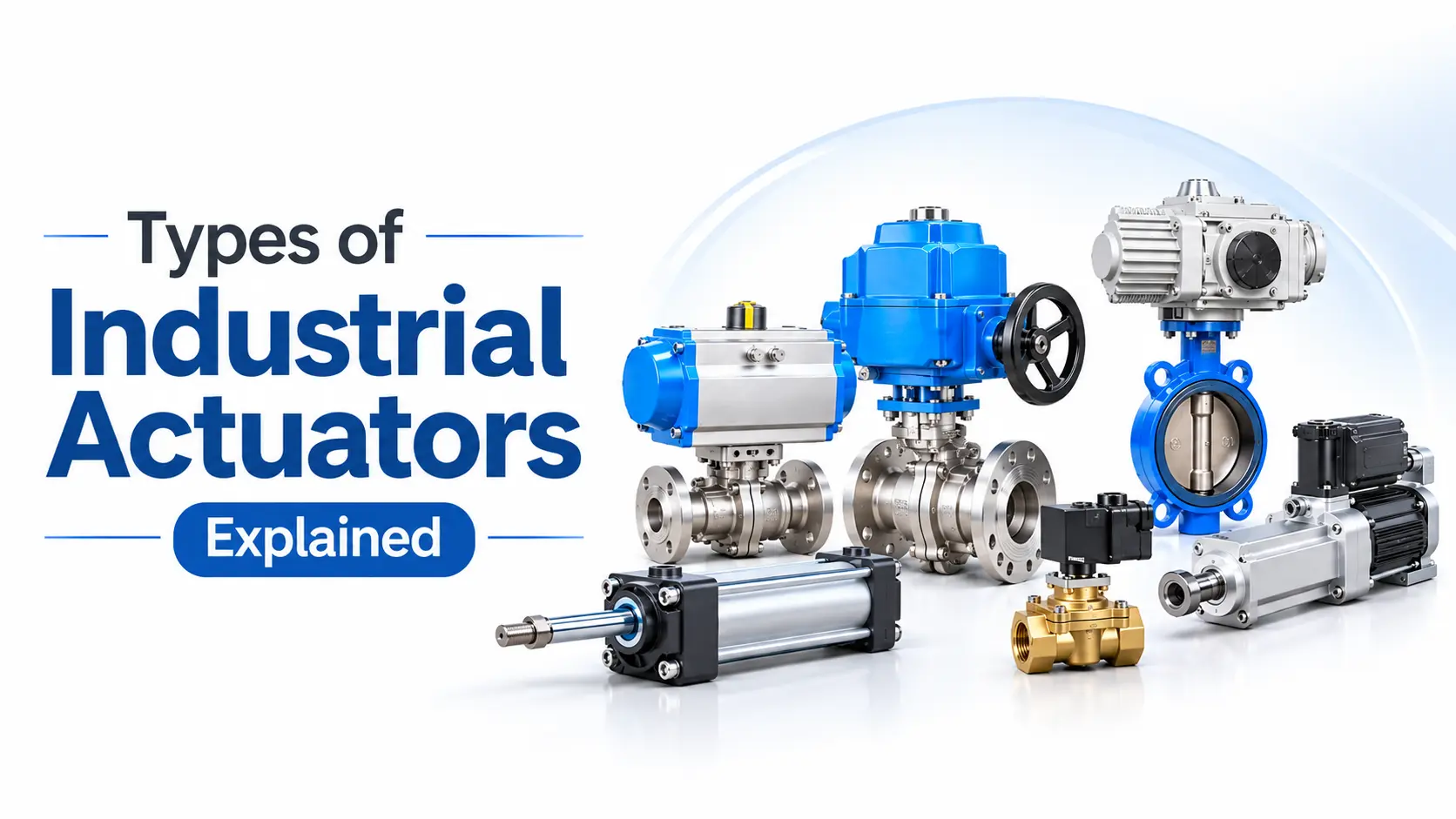
Main Types of Industrial Actuators
|
Actuator type |
Power source |
Main characteristics |
Common applications |
|---|---|---|---|
|
Pneumatic |
Compressed air |
Fast response, simple construction and spring-return options |
Ball, butterfly and control valves |
|
Electric |
Electric motor |
Programmable control, position feedback and no air supply |
Quarter-turn, multi-turn and linear duties |
|
Hydraulic |
Pressurized hydraulic fluid |
High torque or thrust from a compact mechanism |
Large pipeline valves and heavy-duty equipment |
Buyers can explore ZF Corporation’s actuator category when researching replacement, automation or retrofit requirements. Category information is provided as a reference and final suitability should be verified on reference to the valve data and complete actuator specification.
Pneumatic Actuators
A pneumatic actuator is a device that operates by moving a piston or diaphragm using the pressure of air. Piston travel can be converted to a 1/4 turn motion by rack and pinion or scotch yoke mechanisms. Pneumatic systems are very common when high cycling or a mechanical spring return function are needed, or for systems that require rapid movement.
Double-acting models are models that use the pressure of air in both directions. Spring-return models use air for one stroke and stored spring energy for the return stroke. A pneumatic actuator air consumption calculation should consider chamber volume, supply pressure, cycle frequency, tubing and accessory demand.
An application example is the Swagelok SS-43GS6-31D pneumatic-actuated valve listing . It has been discontinued (Availability, Condition, Compatibility, possible replacement options should be checked).
Electric Actuators
An electric actuator is a mechanism that converts the electrical energy into mechanical energy by means of a motor, gearing and control electronics. The quarter turn type is used to drive rotary-type valves and can be multi-turn type which may drive gate-type valves. For electric linear designs dampers and control elements can be placed without compressed air.
The electric actuator duty cycle S2 S4 rating is important. Short-time and intermittent periodic duties create different thermal loads. Cycle time, starts per hour, ambient temp and motor protection should reflect the real operating schedule and not be a generic cycle estimate.
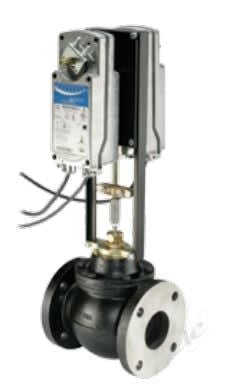
This example of a product listing for a discontinued two-way valve actuator illustrates the importance of cross-referencing when replacing products. Until checking is done for voltage, torque, dimensions, connection and control signals, the suggested successor shall not be considered as a drop-in replacement.
Hydraulic Actuators
A hydraulic actuator will move a cylinder or rotary mechanism using pressurized fluid. It can provide high force, which makes hydraulic actuator high torque valve operation suitable for many large pipeline valves and demanding shutdown works.
A power unit, clean fluid, filter, hoses or pipes, and leak management are all components of hydraulic systems. The selection should be based on available utilities, response times, environmental impacts, maintenance resources and lifecycle of the entire hydraulic system.
How to Size an Actuator for a Valve
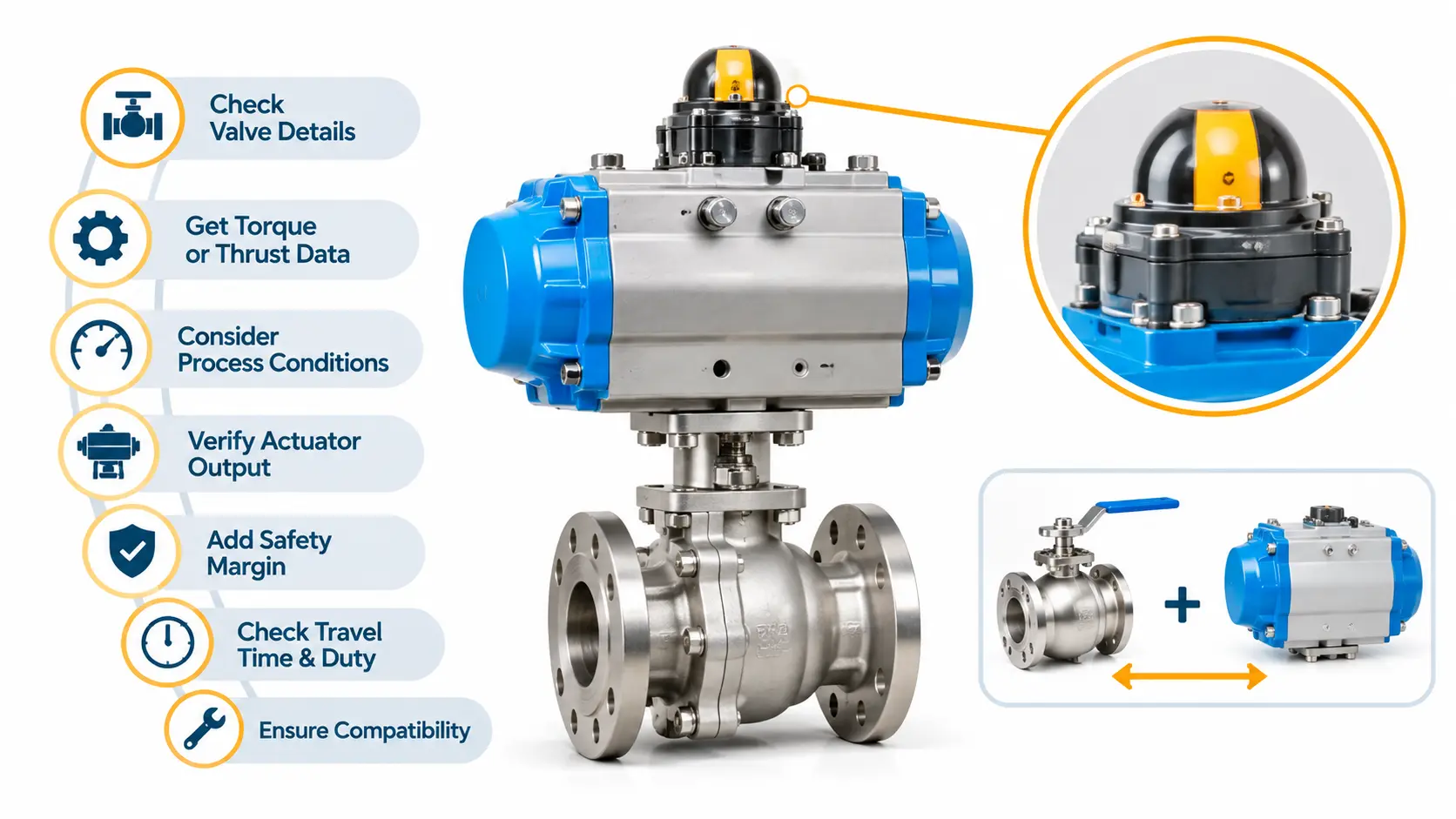
Making the correct size valve actuator start with verified valve torque or thrust data and not pipe size. For rotary valves, get torque at break-open, at running and end-to-close/break-to-close at maximum differential pressure. For linear valves, establish stem thrust over the complete stroke.
-
Determine the valve type, valve size and pressure class, and stem arrangement.
-
Get valve manufacturer's torque or thrust data.
-
Take worst case process conditions and maximum differential pressure.
-
Check actuator output at minimum available power or supply pressure.
-
Add manufacturer or project required sizing margin.
-
Verify travel time, duty cycle and operating temperature.
-
Verify bracket, coupling and stem-adapter compatibility.
For ball valves, it's important to note that the breakaway torque can be greater than the running torque, so the comparison between the actuator torque output and the valve break torque is especially crucial. For more information on valve construction and procurement, buyers should check out the industrial ball-valve buyer guide
Safety note: Please do not use a universal sizing factor of 1.25 or 1.5 for all applications. The required margin is dependent upon valve design, seat material, ageing, service, differential pressure and project rules. Refer to the approved manufacturer information and the engineering specification set by the Governors.
Fail-Safe Modes and Spring Return
A fail-safe actuator which, on the loss of power, air or control signal, moves to and/or stays in a certain position. The common states include fail-open, fail-closed and fail-in-place. Spring return pneumatic units are based on stored mechanical energy, and other systems can be based on accumulators, batteries or emergency power.
Correct selection of fail-safe spring return actuator should be in accordance with the process-safety philosophy. The fuel valve might have to shut off when failure occurs, and the cooling valve might have to open. The whole valve actuator assembly should be checked, should be oriented but before assembly of accessories should be checked for their behaviour.
ISO 5211 Mounting Compatibility
ISO 5211 is a standard that covers interfaces between part-turn actuators and valves and mounting flange and drive arrangements. Actuator mounting ISO 5211 valve interface supports standardization, but not that any actuator will work on any valve.
Furthermore, engineers will need to check the dimensions of the stems, the strength of the couplings, the alignment, stiffness of the brackets and the output torque. If there is poor alignment it can cause side loading, increased friction and early wear. Verify the existing standard version identified in the project prior to procurement.
Hazardous-Area and Environmental Requirements
An explosion proof actuator or appropriately protected accessory may be required in a classified location. The markings are different for ATEX, IECEx and North American Class/Division. The equipment should be appropriate for the zone, gas or dust group, temperature class and protection concept.
Not all pneumatic systems can be made safe for all hazardous areas. Electrical ignition sources can be added through use of solenoids, limit switches and positioners. Similarly, an IP or NEMA rating for an enclosure applies to environmental ingress only and it is not an explosion rating.
Smart Positioners and Control Integration
A smart positioner accepts a control command, compares the valve position with the command and controls the output of the actuator to minimize the error. A smart positioner for industrial actuators 4-20mA HART can also offer the ability to configure, diagnose, monitor and alert for actuator travel and maintenance. The supported protocols may include HART, Profibus or Foundation Fieldbus.
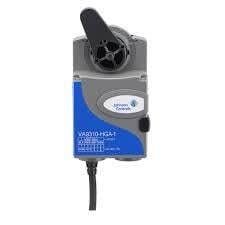
ZF Corporation’s actuators and positioners category includes related automation products. One example is the Sauter 7 Nm, 24 V damper actuator and positioner , whose torque, voltage and control method must be matched to the application.
A discontinued VAV controller without an internal actuator also illustrates an important distinction: a controller may command or monitor movement without containing the actuator that produces it.
Brand and Technology Research
Engineers may encounter technologies from manufacturers such as Rotork, Emerson, Auma, Flowserve, Siemens and ABB. ZF Corporation provides Rotork product listings for market research and independent sourcing. Specifications are used to determine product suitability, not only by the manufacturer's name.
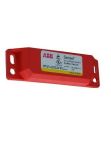
Consumers can also check out the ABB product listings when checking out automation and control choices. Such references are not to be interpreted as a partnership, endorsement or authorized-distributor status.
Maintenance and Common Selection Mistakes
Actuator preventive maintenance can be leak testing, lubrication review, corrosion inspection, fastener verification, travel testing and fail safe confirmation. The frequency of maintenance should be in accordance with the manufacturer's recommendation and the criticality of the service conditions and equipment.
Common mistakes include:
-
Selecting by valve size rather than verified torque or thrust
-
Ignoring minimum air pressure or supply voltage
-
Choosing an incorrect fail-open or fail-closed action
-
Overlooking duty cycle and ambient temperature
-
Using unsuitable equipment in a classified location
-
Mismatching 4–20 mA, discrete or digital communication
-
Assuming a mounting interface guarantees mechanical suitability
Frequently Asked Questions
What are the main types of industrial actuators?
There are three main categories of power sources: pneumatic, electric and hydraulic. They can be used to create rotary, multi-turn or linear motion for on/off or modulating operations..
What is the difference between spring return and double acting?
A double-acting unit uses supplied power in both directions. A spring-return unit uses power for one stroke and stored spring energy for the return stroke.
How are actuators integrated with a PLC or DCS?
Integration can be provided with commands, 4–20 mA signals or supported digital protocol. Position feedback, alarms, power and communication configuration are also required to be compatible.
Final Selection Advice
A reliable industrial actuator must be chosen for the entire valve, mounting and control assembly. Check output range under worst conditions, fail action and duty cycle, and hazardous area and communication requirements prior to ordering.
Looking for an actuator or valve-automation solution?
Share your valve information, torque or thrust, power source, fail position, mount and control specifications with ZF Corporation.
Talk to Our Specialist
Disclaimer: This article provides general educational information and does not replace actuator sizing, functional-safety analysis or project engineering. Verify suitability against current standards, certification, manufacturer documentation and site requirements. Brand references do not imply partnership, authorization or endorsement.