
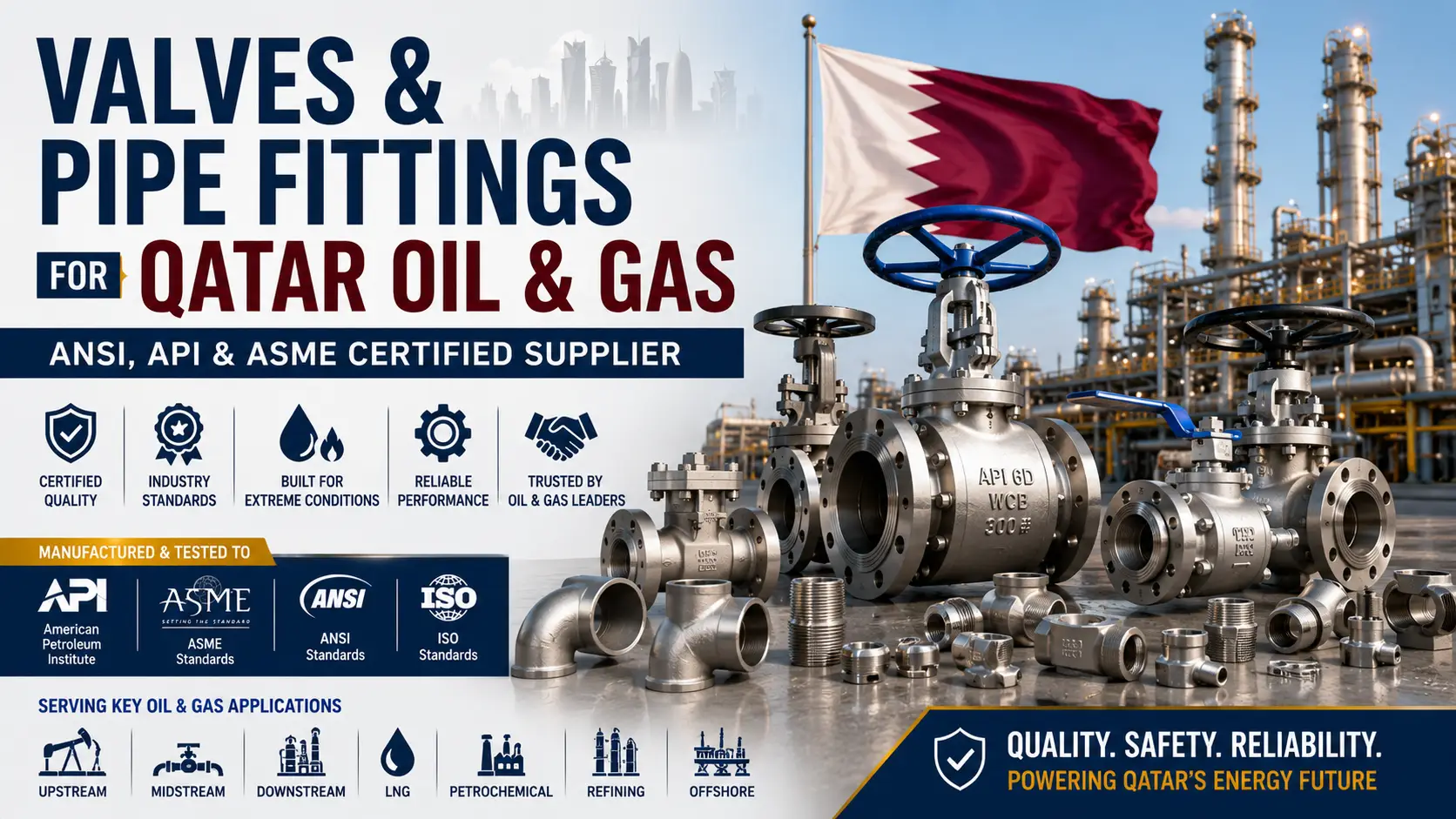
Valves Pipe Fittings Qatar Oil Gas: Complete Procurement Guide for LNG, Petrochemical & Offshore Projects
The energy sector is an industry that operates on a scale so large that absolute reliability from all components of the pipelines and process systems is required in Qatar. Specifically, when it comes to valve pipe fittings Qatar oil gas projects rely on, they simply cannot afford to get it wrong: a mis-specified valve, missing certifications, or an inappropriate material can lead to expensive project halts, safety incidents, and regulatory compliance penalties. From the North Field Expansion to a Ras Laffan LNG facility or a petrochemical plant, this comprehensive procurement guide provides all the criteria to assess, specify and source the correct product with the correct certification for Qatar's most challenging projects.
Ready to source valves and pipe fittings for your Qatar project? Submit your Bill of Materials, datasheet, or project specification and our team will provide a technical review and competitive quotation — typically within 24 hours for in-stock items. Request a Quote
Why Valves and Fittings Matter in Qatar's Energy Sector
Qatar is considered one of the world's biggest hydrocarbon producers, with the North Field, the world's largest single natural gas reservoir, and a developing LNG export infrastructure that is based on Ras Laffan Industrial City. The North Field Expansion programm is Qatar Energy's biggest energy infrastructure project anywhere on earth, with the addition of around 142 million tones per year of LNG capacity by 2030.
Thousands of valves and pipe fittings are in these systems every barrel of oil, every cubic meter of gas and every tone of LNG moves through them. They serve important purposes, such as separating process flows, controlling flow rates, preventing backflow, limiting pressure levels, and safeguarding equipment and personnel against the effects of failure. The implications of component failure are critical in sour gas service, LNG applications at cryogenic temperatures and in high pressure offshore service.
For the procurement engineer, EPC contractor, and supply chain working in Qatar, it's not just about finding a supplier. It's from a supplier that they can get API certified valves Qatar that have full material traceability, within project deadlines, and the right pressure class for each service condition.
For our complete range of flow control equipment, visit our Industrial Valves page.
Types of Industrial Valves Used in Qatar Oil and Gas Projects
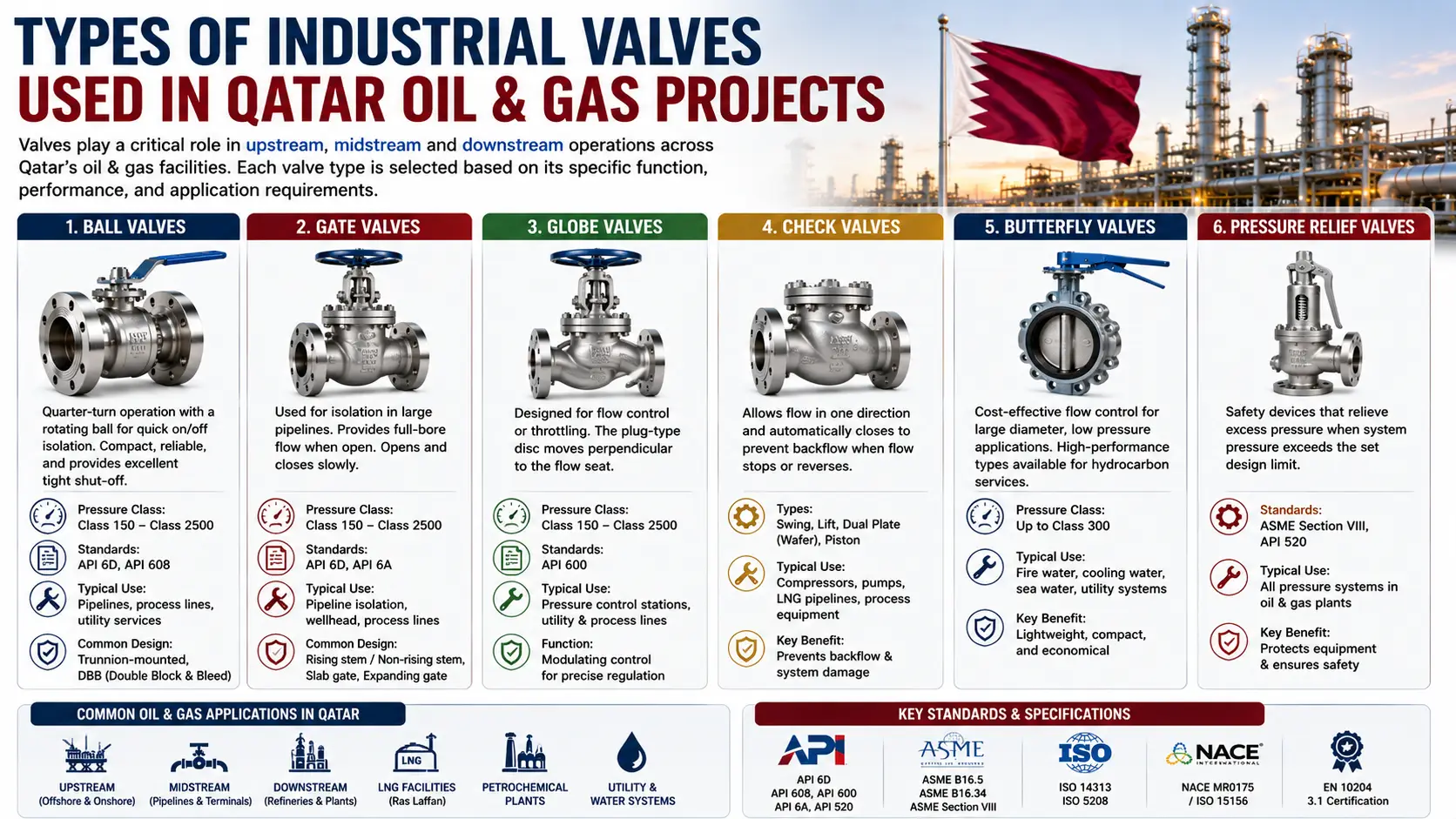
Before specifying the correct valve, it is important to know the role of each type of valve. Valves are available in various types and used in many applications at Qatar's oil and gas facilities, depending on their functions in upstream, midstream and downstream operations.
Ball Valves
In Qatar's oil and gas industry, the most common type of isolation valves used are ball valves. Full/bore or reduced/bore flow passage with a quarter-turn open/close operation, achieved by a rotating ball designed with a central bore. Compact, quick-acting, and with excellent tight shut-off, Ball valves are perfect for on/off isolation in pipelines, process lines, and utility services.
The pressure class of ball valves are usually in the range of Class 150 to Class 2500 and are often identified by API 6D (pipeline ball valves) or API 608 (general purpose) specification. For pipeline services of large size and high operating pressure, the most common specification is a trunnion-mounted, double-block-and-bleed (DBB) ball valve.
Gate Valves
For bigger pipeline sizes, gate valves are the traditional full-bore valve that performs the function of isolation. A rising or non-rising stem is used to close a wedge gate across the flow path. Gate valves open and close slowly, compared to ball valves, but when fully open they offer a clear path for flow, which is essential when pigging export pipelines.
API 6D gate valves are the standard that is used for pipeline isolation service. API 6A gate valves (slab gate, expanding gate) are used for wellhead and process applications.
Globe Valves
Globe valves are used for flow control or throttling. Flow rate is regulated by a plug-type disc which is oriented perpendicular to the flow seat. They are often found in pressure control stations, utility services or process lines where a modulating control is needed.
Check Valves
The check valve is a valve that allows flow in one direction and automatically closes when the flow ceases and/or reverses direction. In valves applications for LNG pipeline valve in Qatar, check valves prevent backflow into the compressor, pump and process equipment.
These are commonly swing check, lift check, dual plate (wafer) check and piston check valves. Selection is based on flow velocity, risk of water hammer and acceptable pressure drop.
Butterfly Valves
Butterfly valves are provided to control flow and are economical for large diameter, lower pressure applications like fire water systems, cooling water and seawater systems. Some hydrocarbon service applications can be used with high-performance butterfly valves with metal seats.
Pressure Relief Valves
Pressure relief valves (PRVs) are safety devices that provide relief for excess pressures when a system is over-pressurized beyond the design pressure. In all pressure systems at an oil and gas plant in Qatar, there is a need to have the appropriate relief protection correctly sized and calibrated in accordance with ASME pressure vessel codes.
Common Pipe Fittings Used in Oil and Gas Projects
In processing facilities, pipe fittings range, change direction, narrow, and end runs of pipe. Similarly, the correct fit is as important as a specification. See full details and certifications of our full line of Pipe Fittings.
Butt Weld Fittings
Butt weld fittings — elbows, tees, reducers, and caps — are welded directly to the pipe, creating a continuous, high-integrity joint suitable for high-pressure and high-temperature service. Butt weld fittings for Qatar oil and gas projects are typically specified to ASME B16.9 in carbon steel (ASTM A234 WPB), stainless steel (316L, 304L), and duplex/super duplex grades.
Forged Fittings
High pressure ratings are needed in smaller bore piping systems (usually 2” and smaller) and these systems are fitted with forged fittings, either socket weld or threaded. Forged fittings are available in carbon steel (ASTM A105), stainless steel (ASTM A182 F316), and duplex grades, and are specified per ASME B16.11. They have been extensively employed in impulse lines within instruments, chemical injection systems and high-pressure sampling systems in Qatar's oil & gas plants.
Flanges
Flanges are used to make bolted and detachable connections between pipes, valves, equipment, and instruments. The range of ASME B16.5 flanges includes those for pressure classes 150 to 2500, with sizes up to 24 inches. In critical service applications, weld neck flanges of the correct pressure class are the preferred option for Qatar oil and gas projects.
For a detailed comparison of pressure classes and selection of materials, see the Flanges guide.
Instrumentation Fittings
Instrument fittings (Tubes, compression, and small bore connectors) are employed in process measurement and control systems across the board. Process facilities in Qatar commonly use instrument tubing connections with brands like Swagelok and Parker Hannifin.
API and ASME Standards for Qatar Oil and Gas Projects
Valves pipe fittings Qatar oil gas procurement must be compliant with recognized international standards. In Qatar, the following standards are most often used in project specifications:
API 6D — Pipeline Valves
API 6D is the American Petroleum Institute code of practice for pipeline valves including ball valves, gate valves, check valves and plug valves. It sets out the design, materials, dimensions, testing and marking requirements. Qatar Energy projects are required to have all the pipeline valves with a valid API 6D monogram license.
API 6A — Wellhead Equipment
API 6A applies to the equipment that is associated with the wellhead and Christmas tree, such as gate valves, check valves, and chokes for wellhead service. It is the standard that governs all wellhead valve procurement in the upstream operations in Qatar.
API 598 — Valve Testing
API 598 sets all the inspection and testing parameters for all types of valves — shell hydrostatic, seat leakage, closure tests. API 598 test reports should always be included as a part of the material documentation package for buyers.
ASME B16.5 — Pipe Flanges and Flanged Fittings
Pipeline flanges and flanged fittings, in NPS ½ through 24 sizes, are referenced by ASME B16.5 for their pressure-temperature ratings, dimensions, tolerances and material requirements. When selecting flanges, you want to be sure to use ASME B16.5 flanges to ensure that the entire piping system is dimensionally compatible.
ASME B16.34 — Valves
ASME B16.34 provides the pressure-temperature ratings, dimensions, tolerances, materials, NDE and testing requirements for valves with flanged, threaded and welding end connections.
NACE MR0175 / ISO 15156
NACE MR0175 (recently released as ISO 15156) specifies the criteria for selecting metallic materials for equipment used in oil and gas service where metallic equipment is exposed to hydrogen sulphide (H₂S) - sour gas service. For Qatar's gas fields, NACE is required on all wetted parts.
The materials that are not compliant will be susceptible to sulphide stress cracking (SSC) and hydrogen induced cracking (HIC). The material selection, heat treatment controls and hardness limits for the valve body material, trim, fasteners and sealing components are all important to consider for NACE compliant valves Qatar.
Material Selection Guide for Qatar Oil and Gas Applications
One of the most technically important decisions that must be made in the procurement of valves and fittings is the selection of the materials. An improper material used in corrosive or high pressure will fail — usually without warning.
Material | Grade | Typical Application |
Carbon Steel | ASTM A105 / A216 WCB | General service, non-corrosive pipelines |
316/316L Stainless Steel | ASTM A182 F316L | Process lines, moderate corrosion resistance |
Duplex Stainless Steel | UNS S31803 / 2205 | Seawater, chloride environments, sour service |
Super Duplex | UNS S32750 / 2507 | Offshore, highly corrosive service, high chloride |
Inconel / Alloy 625 | UNS N06625 | High-temperature, highly corrosive environments |
Hastelloy C276 | UNS N10276 | Aggressive chemical, high H₂S environments |
Duplex and Super Duplex Stainless Steel
These two alloys, duplex stainless steel (2205) and super duplex (2507), have high strength, excellent corrosion resistance, and stress corrosion cracking resistance, and are preferred materials for offshore platforms, seawater injection systems, and high corrosion process environments. Duplex stainless steel fittings are used in subsea and offshore platform applications in increasing numbers all over the Qatar.
Carbon Steel in Sour Service
Only standard carbon steel can be used in sour service if it has the hardness and heat treatment characteristics specified in NACE MR0175. Each heat of material must be hardness tested to determine that the hardness is not over 22 HRC (approx 250 HV).
LNG and Cryogenic Valve Applications
The engineering problems involved in LNG service are unique. LNG is stored and shipped at nearly −162°C, which is well below the ductile-to-brittle transition temperature of typical carbon steel. In LNG service all valves and fittings must remain ductile, tough and pressure container at these extreme temperatures.
Stainless steel valves for LNG projects Qatar are generally produced using austenitic type of stainless steel (316L, 304L) or cryogenic grade carbon steel (ASTM A352 LCC, LCB), which have been tested for low temperature toughness by Charpy impact testing.
Ras Laffan Industrial City is home to the world's largest cluster of LNG trains, while the procurement regulations for LNG pipeline valves Qatar infrastructure are some of the strictest in the worldwide valve market.
Check Valves for LNG Terminals
Check valves are used to prevent backflow in LNG loading arms, transfer lines, pump discharge piping, etc., to prevent cavitation damage or water hammer. The duty of LNG terminals Qatar check valves is to test and certify to cryogenic test procedures, typically BS 6364 or to project specific test procedures.
Offshore Valve Applications
Offshore gas production platforms in Qatar, in the Persian Gulf and Gulf of Oman, need to be able to deal with marine atmospheric corrosion, seawater contact, dynamic loading of the platform and offshore process safety requirements, and to do so, require valves and fittings that can meet these challenges. Valves for offshore oil platform Qatar should meet:
API 607 / API 6FA Fireproof / Fire Safe Design
Anti-foam effect to improve performance in foaming applications
Packaging that meets the ISO 15848 or API 624 standard for low-emission packing (fugitive emissions control)
To EN 10204 3.1 or 3.2 depending on the demands of offshore projects
ATEX-rated actuators when the valve needs to be operated in the presence of hazardous classified areas.
EN 10204 3.1 Material Traceability
EN 10204 3.1 is the European standard that sets out three types of inspection documents for metallic materials. For oil and gas projects in Qatar, the minimum acceptable documentation is EN 10204 3.1 material test certificates (MTCs) which are to confirm that the steel used has been tested for heat and mechanical and chemical properties are as specified.
In higher criticality applications such as sour service, offshore platforms, and LNG facilities, EN 10204 3.2 (third party witnessed inspection) may be needed. It is the responsibility of the buyer to ensure all MTCs are valid with the heat numbers on delivered components.
Valve and Fitting Comparison Tables
Ball vs Gate vs Globe vs Check Valve
Feature | Ball Valve | Gate Valve | Globe Valve | Check Valve |
Primary Function | On/Off Isolation | On/Off Isolation | Flow Control / Throttling | Backflow Prevention |
Operation | Quarter-turn | Multi-turn | Multi-turn | Automatic |
Pressure Drop | Low | Very Low | High | Moderate |
Throttling | No | No | Yes | No |
Pigging | Full-bore types | Yes | No | No |
API Standard | API 6D / API 608 | API 6D / API 6A | API 623 | API 6D |
Pressure Class | 150–2500 | 150–2500 | 150–2500 | 150–2500 |
Material Comparison: Carbon Steel vs Stainless Steel vs Duplex
Property | Carbon Steel | 316L Stainless Steel | Duplex 2205 |
Corrosion Resistance | Low | Moderate | High |
Sour Service (NACE) | Conditional | Yes | Yes |
Cryogenic Service | Limited grades | Excellent | Good |
Chloride Resistance | Poor | Moderate | Excellent |
Relative Cost | Low | Medium | High |
Typical Use | Onshore pipelines | Process lines | Offshore, seawater |
API Standards Comparison
Standard | Scope | Application |
API 6D | Pipeline valves | Mainline ball, gate, check valves |
API 6A | Wellhead and Christmas tree equipment | Upstream wellhead valves |
API 608 | Metal ball valves | General industrial service |
API 598 | Valve testing | All valve types — inspection and test |
API 607 | Fire testing | Fire-safe valve certification |
API 624 | Stem packing fugitive emissions | Stem seal leakage control |
Pressure Class Selection Guide
It is important to know the different pressure classes as they are important for proper valve and flange specification. The maximum pressure for each class is dependent on material group and operating temperature.
Pressure Class | Approx. Max Pressure (CS at 38°C) | Typical Application |
Class 150 | 19.6 bar | Low-pressure utility, water |
Class 300 | 51 bar | General process service |
Class 600 | 102 bar | Higher pressure process lines |
Class 900 | 153 bar | High-pressure gas service |
Class 1500 | 255 bar | Very high-pressure service |
Class 2500 | 425 bar | Extreme pressure, wellhead service |
Class 900 to Class 2500 components are typically used for high pressure valves on the oil and gas projects in Qatar, especially on wellhead, high pressure separator and gas compression applications. When determining the pressure class, always check the pressure-temperature rating of the material group specified.
How to Select the Right Valves for Your Qatar Project
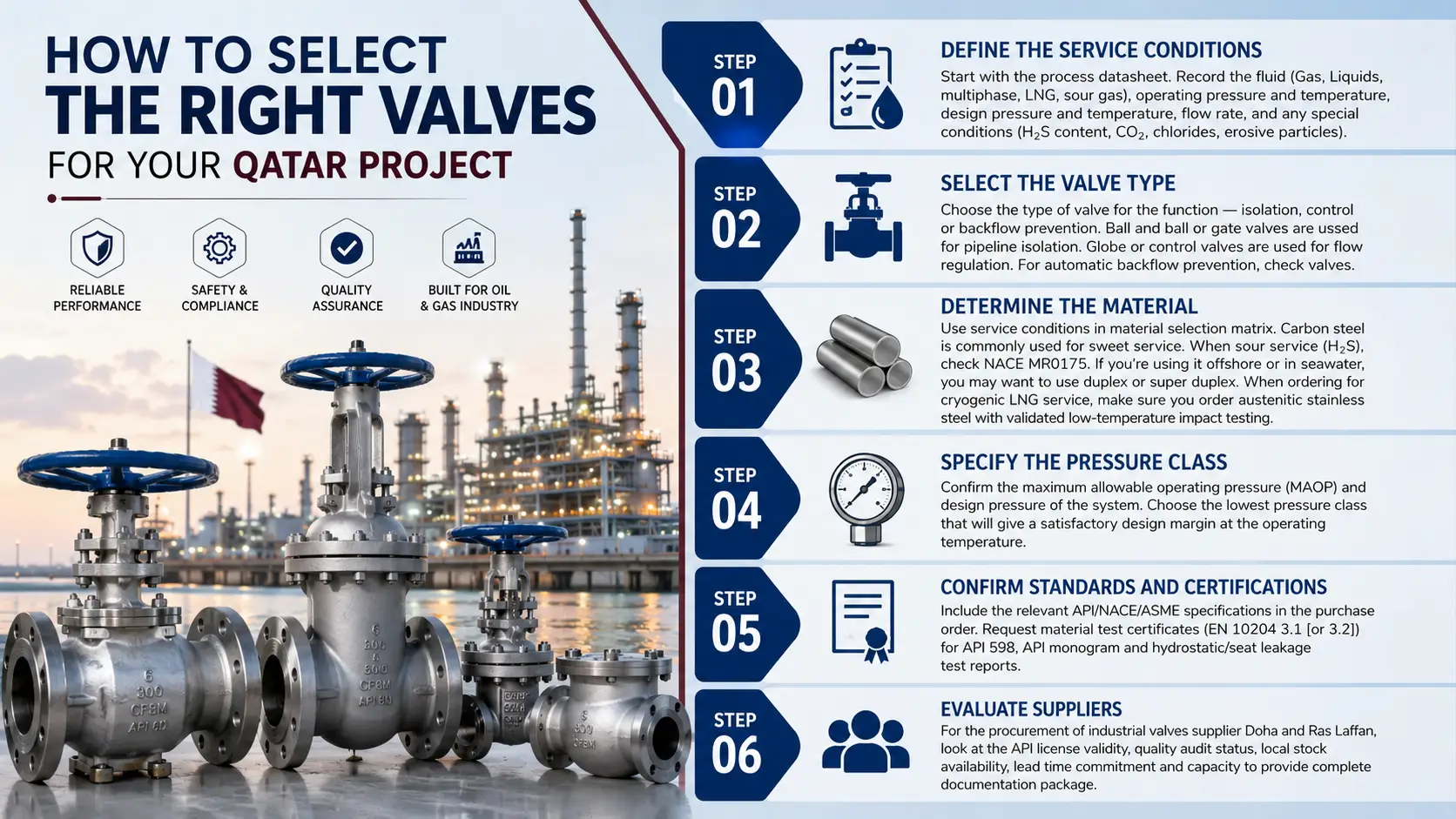
Step 1: Define the Service Conditions
Start with the process datasheet. Record the fluid (Gas, Liquids, multiphase, LNG, sour gas), operating pressure and temperature, design pressure and temperature, flow rate, and any special conditions (H₂S content, CO₂, chlorides, erosive particles).
Step 2: Select the Valve Type
Choose the type of valve for the function — isolation, control or backflow prevention. Ball and ball or gate valves are used for pipeline isolation. Globe or control valves are used for flow regulation. For automatic backflow prevention, check valves.
Step 3: Determine the Material
Use service conditions in material selection matrix. Carbon steel is commonly used for sweet service. When sour service (H₂S), check NACE MR0175. If you're using it offshore or in seawater, you may want to use duplex or super duplex. When ordering for cryogenic LNG service, make sure you order austenitic stainless steel with validated low-temperature impact testing.
Step 4: Specify the Pressure Class
Confirm the maximum allowable operating pressure (MAOP) and design pressure of the system. Choose the lowest pressure class that will give a satisfactory design margin at the operating temperature.
Step 5: Confirm Standards and Certifications
Include the relevant API/NACE/ASME specifications in the purchase order. Request material test certificates (EN 10204 3.1 [or 3.2]) for API 598, API monogram and hydrostatic/seat leakage test reports.
Step 6: Evaluate Suppliers
For the procurement of industrial valves supplier Doha and Ras Laffan, look at the API license validity, quality audit status, local stock availability, lead time commitment and capacity to provide complete documentation package.
Supplier Evaluation Checklist
Before ordering oil and gas valves Qatar suppliers, make sure that the suppliers have the following:
CERTIFICATIONS & STANDARDS COMPLIANCE
Valid API 6D / API 6A / API 608 monogram license
The company has been certified to ISO 9001:2015 quality management system.
The existence of NACE MR0175 compliance evidence of sour service products.
Fire-safe certification to API 607 / API 6FA as required
The low emission packing certificate to ISO 15848 / API 624 is required if necessary.
MATERIAL TRACEABILITY
All pressure containing parts, EN 10204 3.1 material test certificates.
Heat tracing and number tracing from MTC to stamped component is possible.
Incorrect material rejection due to PMI testing
TESTING AND INSPECTION
Hydrostatic shell test reports to API 598
Indicates that this product complies with API 598 seat leakage test requirements.
Dimensional inspection records
DELIVERY AND LOGISTICS
Confirm availability of stock in Qatar / UAE hub.
Lead time commitment in writing
Excessive shipping controls to be documented (where applicable)
The student will give a presentation on a package selected for onshore/offshore installation and discuss the preservation methods
Procurement Best Practices for Qatar Oil and Gas Projects
Always Specify Documentation Requirements in the Purchase Order
Not all suppliers will have the EN 10204 3.1 MTCs, API test reports, or third-party inspection certificates. All required documents must be stated explicitly in the purchase order and delivery will be accepted only in the case of the complete documentation package.
Verify API License Numbers Before Ordering
The API has a public list of people who have an active API monogram. Check the specific facility, not the company name, to ensure that it has a valid, current license in the category of the product being purchased. Some supply chains are known to be susceptible to counterfeit API marked products.
Specify NACE Compliance at the Enquiry Stage
Inquire if there is a section of the piping system that is in sour service, and communicate it at this point. These are all factors related to the selection of materials, requirements on heat treatment and hardness testing, factors that must be controlled during the manufacturing process and not retrospectively as part of NACE MR0175 compliance.
Require Heat-Specific Material Traceability
If the part is pressure containing, stipulate that the heat number on the EN 10204 3.1 MTC be the same as the heat number physically stamped or marked on the part. This is the only means of ensuring that the material being tested is the material received.
Plan for Long-Lead Items Early
Some valve types may have a lead time of 20 to 40 weeks such as large bore ball valves, subsea valves, cryogenic LNG valves and special alloy parts. Procurement teams must be aware of the long lead valve items in the FEED phase and order those valves in advance of construction.
Future Trends in Qatar Energy Projects
North Field Expansion Procurement Wave
The Qatar Energy's North Field Expansion is the biggest procurement package in the nation's energy history. Valves and pipe are major element of the material scope for billion dollar dollars of equipment procurements that are being done by EPC contractors such as TechnipFMC, Chiyoda, McDermott and Saipem for Qatar Energy.
Smart Valve Monitoring
In Qatar's oil and gas facilities, digital technology is changing the way that valves are monitored and maintained. Smart valve positioners equipped with built-in diagnostics, wireless sensor networks and actuators connected to the IIoT help to guarantee condition-based maintenance which decreases unplanned shut downs and extends the valve life.
ESG and Fugitive Emissions Compliance
The use of low emission valve packing (ISO 15848-1, API 624) and fugitive emission monitoring programs is increasing due to the environmental regulations and Qatar Energy's ESG commitments across Qatar's producing facilities.
Digital Inventory Management
Industrial valves supplier Doha and other regions have come to expect digital inventory management systems that integrate ERP platforms with real-time inventory visibility, document management and supplier qualification databases, as requirements are growing for major EPC contractors.
Frequently Asked Questions
What valves are most commonly used in Qatar oil and gas projects?
Ball valves, gate valves, globe valves, check valves, and butterfly valves are the most widely used types. Ball valves dominate pipeline isolation service; gate valves are preferred for large-bore mainline duties; globe valves handle throttling and regulation; and check valves provide automatic backflow protection.
What is API 6D certification?
API 6D is the American Petroleum Institute's standard for pipeline valves, which specifies requirements for the design, materials, dimensions, testing, and marking of valves. For most Oil Gas Pipeline Valves & Valves Pipe Fittings Qatar projects a special API 6D monogram license is required.
What are forged fittings used for?
For maximum mechanical strength, forged fittings are employed in small bore, high pressure piping systems (usually 2” and smaller). Typical uses include instrument impulse lines, chemical injection systems, hydraulic lines and HP sampling systems.
Which valve is best for pipeline isolation?
Isolation valves are preferred to be ball valves or gate valves. Ball valves are quick acting valves with excellent tight shutoff. The Gate valve offers a completely unobstructed flow path that is suitable for pigging operations on large diameter export pipelines.
How are industrial valves tested?
Industrial valves are tested according to the API 598 (shell hydrostatic pressure test, seat leakage and back-seat test for rising-stem valves). The Test certificate is included in the material documentation package.
What is the difference between gate and ball valves?
Gate valves have a wedge gate that is moved by a handwheel with multiple turns and are slow acting but give a full bore path of flow. Ball valves have a rotating ball that has a 1/4-turn action which is quick, compact and offers excellent shutoff.
Where can I buy industrial valves in Qatar?
Industrial valves supplier Doha can offer a special industrial distributor who has stock in Doha and in Ras Laffan Industrial City. When choosing API 6D valves supplier Qatar, check for API license, Qatar project experience and full documentation capability.
How do I verify that valves and fittings are genuinely certified?
Look directly on the API website (api.org/monogram) for API number verification, review manufacturer's facility information on the API website, check EN 10204 3.1 MTCs for heat number traceability, and in the event of project risk, commission third-party inspection and PMI testing at the manufacturer's facility prior to shipment.
Conclusion
Valves and pipe fittings for Qatar oil and gas projects are more than just part numbers. It is about making sure that the system is compliant, reliable and performs well over time in one of the harsher industrial environments around the globe.
Leaks, downtime and safety incidents can result from the wrong valve or fitting. The right one? Does not require maintenance year after year.
When choosing for a project in Qatar, from a new pipeline to an expansion of a refinery, the selection needs to be based on pressure class, material compatibility, pressure-temperature ratings and certification requirements. API, ASME and ANSI standards are there for a reason. There is no choice but to listen to them.
Those procurement teams that validate certifications, ascertain material traceability, and assess suppliers based on documented standards never have the problems that arise later in a project's lifecycle. When it comes to choosing between suppliers, the one that has the correct documents and a proven history is nearly always the better option — even if it is a little more expensive.
Not sure which valve type, material, or pressure class is right for your application? Our engineering team can help you work through the specification from process conditions to purchase order. Talk to Our Valve Specialist.
DISCLAIMER: ZFC Corporation is not affiliated with, authorized by, endorsed by, or acting as an official representative of any manufacturer, brand, or trademark owner referenced on this website. All product names, trademarks, brand names, logos, and manufacturer references are the property of their respective owners and are used solely for identification, reference, and compatibility purposes.