Preventive vs Predictive Maintenance: Complete Guide to Strategies, Technologies, and Selection
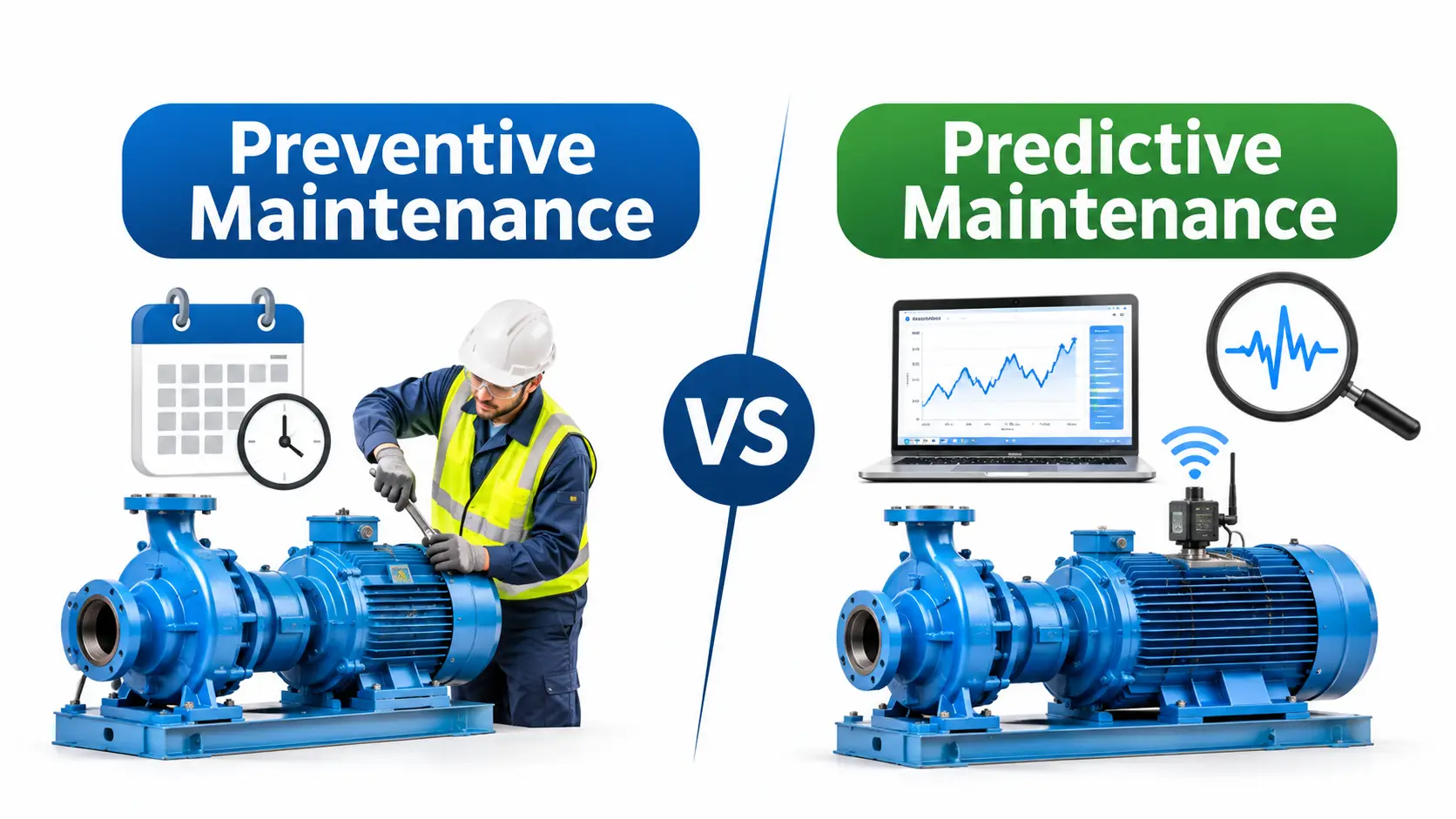
Preventive vs predictive maintenance is the central choice in any reliability program. One method is to be on the calendar for the services, and the other is to wait for data to indicate the need for services. This Guide will explain the difference between them in terms of the definitions, costs, technologies and a step-by-step process for selecting, using or moving to, or from, one or the other for your assets.
Need help sourcing maintenance spares or monitoring-ready components? Request a Quote and our team will review your requirements.
1. What Is Preventive Maintenance?
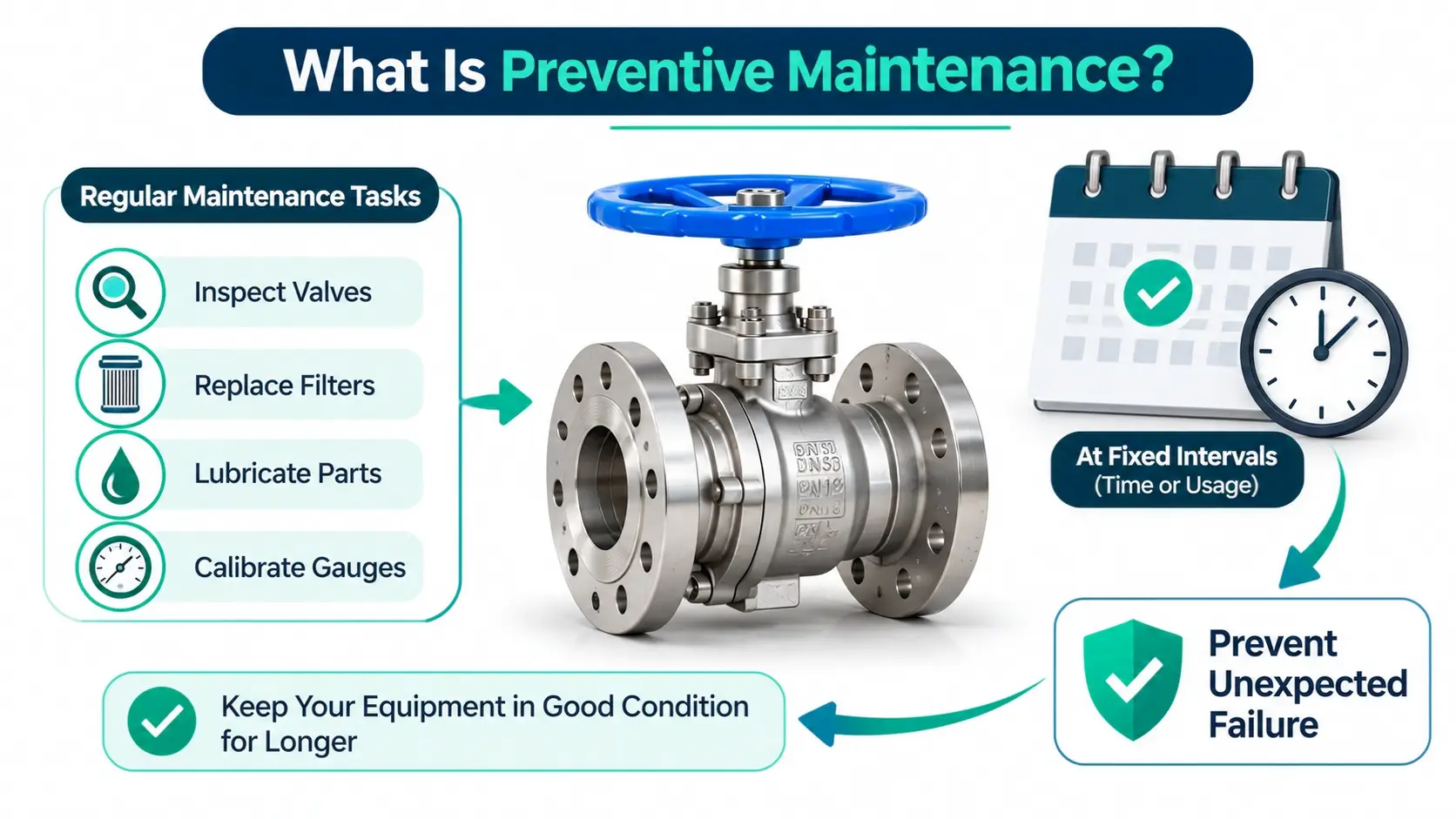
The definition of preventive maintenance is very simple: maintaining the equipment at specific time or usage intervals before it fails, whatever the condition is. Common services include belt checks, filter replacements, lubrication and gauge calibration. This is where preventive vs predictive maintenance examples begin, as simple tasks as valves inspections are done regularly. Fixed PM schedule is simple to schedule but may be costly if used to maintain healthy equipment.
2. What Is Predictive Maintenance?
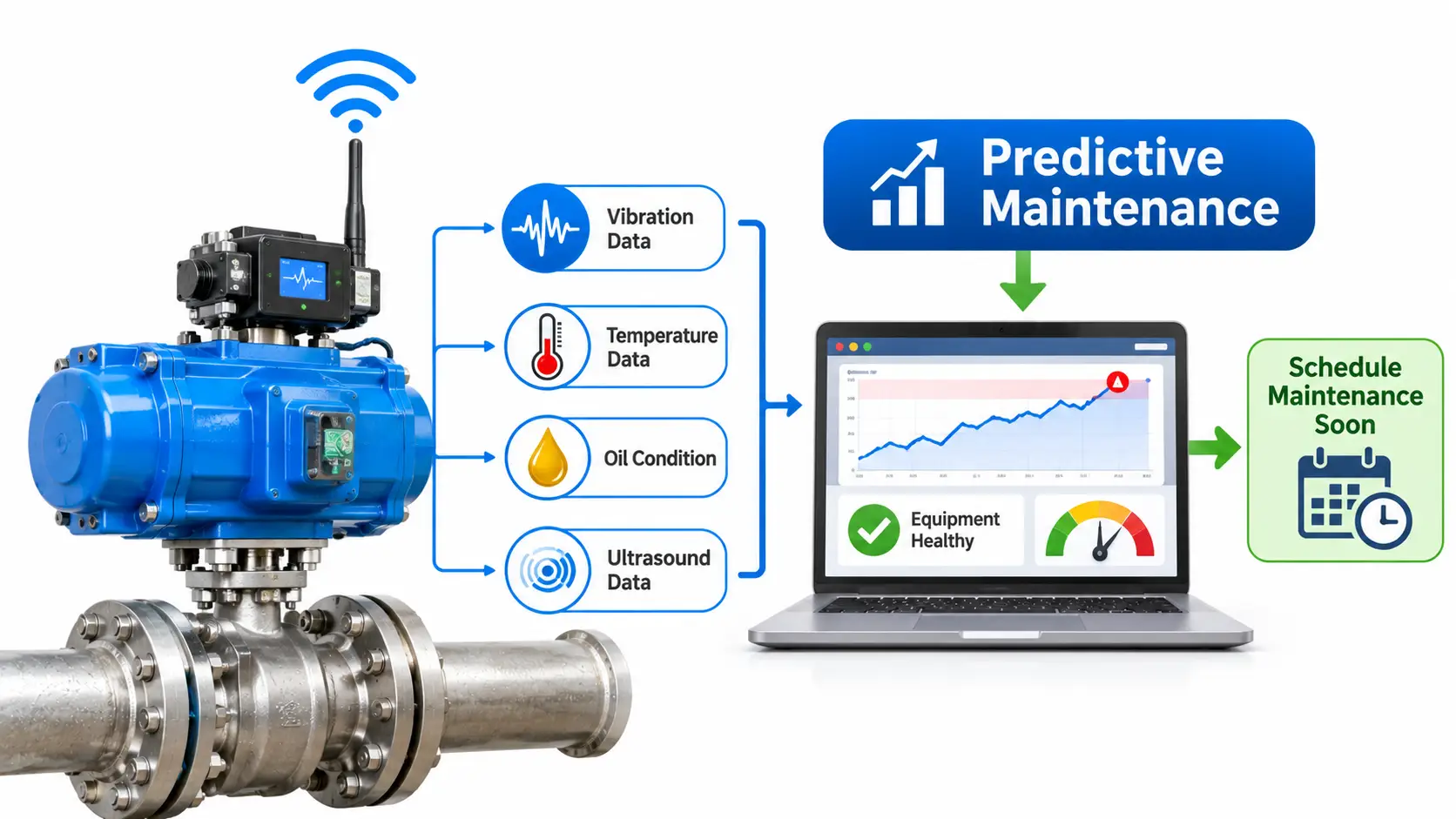
Condition data is the focus of the predictive maintenance definition. Sensors and inspections involve vibration measurement, temperature measurement, oil condition/ultrasound measurement and analytics to predict when a fault will hit the limit. Work occurs when there is evidence of the need. This ties in with condition-based maintenance (CBM), which initiates maintenance when a specified condition is reached, and predictive maintenance (PdM), which incorporates trend forecasting. Show actuators are not the only ones reporting diagnostics, even smart actuators are reporting diagnostics.
3. Key Differences Between Preventive and Predictive Maintenance
This maintenance strategy comparison shows the difference between preventive and predictive maintenance, starting with the trigger.
Factor | Preventive | Predictive |
|---|---|---|
Trigger | Time or usage | Condition data |
Upfront cost | Low | Higher |
Labor | Routine, scheduled | Analysis skills needed |
Downtime | Planned, sometimes excessive | Fewer surprises |
Best for | Simple, low-risk assets | Critical, costly assets |
Preventive work is calendar oriented and predictive work is evidence oriented in PdM vs PM maintenance terms. The baseline of both is reactive maintenance, repairing after failure. Digital valve controllers like Fisher report valve health on a continuous basis, rather than waiting for a service date.
4. Preventive Maintenance: Schedule, Tasks, and Limitations
A preventive maintenance program for industrial equipment is based on manufacturer's recommendations, criticality of assets and failure experience.
Tasks that have to be completed over a period of time: lubrication, filter changes, inspections.
Tasks based on usage: replacement after a certain period of use.
Limits: excess maintenance, random failures and errors detected during intrusive activities.
Plan spares before each interval. Our bearing procurement guide covers stocking bearings.
5. Predictive Maintenance: Technologies and Condition Monitoring
Each predictive maintenance technology can identify particular failures.
Technique | Detects | Typical Assets |
|---|---|---|
Vibration analysis | Imbalance, misalignment, bearing wear | Pumps, motors, fans |
Infrared thermography | Hot spots, loose connections | Switchgear, motors |
Oil analysis | Wear particles, contamination | Gearboxes, hydraulics |
Ultrasonic testing | Leaks, lubrication state | Bearings, valves |
Methods are best used in combination; using vibration in combination with oil analysis gives a complete picture of rotating equipment. Vibration condition monitoring is covered by ISO 13373, while bearings are typical for the use of condition monitoring sensors made by companies like SKF
6. Preventive vs Predictive: Cost, ROI, and Resource Requirements
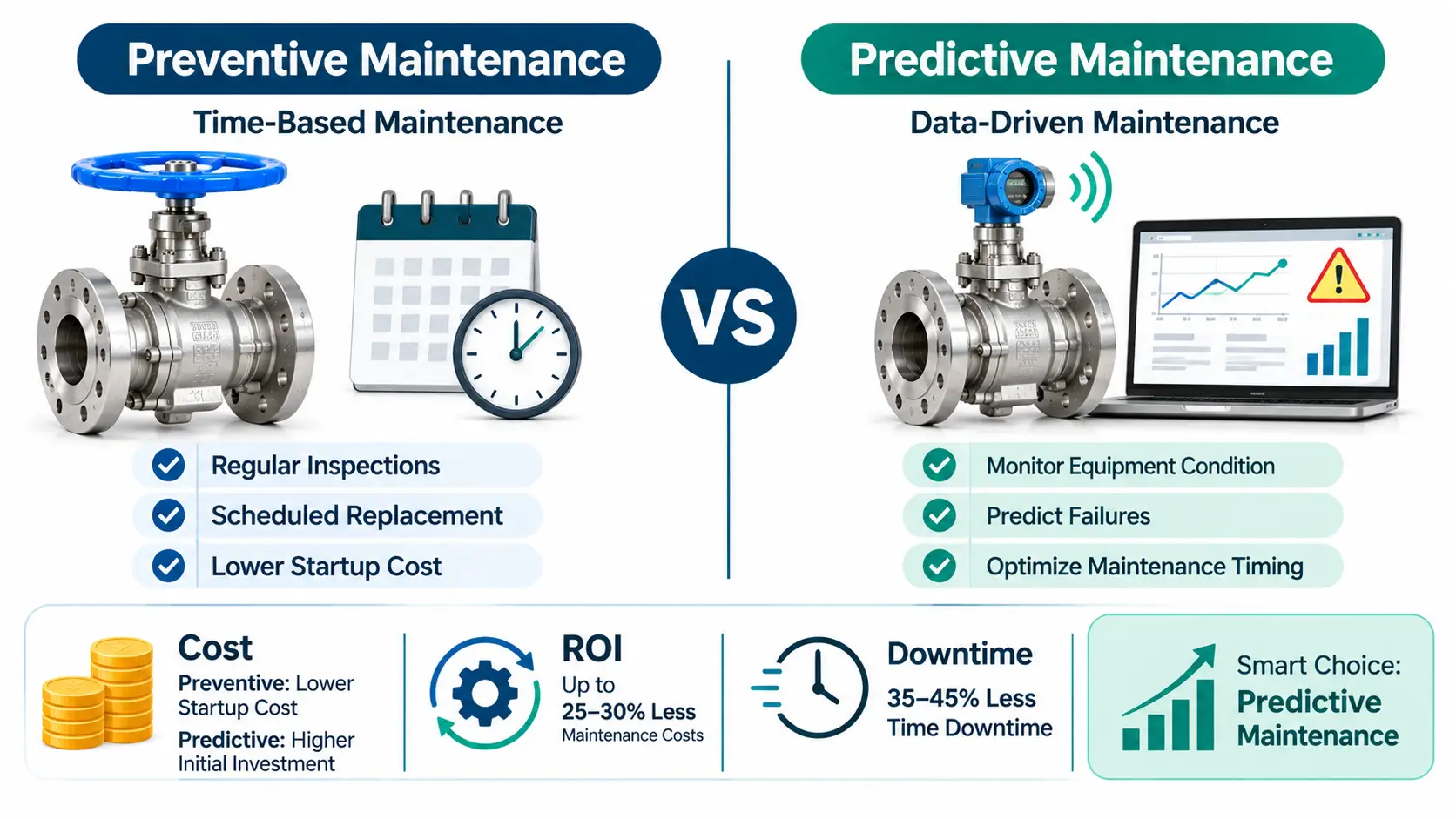
The primary difference between preventive vs predictive maintenance is timing. Preventive programs have low startup costs, but invest labor and parts in unnecessary work. Sensors, software and training are needed first, before a predictive program can be implemented.
The O&M guide from the United States Department of Energy states that up to 25–30% less maintenance costs and 35–45% less time downtime than reactive maintenance. These are context- and age specific numbers and should not be interpreted as minimums or certainties, but rather an indication of ROI for predictive maintenance cost benefits. Reduce maintenance costs by adding spares: OEM vs aftermarket parts choices have impact on cost and lead time.
7. How to Choose the Right Maintenance Strategy for Your Assets
Use FMEA to rank assets by criticality and consequence of failure; match strategy. A good test case is valve criticality – where service conditions dictate risk is seen in our valve selection guide.
Asset | Strategy | Reason |
|---|---|---|
Critical, high-cost rotating | Predictive | Early warning |
Moderate criticality | Preventive plus inspections | Balanced cost |
Low criticality, cheap | Run to failure | Cheaper than monitoring |
8. Implementing a Predictive Maintenance Program: Step-by-Step
Let's take a look at how to execute predictive maintenance in manufacturing:
Rank assets by criticality using FMEA.
Select techniques for each failure mode. Suppliers like Parker have fluid condition sensors for hydraulic systems.
Gather baseline data prior to alarming.
Set thresholds and validate alerts with manual inspections.
Integrate data with your CMMS.
Perform a pilot on a small number of key assets.
Train techs, not just engineers.
Discuss MTBF, MTTR and unplanned downtime.
9. Combining Preventive and Predictive Maintenance: Hybrid Approaches
Most plants have "layers": preventative maintenance for simple assets and predictive monitoring for critical assets. Diagnostics may be required for safety-critical actuators, while stroke tests are sufficient for simple actuators. Condition based maintenance is a continuum of preventive maintenance, and preventive vs predictive maintenance is more of an either-or issue.
10. Common Maintenance Strategy Mistakes to Avoid
Use of predictive monitoring to measure ROI of negative value for low criticality assets.
Estimating alarm thresholds in the absence of baseline data.
Purchasing sensors that do not fit into the CMMS.
Training exclusively reliability engineers.
Failure to follow the lubrication basics; manufacturers like FAG will generally provide lubrication information.
11. Frequently Asked Questions
What is the difference between preventive and predictive maintenance?
Frequent maintenance is scheduled – preventive maintenance. Predictive maintenance is the use of condition data to take action when there is proof that it is necessary.
Is predictive maintenance more expensive than preventive maintenance?
It is more expensive initially for sensors and training but can help to reduce unnecessary tasks and unplanned downtime in the long run, thus reducing overall costs.
Can preventive and predictive maintenance be used together?
Yes. At many sites, simple assets are dealt with by preventive tasks and critical, high value assets are handled using predictive monitoring.
How does predictive maintenance affect spare parts inventory?
It enables planned buying based on forecasts of failures, which helps to minimize emergency orders. However, there is still a need to plan stock for critical items like bearings.
What KPIs measure predictive maintenance success?
MTBF, MTTR, overall equipment effectiveness, maintenance cost per unit, and the percentage of planned work versus unplanned work.
12. Conclusion
The decision between preventive and predictive maintenance involves prioritizing asset criticality, balancing costs and basing decisions on solid data. Most sites have both, and include monitoring where failure is most debilitating. Technical information from bearing and condition monitoring organizations like Schaeffler is worthwhile reading.
Brand names are used for identification only and imply no partnership or endorsement by Z&F Corporation.
Need help with maintenance spares or monitoring-ready components? Talk to Our Specialist and we will help identify suitable products.